
Mapa mental
Skin
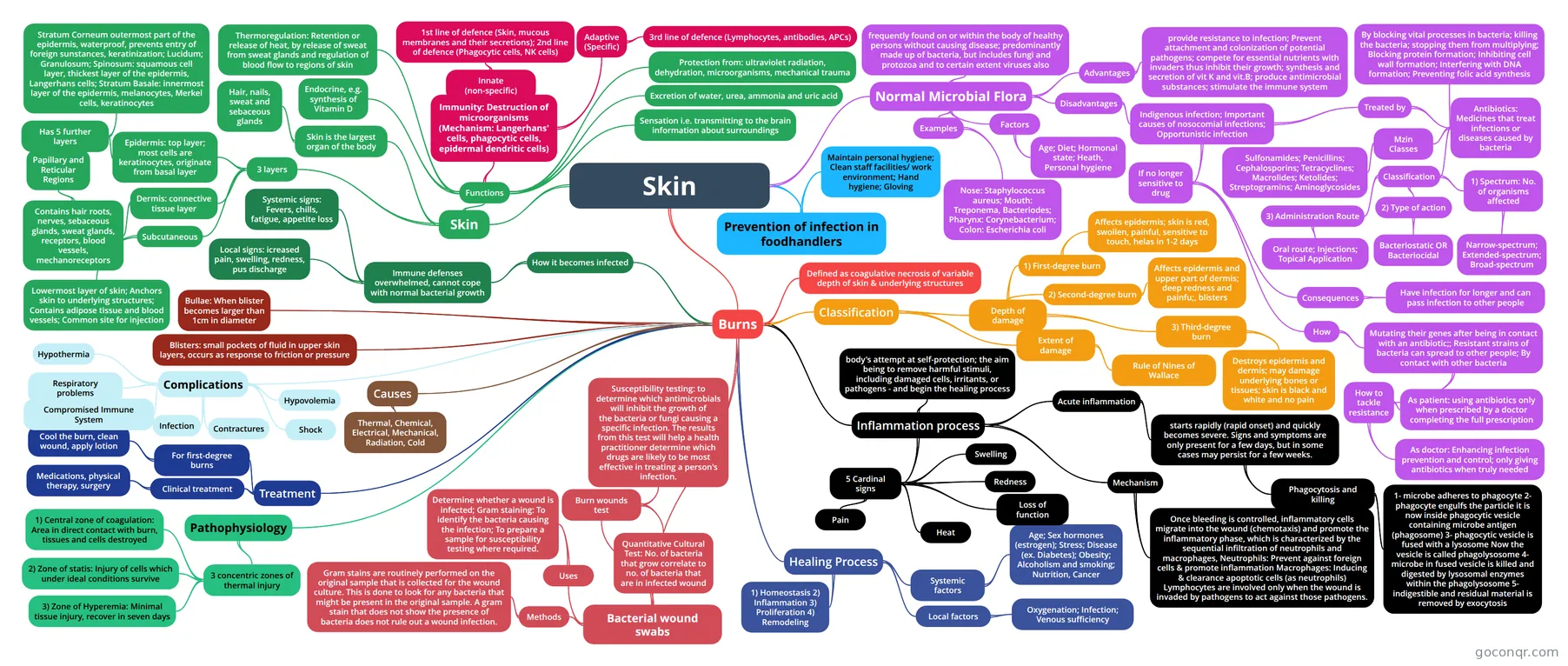
Mind map: Skin microbiology
Contenido del mapa
Skin
Skin
- Skin is the largest organ of the body
- Hair, nails, sweat and sebaceous glands
- 3 layers
- Epidermis: top layer; most cells are keratinocytes, originate from basal layer
- Has 5 further layers
- Stratum Corneum outermost part of the epidermis, waterproof, prevents entry of foreign sunstances, keratinization; Lucidum; Granulosum; Spinosum: squamous cell layer, thickest layer of the epidermis, Langerhans cells; Stratum Basale: innermost layer of the epidermis, melanocytes, Merkel cells, keratinocytes
- Has 5 further layers
- Dermis: connective tissue layer
- Contains hair roots, nerves, sebaceous glands, sweat glands, receptors, blood vessels, mechanoreceptors
- Papillary and Reticular Regions
- Contains hair roots, nerves, sebaceous glands, sweat glands, receptors, blood vessels, mechanoreceptors
- Subcutaneous
- Lowermost layer of skin; Anchors skin to underlying structures; Contains adipose tissue and blood vessels; Common site for injection
- Epidermis: top layer; most cells are keratinocytes, originate from basal layer
- Functions
- Protection from: ultraviolet radiation, dehydration, microorganisms, mechanical trauma
- Sensation i.e. transmitting to the brain information about surroundings
- Endocrine, e.g. synthesis of Vitamin D
- Thermoregulation: Retention or release of heat, by release of sweat from sweat glands and regulation of blood flow to regions of skin
- Immunity: Destruction of microorganisms (Mechanism: Langerhans' cells, phagocytic cells, epidermal dendritic cells)
- Innate (non-specific)
- 1st line of defence (Skin, mucous membranes and their secretions); 2nd line of defence (Phagocytic cells, NK cells)
- Adaptive (Specific)
- 3rd line of defence (Lymphocytes, antibodies, APCs)
- Innate (non-specific)
- Excretion of water, urea, ammonia and uric acid
- Skin is the largest organ of the body
Normal Microbial Flora
- frequently found on or within the body of healthy persons without causing disease; predominantly made up of bacteria, but includes fungi and protozoa and to certain extent viruses also
- Advantages
- provide resistance to infection; Prevent attachment and colonization of potential pathogens; compete for essential nutrients with invaders thus inhibit their growth; synthesis and secretion of vit K and vit.B; produce antimicrobial substances; stimulate the immune system
- Disadvantages
- Indigenous infection; Important causes of nosocomial infections; Opportunistic infection
- Treated by
- Antibiotics: Medicines that treat infections or diseases caused by bacteria
- By blocking vital processes in bacteria; killing the bacteria; stopping them from multiplying; Blocking protein formation; Inhibiting cell wall formation; Interfering with DNA formation; Preventing folic acid synthesis
- Classification
- 1) Spectrum: No. of organisms affected
- Narrow-spectrum; Extended-spectrum; Broad-spectrum
- 2) Type of action
- Bacteriostatic OR Bacteriocidal
- 3) Administration Route
- Oral route; Injections; Topical Application
- 1) Spectrum: No. of organisms affected
- Mzin Classes
- Sulfonamides; Penicillins; Cephalosporins; Tetracyclines; Macrolides; Ketolides; Streptogramins; Aminoglycosides
- Antibiotics: Medicines that treat infections or diseases caused by bacteria
- If no longer sensitive to drug
- Consequences
- Have infection for longer and can pass infection to other people
- How
- Mutating their genes after being in contact with an antibiotic;; Resistant strains of bacteria can spread to other people; By contact with other bacteria
- How to tackle resistance
- As patient: using antibiotics only when prescribed by a doctor completing the full prescription
- As doctor: Enhancing infection prevention and control; only giving antibiotics when truly needed
- How to tackle resistance
- Mutating their genes after being in contact with an antibiotic;; Resistant strains of bacteria can spread to other people; By contact with other bacteria
- Consequences
- Treated by
- Indigenous infection; Important causes of nosocomial infections; Opportunistic infection
- Factors
- Age; Diet; Hormonal state; Heath, Personal hygiene
- Examples
- Nose: Staphylococcus aureus; Mouth: Treponema, Bacteriodes; Pharynx: Corynebacterium; Colon: Escherichia coli
Prevention of infection in foodhandlers
- Maintain personal hygiene; Clean staff facilities/ work environment; Hand hygiene; Gloving
Burns
- Defined as coagulative necrosis of variable depth of skin & underlying structures
- Classification
- Extent of damage
- Rule of Nines of Wallace
- Depth of damage
- 1) First-degree burn
- Affects epidermis; skin is red, swollen, painful, sensitive to touch, helas in 1-2 days
- 2) Second-degree burn
- Affects epidermis and upper part of dermis; deep redness and painfu;, blisters
- 3) Third-degree burn
- Destroys epidermis and dermis; may damage underlying bones or tissues; skin is black and white and no pain
- 1) First-degree burn
- Extent of damage
- Causes
- Thermal, Chemical, Electrical, Mechanical, Radiation, Cold
- Treatment
- For first-degree burns
- Cool the burn, clean wound, apply lotion
- Clinical treatment
- Medications, physical therapy, surgery
- For first-degree burns
- Complications
- Infection
- Hypovolemia
- Hypothermia
- Respiratory problems
- Shock
- Contractures
- Compromised Immune System
- Pathophysiology
- 3 concentric zones of thermal injury
- 1) Central zone of coagulation: Area in direct contact with burn, tissues and cells destroyed
- 2) Zone of statis: Injury of cells which under ideal conditions survive
- 3) Zone of Hyperemia: Minimal tissue injury, recover in seven days
- 3 concentric zones of thermal injury
- Blisters: small pockets of fluid in upper skin layers, occurs as response to friction or pressure
- Bullae: When blister becomes larger than 1cm in diameter
- How it becomes infected
- Immune defenses overwhelmed, cannot cope with normal bacterial growth
- Local signs: icreased pain, swelling, redness, pus discharge
- Systemic signs: Fevers, chills, fatigue, appetite loss
- Immune defenses overwhelmed, cannot cope with normal bacterial growth
- Inflammation process
- body's attempt at self-protection; the aim being to remove harmful stimuli, including damaged cells, irritants, or pathogens - and begin the healing process
- Acute inflammation
- starts rapidly (rapid onset) and quickly becomes severe. Signs and symptoms are only present for a few days, but in some cases may persist for a few weeks.
- Phagocytosis and killing
- 1- microbe adheres to phagocyte 2- phagocyte engulfs the particle it is now inside phagocytic vesicle containing microbe antigen (phagosome) 3- phagocytic vesicle is fused with a lysosome Now the vesicle is called phagolysosome 4- microbe in fused vesicle is killed and digested by lysosomal enzymes within the phagolysosome 5- indigestible and residual material is removed by exocytosis
- Phagocytosis and killing
- starts rapidly (rapid onset) and quickly becomes severe. Signs and symptoms are only present for a few days, but in some cases may persist for a few weeks.
- Mechanism
- Once bleeding is controlled, inflammatory cells migrate into the wound (chemotaxis) and promote the inflammatory phase, which is characterized by the sequential infiltration of neutrophils and macrophages, Neutrophils: Prevent against foreign cells & promote inflammation Macrophages: Inducing & clearance apoptotic cells (as neutrophils) Lymphocytes are involved only when the wound is invaded by pathogens to act against those pathogens.
- 5 Cardinal signs
- Redness
- Swelling
- Heat
- Loss of function
- Pain
- Bacterial wound swabs
- Burn wounds test
- Quantitative Cultural Test: No. of bacteria that grow correlate to no. of bacteria that are in infected wound
- Susceptibility testing: to determine which antimicrobials will inhibit the growth of the bacteria or fungi causing a specific infection. The results from this test will help a health practitioner determine which drugs are likely to be most effective in treating a person's infection.
- Uses
- Determine whether a wound is infected; Gram staining: To identify the bacteria causing the infection; To prepare a sample for susceptibility testing where required.
- Methods
- Gram stains are routinely performed on the original sample that is collected for the wound culture. This is done to look for any bacteria that might be present in the original sample. A gram stain that does not show the presence of bacteria does not rule out a wound infection.
- Burn wounds test
- Healing Process
- 1) Homeostasis 2) Inflammation 3) Proliferation 4) Remodeling
- Local factors
- Oxygenation; Infection; Venous sufficiency
- Systemic factors
- Age; Sex hormones (estrogen); Stress; Disease (ex. Diabetes); Obesity; Alcoholism and smoking; Nutrition, Cancer
Información
- Descripción
- Mapa Mental sobre Skin, creado por sab_191 el 31/10/2014.
- Creado por
- sab_191
- Visitas
- 5
- Valoración