
Mapa mental
STACKS

Contenido del mapa
STACKS
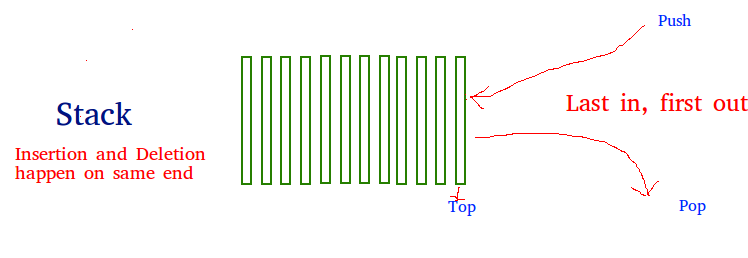
Last in, first out
stack of books as an example
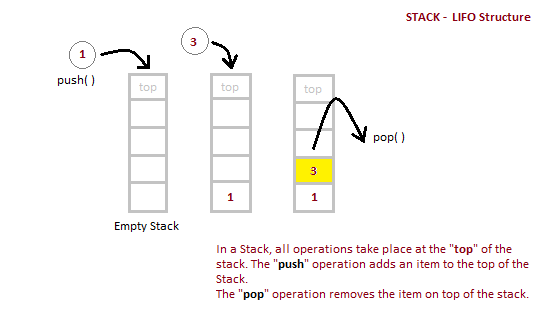
Push and Pop
- In a pure stack abstraction the only access is to the topmost element. An item stored deeper in the stack can only be obtained by repeatedly removing the topmost element until the value in question rises to the top. But as we will see in the discussion of implementation alternatives, often a stack is combined with other abstractions, such as a dynamic array. In this situation the data structure allows other operations, such as a search or direct access to elements. Whether or not this is a good design decision is a topic explored in one of the lessons described later in this chapter. To illustrate the workings of a stack, consider the following sequence of operations: push(“abe”) push(“amy”) push(“andy”) pop() push(“anne”) push(“alfred”) pop() pop()
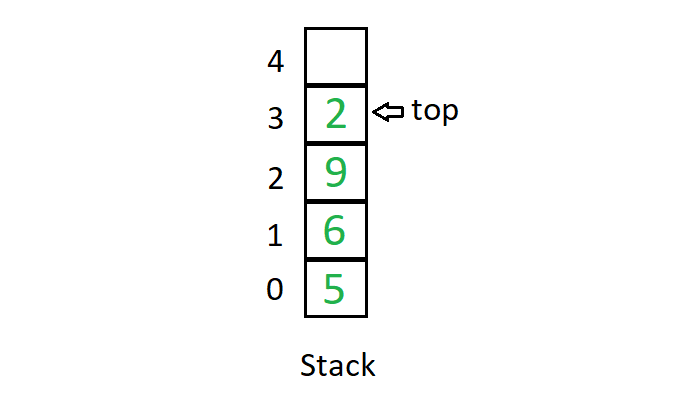
TOP
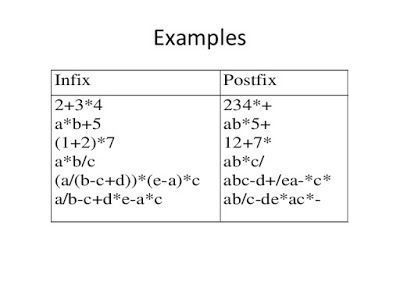
Evaluating Expressions
- Two standard examples that illustrate the utility of the stack expression involve the evaluation of an arithmetic expression. Normally we are used to writing arithmetic expressions in what is termed infix form. Here a binary operator is written between two arguments, as in 2 + 3 * 7. Precedence rules are used to determine which operations should be performed first, for example multiplication typically takes precedence over addition. Associativity rules apply when two operations of the same precedence occur one right after the other, as in 6 – 3 – 2. For addition, we normally perform the left most operation first, yielding in this case 3, and then the second operation, which yields the final result 1. If instead the associativity rule specified right to left evaluation we would have first performed the calculation 3 – 2, yielding 1, and then subtracted this from 6, yielding the final value 5. Parenthesis can be used to override either precedence or Chapter 6: Stacks 7 associativity rul
Programs of syacks
You are familiar with the concept of a stack from many everyday examples. For example, you have seen a stack of books on a desk, or a stack of plates in a cafeteria. The common characteristic of these examples is that among the items in the collection, the easiest element to access is the topmost value. In the stack of plates, for instance, the first available plate is the topmost one. In a true stack abstraction that is the only item you are allowed to access. Furthermore, stack operations obey the last-in, first-out principle, or LIFO. If you add a new plate to the stack, the previous topmost plate is now inaccessible. It is only after the newly added plate is removed that the previous top of the stack once more becomes available. If you remove all the items from a stack you will access them in reverse chronological order – the first item you remove will be the item placed on the stack most recently, and the last item will be the value that has been held in the stack for the longest
Memory management
- The linked list and the Dynamic Array data structures take different approaches to the problem of memory management. The Dynamic Array uses a large block of memory. This means that memory allocation is much less common, but when it occurs much more work must be performed. The linked list allocates a new link every time a new element is added. This makes memory allocation more frequent, but as the memory blocks are small less work is performed on each allocation. If, as is often the case, a linked list is used to store pointers to a dynamically allocated value, then there are two dynamically allocated spaces to manage, the link and the data field itself: An important principle of good memory management is “everybody must clean up their own mess”. (This is sometimes termed the kindergarten principle). The linked list allocates space for the link, and so must ensure that the space is freed by calling the associated pop routine. The user of the list allocates space for the data value, and
Imágenes y archivos del mapa
Información
- Descripción
- Mapa Mental sobre STACKS, creado por Enrique Ramos el 22/02/2019.
- Creado por
- Enrique Ramos
- Visitas
- 0
- Valoración