
Mapa mental
Nazi Propaganda
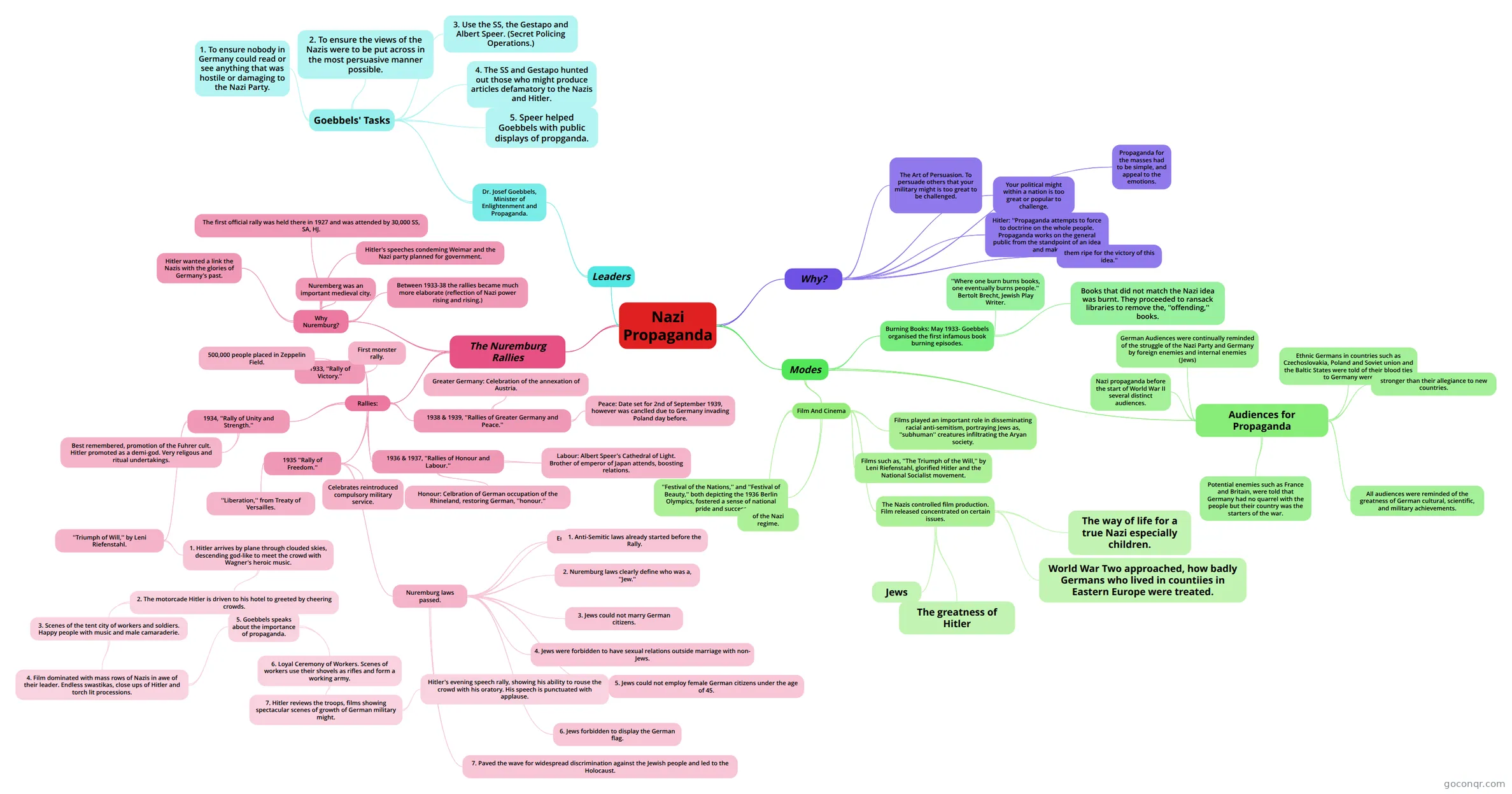
Mind map: Nazi propaganda
Contenido del mapa
Nazi Propaganda
Modes
- Burning Books: May 1933- Goebbels organised the first infamous book burning episodes.
- Books that did not match the Nazi idea was burnt. They proceeded to ransack libraries to remove the, ''offending,'' books.
- ''Where one burn burns books, one eventually burns people.'' Bertolt Brecht, Jewish Play Writer.
- Film And Cinema
- Films played an important role in disseminating racial anti-semitism, portraying Jews as, ''subhuman'' creatures infiltrating the Aryan society.
- Films such as, ''The Triumph of the Will,'' by Leni Riefenstahl, glorified Hitler and the National Socialist movement.
- ''Festival of the Nations,'' and ''Festival of Beauty,'' both depicting the 1936 Berlin Olympics, fostered a sense of national pride and success
- of the Nazi regime.
- The Nazis controlled film production. Film released concentrated on certain issues.
- Jews
- The greatness of Hitler
- The way of life for a true Nazi especially children.
- World War Two approached, how badly Germans who lived in countiies in Eastern Europe were treated.
- Audiences for Propaganda
- Nazi propaganda before the start of World War II several distinct audiences.
- German Audiences were continually reminded of the struggle of the Nazi Party and Germany by foreign enemies and internal enemies (Jews)
- Ethnic Germans in countries such as Czechoslovakia, Poland and Soviet union and the Baltic States were told of their blood ties to Germany were
- stronger than their allegiance to new countries.
- Potential enemies such as France and Britain, were told that Germany had no quarrel with the people but their country was the starters of the war.
- All audiences were reminded of the greatness of German cultural, scientific, and military achievements.
- Burning Books: May 1933- Goebbels organised the first infamous book burning episodes.
Why?
- The Art of Persuasion. To persuade others that your military might is too great to be challenged.
- Your political might within a nation is too great or popular to challenge.
- Hitler: ''Propaganda attempts to force to doctrine on the whole people. Propaganda works on the general public from the standpoint of an idea and make
- them ripe for the victory of this idea.''
- Propaganda for the masses had to be simple, and appeal to the emotions.
Leaders
- Dr. Josef Goebbels, Minister of Enlightenment and Propaganda.
- Goebbels' Tasks
- 1. To ensure nobody in Germany could read or see anything that was hostile or damaging to the Nazi Party.
- 2. To ensure the views of the Nazis were to be put across in the most persuasive manner possible.
- 3. Use the SS, the Gestapo and Albert Speer. (Secret Policing Operations.)
- 4. The SS and Gestapo hunted out those who might produce articles defamatory to the Nazis and Hitler.
- 5. Speer helped Goebbels with public displays of propganda.
- Goebbels' Tasks
- Dr. Josef Goebbels, Minister of Enlightenment and Propaganda.
The Nuremburg Rallies
- Why Nuremburg?
- Hitler wanted a link the Nazis with the glories of Germany's past.
- Nuremberg was an important medieval city.
- The first official rally was held there in 1927 and was attended by 30,000 SS, SA, HJ.
- Hitler's speeches condeming Weimar and the Nazi party planned for government.
- Between 1933-38 the rallies became much more elaborate (reflection of Nazi power rising and rising.)
- Rallies:
- 1933, ''Rally of Victory.''
- First monster rally.
- 500,000 people placed in Zeppelin Field.
- 1934, ''Rally of Unity and Strength.''
- Best remembered, promotion of the Fuhrer cult. Hitler promoted as a demi-god. Very religous and ritual undertakings.
- ''Triumph of Will,'' by Leni Riefenstahl.
- 1. Hitler arrives by plane through clouded skies, descending god-like to meet the crowd with Wagner's heroic music.
- 2. The motorcade Hitler is driven to his hotel to greeted by cheering crowds.
- 3. Scenes of the tent city of workers and soldiers. Happy people with music and male camaraderie.
- 4. Film dominated with mass rows of Nazis in awe of their leader. Endless swastikas, close ups of Hitler and torch lit processions.
- 5. Goebbels speaks about the importance of propaganda.
- 6. Loyal Ceremony of Workers. Scenes of workers use their shovels as rifles and form a working army.
- 7. Hitler reviews the troops, films showing spectacular scenes of growth of German military might.
- Hitler's evening speech rally, showing his ability to rouse the crowd with his oratory. His speech is punctuated with applause.
- 7. Hitler reviews the troops, films showing spectacular scenes of growth of German military might.
- 6. Loyal Ceremony of Workers. Scenes of workers use their shovels as rifles and form a working army.
- 5. Goebbels speaks about the importance of propaganda.
- 4. Film dominated with mass rows of Nazis in awe of their leader. Endless swastikas, close ups of Hitler and torch lit processions.
- 3. Scenes of the tent city of workers and soldiers. Happy people with music and male camaraderie.
- 2. The motorcade Hitler is driven to his hotel to greeted by cheering crowds.
- 1. Hitler arrives by plane through clouded skies, descending god-like to meet the crowd with Wagner's heroic music.
- 1936 & 1937, ''Rallies of Honour and Labour.''
- Honour: Celbration of German occupation of the Rhineland, restoring German, ''honour.''
- Labour: Albert Speer's Cathedral of Light. Brother of emperor of Japan attends, boosting relations.
- 1935 ''Rally of Freedom.''
- Celebrates reintroduced compulsory military service.
- ''Liberation,'' from Treaty of Versailles.
- Nuremburg laws passed.
- Enter text here
- 1. Anti-Semitic laws already started before the Rally.
- 2. Nuremburg laws clearly define who was a, ''Jew.''
- 3. Jews could not marry German citizens.
- 4. Jews were forbidden to have sexual relations outside marriage with non- Jews.
- 5. Jews could not employ female German citizens under the age of 45.
- 6. Jews forbidden to display the German flag.
- 7. Paved the wave for widespread discrimination against the Jewish people and led to the Holocaust.
- 1938 & 1939, ''Rallies of Greater Germany and Peace.''
- Greater Germany: Celebration of the annexation of Austria.
- Peace: Date set for 2nd of September 1939, however was canclled due to Germany invading Poland day before.
- 1933, ''Rally of Victory.''
- Why Nuremburg?
Información
- Descripción
- Mapa Mental sobre Nazi Propaganda, creado por aly.farrell el 18/02/2013.
- Creado por
- aly.farrell
- Visitas
- 934
- Valoración
Más sobre Nazi Propaganda and Censorship