
Mapa mental
Geography: Tropical Storms
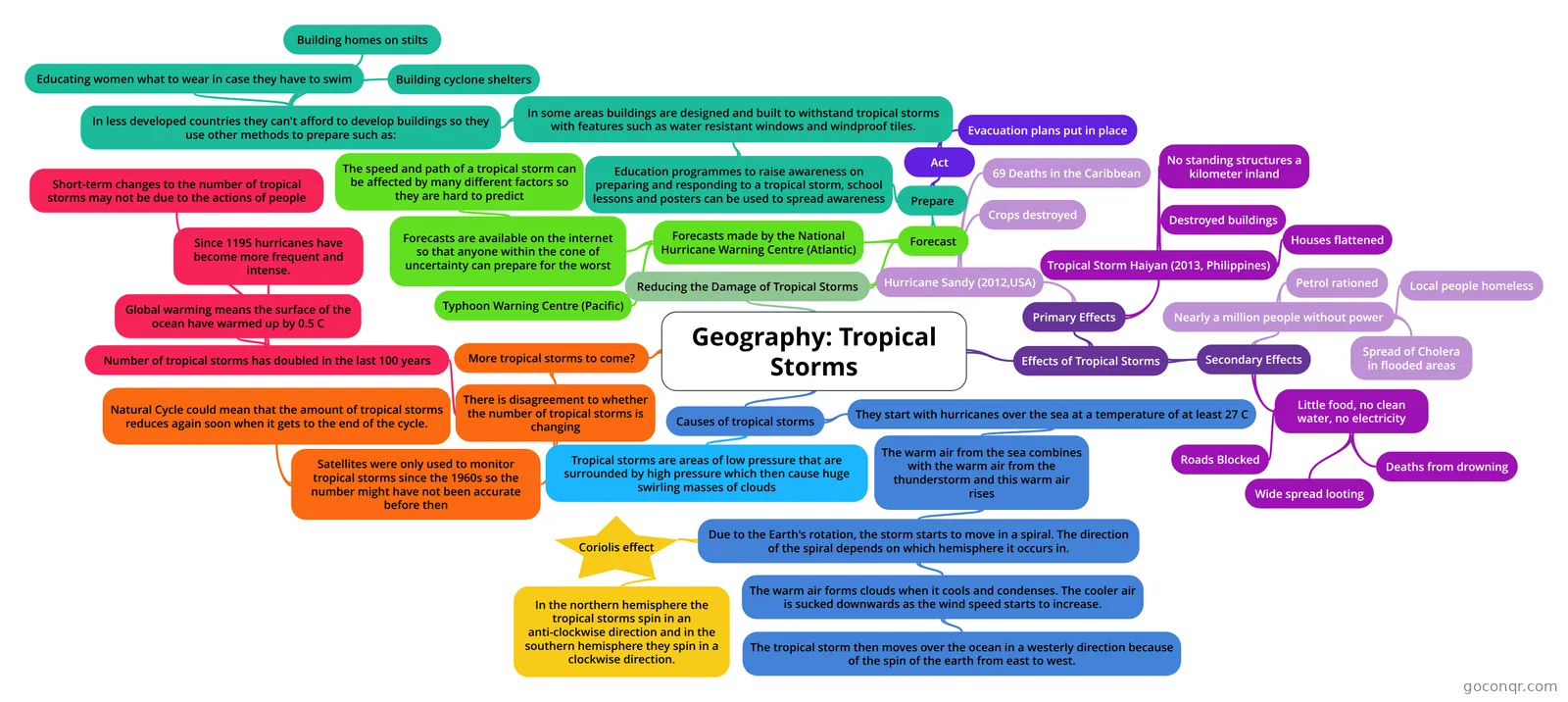
Mind map: Tropical storms geography
Contenido del mapa
Geography: Tropical Storms
Causes of tropical storms
- They start with hurricanes over the sea at a temperature of at least 27 C
- The warm air from the sea combines with the warm air from the thunderstorm and this warm air rises
- Due to the Earth's rotation, the storm starts to move in a spiral. The direction of the spiral depends on which hemisphere it occurs in.
- The warm air forms clouds when it cools and condenses. The cooler air is sucked downwards as the wind speed starts to increase.
- The tropical storm then moves over the ocean in a westerly direction because of the spin of the earth from east to west.
- Coriolis effect
- In the northern hemisphere the tropical storms spin in an anti-clockwise direction and in the southern hemisphere they spin in a clockwise direction.
- The warm air forms clouds when it cools and condenses. The cooler air is sucked downwards as the wind speed starts to increase.
- Due to the Earth's rotation, the storm starts to move in a spiral. The direction of the spiral depends on which hemisphere it occurs in.
- The warm air from the sea combines with the warm air from the thunderstorm and this warm air rises
- Tropical storms are areas of low pressure that are surrounded by high pressure which then cause huge swirling masses of clouds
- They start with hurricanes over the sea at a temperature of at least 27 C
Effects of Tropical Storms
- Primary Effects
- Tropical Storm Haiyan (2013, Philippines)
- Destroyed buildings
- No standing structures a kilometer inland
- Houses flattened
- Hurricane Sandy (2012,USA)
- Crops destroyed
- 69 Deaths in the Caribbean
- Tropical Storm Haiyan (2013, Philippines)
- Secondary Effects
- Nearly a million people without power
- Petrol rationed
- Spread of Cholera in flooded areas
- Local people homeless
- Little food, no clean water, no electricity
- Roads Blocked
- Deaths from drowning
- Wide spread looting
- Nearly a million people without power
- Primary Effects
Reducing the Damage of Tropical Storms
- Forecast
- Prepare
- Act
- Evacuation plans put in place
- Education programmes to raise awareness on preparing and responding to a tropical storm, school lessons and posters can be used to spread awareness
- In some areas buildings are designed and built to withstand tropical storms with features such as water resistant windows and windproof tiles.
- In less developed countries they can't afford to develop buildings so they use other methods to prepare such as:
- Educating women what to wear in case they have to swim
- Building homes on stilts
- Building cyclone shelters
- In less developed countries they can't afford to develop buildings so they use other methods to prepare such as:
- In some areas buildings are designed and built to withstand tropical storms with features such as water resistant windows and windproof tiles.
- Act
- Forecasts made by the National Hurricane Warning Centre (Atlantic)
- Typhoon Warning Centre (Pacific)
- Forecasts are available on the internet so that anyone within the cone of uncertainty can prepare for the worst
- The speed and path of a tropical storm can be affected by many different factors so they are hard to predict
- Prepare
- Forecast
More tropical storms to come?
- There is disagreement to whether the number of tropical storms is changing
- Satellites were only used to monitor tropical storms since the 1960s so the number might have not been accurate before then
- Natural Cycle could mean that the amount of tropical storms reduces again soon when it gets to the end of the cycle.
- Number of tropical storms has doubled in the last 100 years
- Global warming means the surface of the ocean have warmed up by 0.5 C
- Since 1195 hurricanes have become more frequent and intense.
- Short-term changes to the number of tropical storms may not be due to the actions of people
- Satellites were only used to monitor tropical storms since the 1960s so the number might have not been accurate before then
- There is disagreement to whether the number of tropical storms is changing
Información
- Descripción
- Mapa Mental sobre Geography: Tropical Storms, creado por Naomi CALVERT el 27/11/2014.
- Creado por
- Naomi CALVERT
- Visitas
- 306
- Etiquetas
- Valoración