
Mapa mental
LEARNING AND MEMORY: FUNCTIONAL PERSPECTIVES, L5-P1
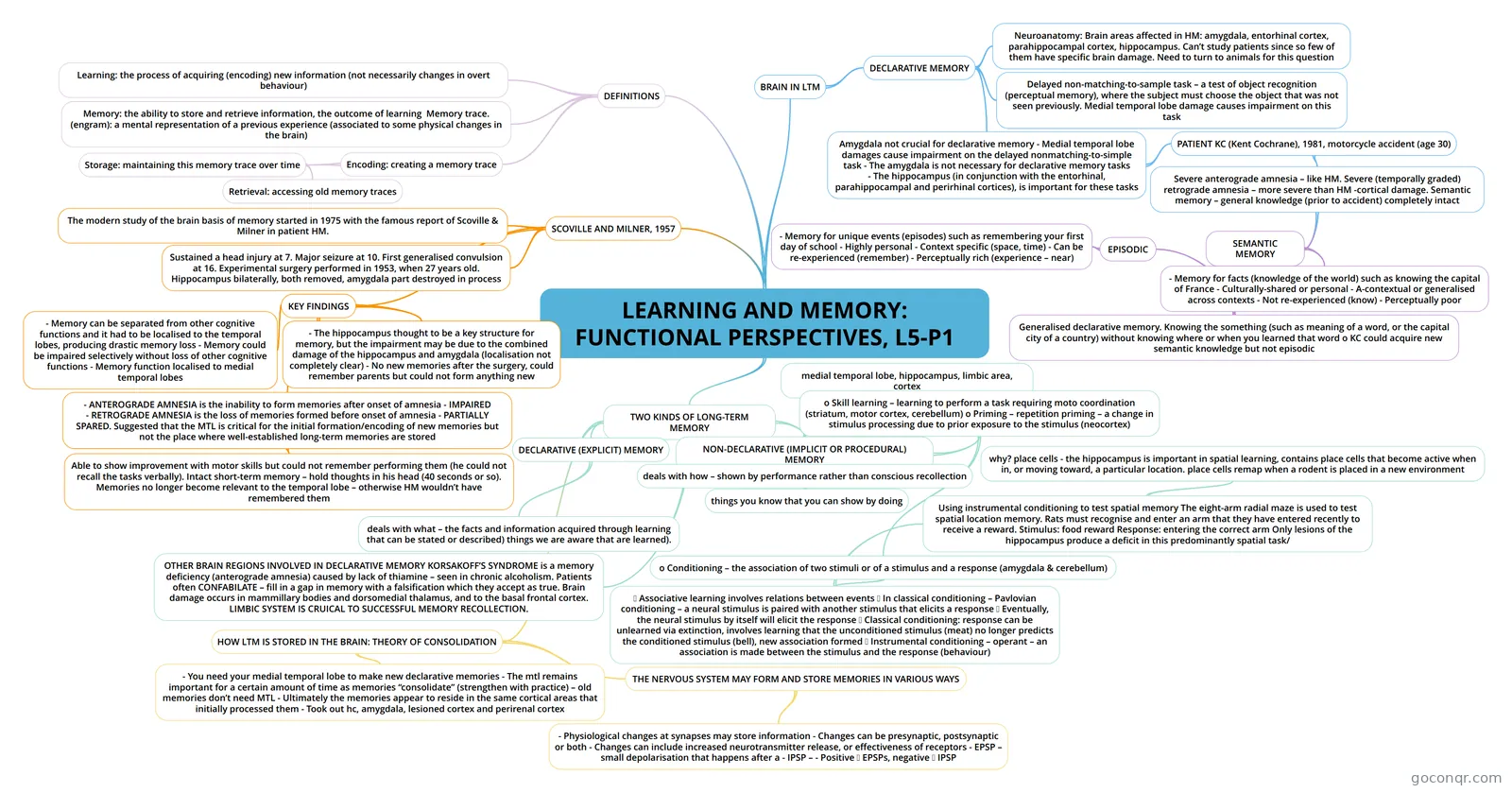
Mind map: Learning and memory: functional perspectives
Contenido del mapa
LEARNING AND MEMORY: FUNCTIONAL PERSPECTIVES, L5-P1
DEFINITIONS
- Learning: the process of acquiring (encoding) new information (not necessarily changes in overt behaviour)
- Memory: the ability to store and retrieve information, the outcome of learning Memory trace. (engram): a mental representation of a previous experience (associated to some physical changes in the brain)
- Encoding: creating a memory trace
- Storage: maintaining this memory trace over time
- Retrieval: accessing old memory traces
- Storage: maintaining this memory trace over time
SCOVILLE AND MILNER, 1957
- The modern study of the brain basis of memory started in 1975 with the famous report of Scoville & Milner in patient HM.
- Sustained a head injury at 7. Major seizure at 10. First generalised convulsion at 16. Experimental surgery performed in 1953, when 27 years old. Hippocampus bilaterally, both removed, amygdala part destroyed in process
- KEY FINDINGS
- - Memory can be separated from other cognitive functions and it had to be localised to the temporal lobes, producing drastic memory loss - Memory could be impaired selectively without loss of other cognitive functions - Memory function localised to medial temporal lobes
- - The hippocampus thought to be a key structure for memory, but the impairment may be due to the combined damage of the hippocampus and amygdala (localisation not completely clear) - No new memories after the surgery, could remember parents but could not form anything new
- - ANTEROGRADE AMNESIA is the inability to form memories after onset of amnesia - IMPAIRED - RETROGRADE AMNESIA is the loss of memories formed before onset of amnesia - PARTIALLY SPARED. Suggested that the MTL is critical for the initial formation/encoding of new memories but not the place where well-established long-term memories are stored
- Able to show improvement with motor skills but could not remember performing them (he could not recall the tasks verbally). Intact short-term memory – hold thoughts in his head (40 seconds or so). Memories no longer become relevant to the temporal lobe – otherwise HM wouldn’t have remembered them
TWO KINDS OF LONG-TERM MEMORY
- DECLARATIVE (EXPLICIT) MEMORY
- deals with what – the facts and information acquired through learning that can be stated or described) things we are aware that are learned).
- NON-DECLARATIVE (IMPLICIT OR PROCEDURAL) MEMORY
- deals with how – shown by performance rather than conscious recollection
- things you know that you can show by doing
- medial temporal lobe, hippocampus, limbic area, cortex
- o Skill learning – learning to perform a task requiring moto coordination (striatum, motor cortex, cerebellum) o Priming – repetition priming – a change in stimulus processing due to prior exposure to the stimulus (neocortex)
- o Conditioning – the association of two stimuli or of a stimulus and a response (amygdala & cerebellum)
- Associative learning involves relations between events In classical conditioning – Pavlovian conditioning – a neural stimulus is paired with another stimulus that elicits a response Eventually, the neural stimulus by itself will elicit the response Classical conditioning: response can be unlearned via extinction, involves learning that the unconditioned stimulus (meat) no longer predicts the conditioned stimulus (bell), new association formed Instrumental conditioning – operant – an association is made between the stimulus and the response (behaviour)
- Using instrumental conditioning to test spatial memory The eight-arm radial maze is used to test spatial location memory. Rats must recognise and enter an arm that they have entered recently to receive a reward. Stimulus: food reward Response: entering the correct arm Only lesions of the hippocampus produce a deficit in this predominantly spatial task/
- why? place cells - the hippocampus is important in spatial learning, contains place cells that become active when in, or moving toward, a particular location. place cells remap when a rodent is placed in a new environment
- Using instrumental conditioning to test spatial memory The eight-arm radial maze is used to test spatial location memory. Rats must recognise and enter an arm that they have entered recently to receive a reward. Stimulus: food reward Response: entering the correct arm Only lesions of the hippocampus produce a deficit in this predominantly spatial task/
- Associative learning involves relations between events In classical conditioning – Pavlovian conditioning – a neural stimulus is paired with another stimulus that elicits a response Eventually, the neural stimulus by itself will elicit the response Classical conditioning: response can be unlearned via extinction, involves learning that the unconditioned stimulus (meat) no longer predicts the conditioned stimulus (bell), new association formed Instrumental conditioning – operant – an association is made between the stimulus and the response (behaviour)
- o Conditioning – the association of two stimuli or of a stimulus and a response (amygdala & cerebellum)
- deals with how – shown by performance rather than conscious recollection
- OTHER BRAIN REGIONS INVOLVED IN DECLARATIVE MEMORY KORSAKOFF’S SYNDROME is a memory deficiency (anterograde amnesia) caused by lack of thiamine – seen in chronic alcoholism. Patients often CONFABILATE – fill in a gap in memory with a falsification which they accept as true. Brain damage occurs in mammillary bodies and dorsomedial thalamus, and to the basal frontal cortex. LIMBIC SYSTEM IS CRUICAL TO SUCCESSFUL MEMORY RECOLLECTION.
- HOW LTM IS STORED IN THE BRAIN: THEORY OF CONSOLIDATION
- - You need your medial temporal lobe to make new declarative memories - The mtl remains important for a certain amount of time as memories “consolidate” (strengthen with practice) – old memories don’t need MTL - Ultimately the memories appear to reside in the same cortical areas that initially processed them - Took out hc, amygdala, lesioned cortex and perirenal cortex
- THE NERVOUS SYSTEM MAY FORM AND STORE MEMORIES IN VARIOUS WAYS
- - Physiological changes at synapses may store information - Changes can be presynaptic, postsynaptic or both - Changes can include increased neurotransmitter release, or effectiveness of receptors - EPSP – small depolarisation that happens after a - IPSP – - Positive EPSPs, negative IPSP
- DECLARATIVE (EXPLICIT) MEMORY
BRAIN IN LTM
- DECLARATIVE MEMORY
- Neuroanatomy: Brain areas affected in HM: amygdala, entorhinal cortex, parahippocampal cortex, hippocampus. Can’t study patients since so few of them have specific brain damage. Need to turn to animals for this question
- Delayed non-matching-to-sample task – a test of object recognition (perceptual memory), where the subject must choose the object that was not seen previously. Medial temporal lobe damage causes impairment on this task
- Amygdala not crucial for declarative memory - Medial temporal lobe damages cause impairment on the delayed nonmatching-to-simple task - The amygdala is not necessary for declarative memory tasks - The hippocampus (in conjunction with the entorhinal, parahippocampal and perirhinal cortices), is important for these tasks
- PATIENT KC (Kent Cochrane), 1981, motorcycle accident (age 30)
- Severe anterograde amnesia – like HM. Severe (temporally graded) retrograde amnesia – more severe than HM -cortical damage. Semantic memory – general knowledge (prior to accident) completely intact
- SEMANTIC MEMORY
- Generalised declarative memory. Knowing the something (such as meaning of a word, or the capital city of a country) without knowing where or when you learned that word o KC could acquire new semantic knowledge but not episodic
- EPISODIC
- - Memory for unique events (episodes) such as remembering your first day of school - Highly personal - Context specific (space, time) - Can be re-experienced (remember) - Perceptually rich (experience – near)
- EPISODIC
- - Memory for facts (knowledge of the world) such as knowing the capital of France - Culturally-shared or personal - A-contextual or generalised across contexts - Not re-experienced (know) - Perceptually poor
- Generalised declarative memory. Knowing the something (such as meaning of a word, or the capital city of a country) without knowing where or when you learned that word o KC could acquire new semantic knowledge but not episodic
- SEMANTIC MEMORY
- Severe anterograde amnesia – like HM. Severe (temporally graded) retrograde amnesia – more severe than HM -cortical damage. Semantic memory – general knowledge (prior to accident) completely intact
- PATIENT KC (Kent Cochrane), 1981, motorcycle accident (age 30)
- DECLARATIVE MEMORY
Información
- Descripción
- psych - bio Mapa Mental sobre LEARNING AND MEMORY: FUNCTIONAL PERSPECTIVES, L5-P1, creado por Jessica Doering el 23/03/2019.
- Creado por
- Jessica Doering
- Visitas
- 0
- Valoración