
Mapa mental
C3: Chemicals of the Natural Environment
Contenido del mapa
C3: Chemicals of the Natural Environment
Reactions of Metals
- If you put a more reactive metal into a solution of a less reactive metal salt, the reactive metal will replace the less reactive metal in the salt.
- E.G. If you put an iron nail in a solution of copper sulfate, the more reactive iron will get rid of the less reactive copper from the salt. You end up with iron sulfate solution and copper metal.
- If you put a less reactive metal into a solution of a more reactive metal salt, nothing will happen.
- Metal + Acid = Salt + Hydrogen
- If you put a more reactive metal into a solution of a less reactive metal salt, the reactive metal will replace the less reactive metal in the salt.
Extracting Metals
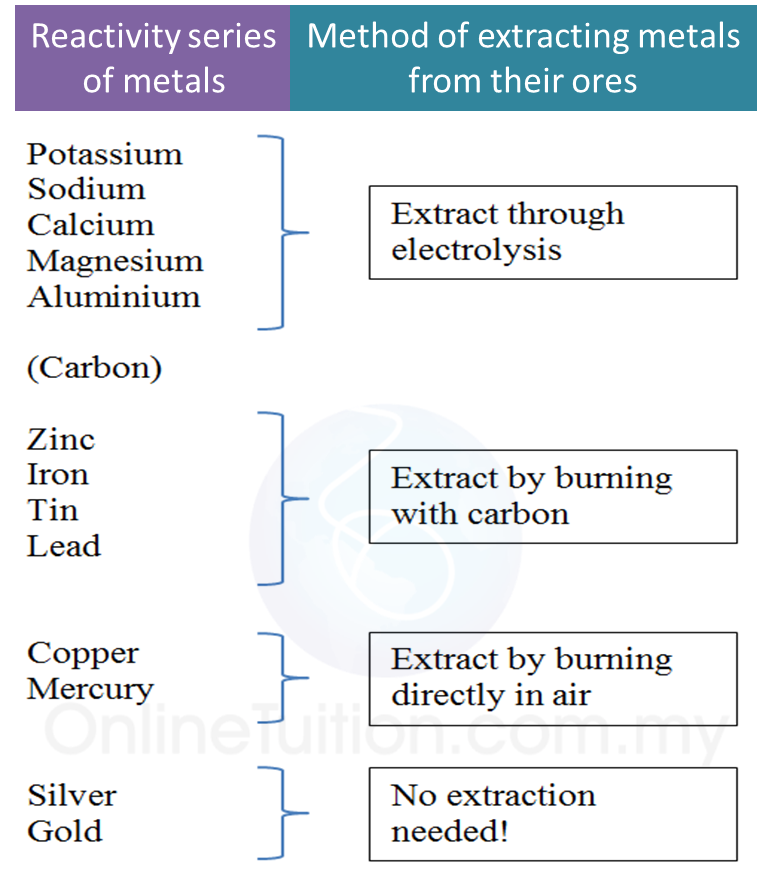
- Some Metals can be Extracted by Reduction with Carbon
- Ores are rocks that contain enough metal to make it extract the metal from it. They often contain compounds of the metal. Before we can use them, they need to be extracted from their ores. The position of the metal in the reactivity series determines how the metal can be extracted.
- Some Metals can be Extracted by Reduction with Carbon
Oxidation and Reduction
- In terms of electrons: Oxidation Is Loss, Reduction Is Gain.
- OIL RIG
- In terms of electrons: Oxidation Is Loss, Reduction Is Gain.
Electrolysis
- Means 'Splitting Up With Energy'
- An electric current is passed through an electrolyte (a molten or dissolved ionic compound), and the ions move towards the electrodes, where they react and the compound decomposes. The positive metal/hydrogen ions in the electrolyte will move towards the cathode (negative electrode) and gain electrons. The negative non-metal ions will move towards the anode (positive electrode) and lose electrons. This creates a flow of charge through the electrolyte.
- Means 'Splitting Up With Energy'
Simple Covalent Substances
- Properties of them
- Molecular compounds don't conduct electricity, because there is no charge
- Held together by very strong covalent bonds
- Melting and boiling points are very low.
- Properties of them
Homologous Series and Alkanes
- Compounds in This Series Share Similar Chemical Properties
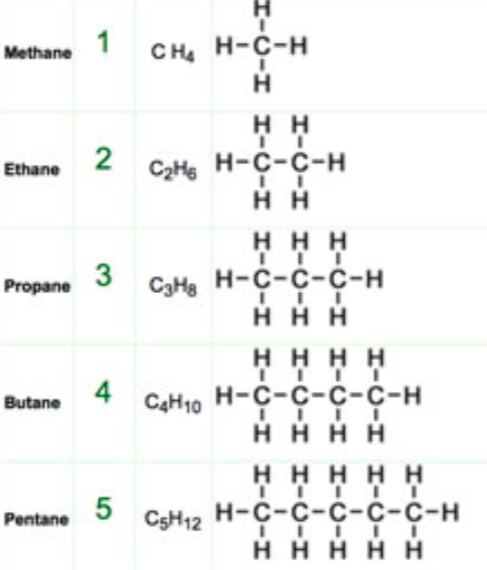
- This series is a family of molecules which share the same general formula. IThe molecular formulas differ by a CH2 unit. Trends can be seen in the physical properties too E.G. the bigger the molecule, the higher the boiling/melting point is.
- Compounds in This Series Share Similar Chemical Properties
Fractional Distillation of Crude Oil
- This can be Used to Separate Hydrocarbon Fractions
- The oil is heated until most of it has turned into gas and enters a fractionating column (tall column which has condensers coming off at various points). The column is heated from the bottom so there's a temperature gradient. The longer hydrocarbons have high boiling points so they condense back into liquids and drain out of the column early on, when they're near the bottom. The shorter hydrocarbons condense and drain out much later on, near the top.
- Uses of Crude Oil
- Provides fuel for transport
- The petrochemical industry uses some of the hydrocarbons from the oil as a feedstock to make new compounds.
- This can be Used to Separate Hydrocarbon Fractions
Imágenes y archivos del mapa
Información
- Descripción
- GCSE Core Science Mapa Mental sobre C3: Chemicals of the Natural Environment, creado por Blerta Morina el 19/04/2019.
- Creado por
- Blerta Morina
- Visitas
- 4
- Etiquetas
- Valoración