
Mapa mental
water supply
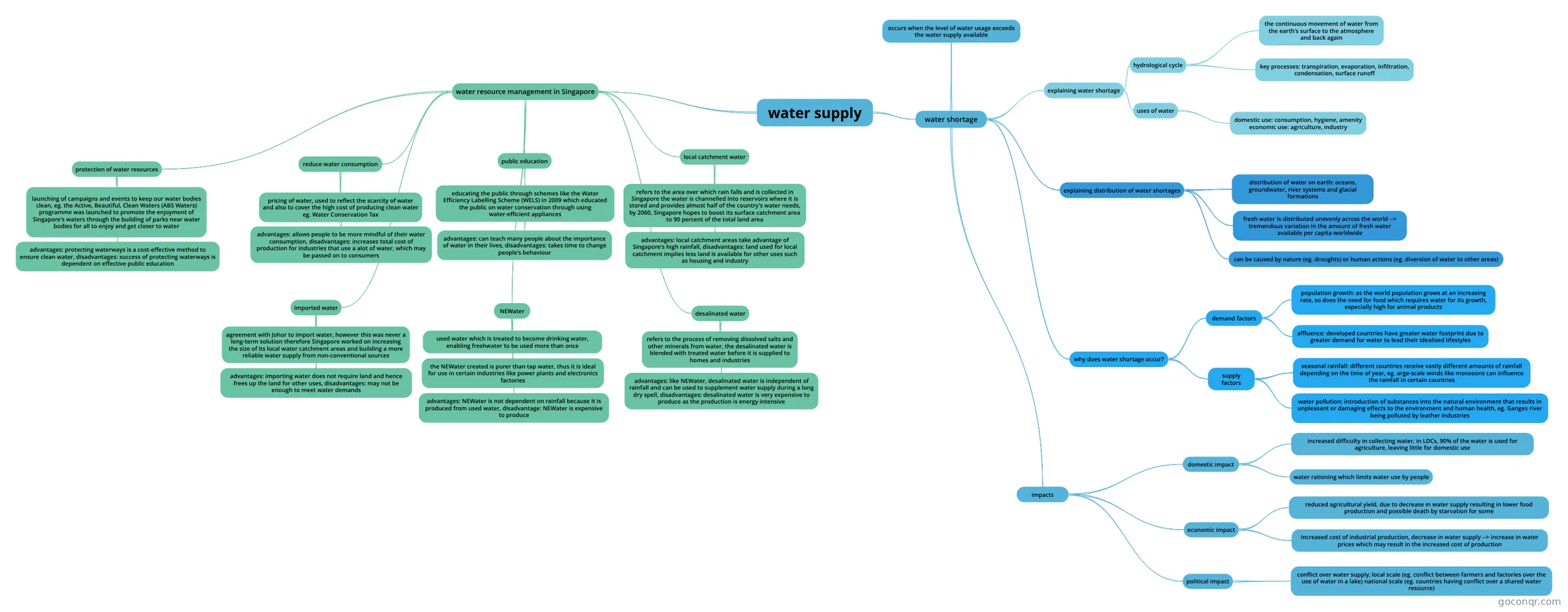
Mind map: Water supply
Contenido del mapa
water supply
water shortage
- occurs when the level of water usage exceeds the water supply available
- explaining water shortage
- hydrological cycle
- the continuous movement of water from the earth's surface to the atmosphere and back again
- key processes: transpiration, evaporation, infiltration, condensation, surface runoff
- uses of water
- domestic use: consumption, hygiene, amenity economic use: agriculture, industry
- hydrological cycle
- explaining distribution of water shortages
- distribution of water on earth: oceans, groundwater, river systems and glacial formations
- fresh water is distributed unevenly across the world --> tremendous variation in the amount of fresh water available per capita worldwide
- can be caused by nature (eg. droughts) or human actions (eg. diversion of water to other areas)
- why does water shortage occur?
- demand factors
- population growth: as the world population grows at an increasing rate, so does the need for food which requires water for its growth, especially high for animal products
- affluence: developed countries have greater water footprint due to greater demand for water to lead their idealised lifestyles
- supply factors
- seasonal rainfall: different countries receive vastly different amounts of rainfall depending on the time of year, eg. arge-scale winds like monsoons can influence the rainfall in certain countries
- water pollution: introduction of substances into the natural environment that results in unpleasant or damaging effects to the environment and human health, eg. Ganges river being polluted by leather industries
- demand factors
- impacts
- domestic impact
- increased difficulty in collecting water, in LDCs, 90% of the water is used for agriculture, leaving little for domestic use
- water rationing which limits water use by people
- economic impact
- reduced agricultural yield, due to decrease in water supply resulting in lower food production and possible death by starvation for some
- increased cost of industrial production, decrease in water supply --> increase in water prices which may result in the increased cost of production
- political impact
- conflict over water supply, local scale (eg. conflict between farmers and factories over the use of water in a lake) national scale (eg. countries having conflict over a shared water resource)
- domestic impact
water resource management in Singapore
- reduce water consumption
- pricing of water, used to reflect the scarcity of water and also to cover the high cost of producing clean water eg. Water Conservation Tax
- advantages: allows people to be more mindful of their water consumption, disadvantages: increases total cost of production for industries that use a alot of water, which may be passed on to consumers
- public education
- educating the public through schemes like the Water Efficiency Labelling Scheme (WELS) in 2009 which educated the public on water conservation through using water-efficient appliances
- advantages: can teach many people about the importance of water in their lives, disadvantages: takes time to change people's behaviour
- educating the public through schemes like the Water Efficiency Labelling Scheme (WELS) in 2009 which educated the public on water conservation through using water-efficient appliances
- local catchment water
- refers to the area over which rain falls and is collected in Singapore the water is channelled into reservoirs where it is stored and provides almost half of the country's water needs, by 2060, Singapore hopes to boost its surface catchment area to 90 percent of the total land area
- advantages: local catchment areas take advantage of Singapore's high rainfall, disadvantages: land used for local catchment implies less land is available for other uses such as housing and industry
- imported water
- agreement with Johor to import water, however this was never a long-term solution therefore Singapore worked on increasing the size of its local water catchment areas and building a more reliable water supply from non-conventional sources
- advantages: importing water does not require land and hence frees up the land for other uses, disadvantages: may not be enough to meet water demands
- NEWater
- used water which is treated to become drinking water, enabling freshwater to be used more than once
- the NEWater created is purer than tap water, thus it is ideal for use in certain industries like power plants and electronics factories
- advantages: NEWater is not dependent on rainfall because it is produced from used water, disadvantage: NEWater is expensive to produce
- desalinated water
- refers to the process of removing dissolved salts and other minerals from water, the desalinated water is blended with treated water before it is supplied to homes and industries
- advantages: like NEWater, desalinated water is independent of rainfall and can be used to supplement water supply during a long dry spell, disadvantages: desalinated water is very expensive to produce as the production is energy intensive
- protection of water resources
- launching of campaigns and events to keep our water bodies clean, eg. the Active, Beautiful, Clean Waters (ABS Waters) programme was launched to promote the enjoyment of Singapore's waters through the building of parks near water bodies for all to enjoy and get closer to water
- advantages: protecting waterways is a cost-effective method to ensure clean water, disadvantages: success of protecting waterways is dependent on effective public education
- reduce water consumption
Información
- Descripción
- Mapa Mental sobre water supply, creado por felicia chua el 12/06/2019.
- Creado por
- felicia chua
- Visitas
- 2
- Valoración
Más sobre Water Scarcity and Drought