
Mapa mental
Lecture 5: Learning
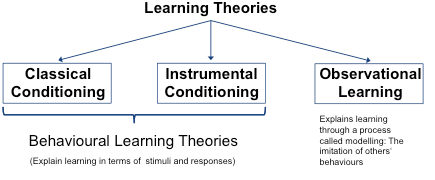
Contenido del mapa
Lecture 5: Learning
Learning is the process by which individuals acquire the purchase and consumption knowledge and experience that they apply to future related behavior.
Learning Theories: Classical Conditioning, Instrumental/ Operant Conditioning, Observational Learning
- Behavioral Learning Theories - Behavior Meaning, Learning has taken place and they explain learning in terms of stimuli and responses.
- Observational Learning - mental change has occurred and that this is necessary for mental learning. This is learning through a process called modelling you observe behaviour and imitate that behaviour
- Classical Conditioning (Pavlov)
- Form of learning in which a stimulus that produces an innate reflex becomes associated with a neutral stimulus, which acquires the power to elicit the same response (Ivan Pavlov).
- When you pair 2 different stimuli, the stimulus that is able to trigger a certain response in an individual and a trigger that was not able to trigger a certain response, by putting them together they will both be able to trigger a response.
- Application in Marketing: Emotions to differentiate a product, that you can communicate a whole consumer experience, important for homogenous products b/c not many chance to differentiate them.
- Use emotion to attach someone to a brand. Brand name is neutral (unconditional) so it just creates a cognitive perception. If you couple the brand with an emotional appeal (conditional) a few times the stimuli can trigger a response.
- Restricted to fairly simple automatic or involuntary responses. Repeated exposures increase the strength of the stimulus-response associations and prevent the decay of these associations in memory. When you stop doing this people quickly start to forget about the response.
- Form of learning in which a stimulus that produces an innate reflex becomes associated with a neutral stimulus, which acquires the power to elicit the same response (Ivan Pavlov).
- Operant/ Instrumental Conditioning (Thomdike, Skinner)
- is a form of behavioural learning in which the probability of a response is changed by its consequences (e.g. by the stimuli that follows the response). If behaviour is rewarded people tend to repeat behaviours, when it is punished - individuals stop these behaviours.
- Trial & Error: Consequences of actions matter most/ + consequences lead to repetition/ - or no consequences lead to no repetition/ Conscious decision
- Operant response: an observable , voluntary behaviour that an organism shows to have meaningful (that you get a reward or avoid punishment) effect on the environment. Skinner said Reward = Reinforce. Two Types of Reinforcements:
- Primary Reinforcements:
- Stimuli that are innately rewarding to an organism, so they fulfil some basic biological need for instance food, sex.
- Secondary Reinforcements:
- Stimuli that acquire reinforcement value through association with a primary reinforce: Money. status. grades etc. B/c the assumption is that you can buy or exchange secondary reinforces for primary reinforces.
- Primary Reinforcements:
- Four different outcomes:
- + Reinforcement:
- Rat gets a reward; behaviour is + reinforced, most likely to show a similar behaviour again.
- - Reinforcement
- Rat gets electrical shocks several times, rat performs certain behaviour so that shocks stop.
- Punishment
- E.g. Electro shock experiment with rats – Shock them when they choose the right exit. Next time: They will not choose that exit.
- Extinction
- When the rat had learnt that on the left exit there is cheese as a reward, and the cheese stops, the rat will stop choosing the left exit as well as there is no reward to gain. He will unlearn this, as there is no reward
- With punishment and extinction you will stop someone from doing something. They both weaken behaviours
- Differences between C and O Conditioning
- With operant conditioning, you have an unconditional and conditional stimulus and you trigger a response. This works through the consequences of behaviour, punishment or reward, +/- reinforced behaviour. With operant conditioning, you can teach animals and people more complex behaviours not innate reflexes like with classical conditioning.
- Differences between C and O Conditioning
- Application in Marketing: Product Offering, Try it - get a reward part of a loyalty program, + reinforced which leads to a higher chance of purchase in the next round
- `examples: Payback system, Miles & More, Loyalty card from a coffee vender
- + Reinforcement:
- is a form of behavioural learning in which the probability of a response is changed by its consequences (e.g. by the stimuli that follows the response). If behaviour is rewarded people tend to repeat behaviours, when it is punished - individuals stop these behaviours.
- Observational Learning
- Is a form of cognitive learning in which new responses are acquired after watching others’ behaviour and the consequences of their behaviour.
- Important in sit. where individuals did have a chance to gather personal experiences. Learning is based on observation or imitation. we observe and imitate the behaviour of another person e.g. a model
- Four Processes: Attention, Retention, Production Process, Motivation
- Attention
- You direct your attention towards a model (Voorbeeld). The greater the attractiveness, competence, status or similarity of the model the more likely attention is directed towards the model‘s behaviour.
- Celebrity endorsement
- You direct your attention towards a model (Voorbeeld). The greater the attractiveness, competence, status or similarity of the model the more likely attention is directed towards the model‘s behaviour.
- Retention
- You retain this behaviour in memory. More likely if the task is of low complexity, the less complex a task it is. The higher the likelihood that observational learning will work.
- Production Process
- You have to have the ability to be in the same situation
- Motivation
- To do the behaviour
- Attention
- Four Processes: Attention, Retention, Production Process, Motivation
- Important in sit. where individuals did have a chance to gather personal experiences. Learning is based on observation or imitation. we observe and imitate the behaviour of another person e.g. a model
- Is a form of cognitive learning in which new responses are acquired after watching others’ behaviour and the consequences of their behaviour.
Imágenes y archivos del mapa
Información
- Descripción
- Masters Consumer Behavior Mapa Mental sobre Lecture 5: Learning, creado por chotika.a el 10/01/2015.
- Creado por
- chotika.a
- Visitas
- 0
- Valoración