
Mapa mental
Culture, Language & Education
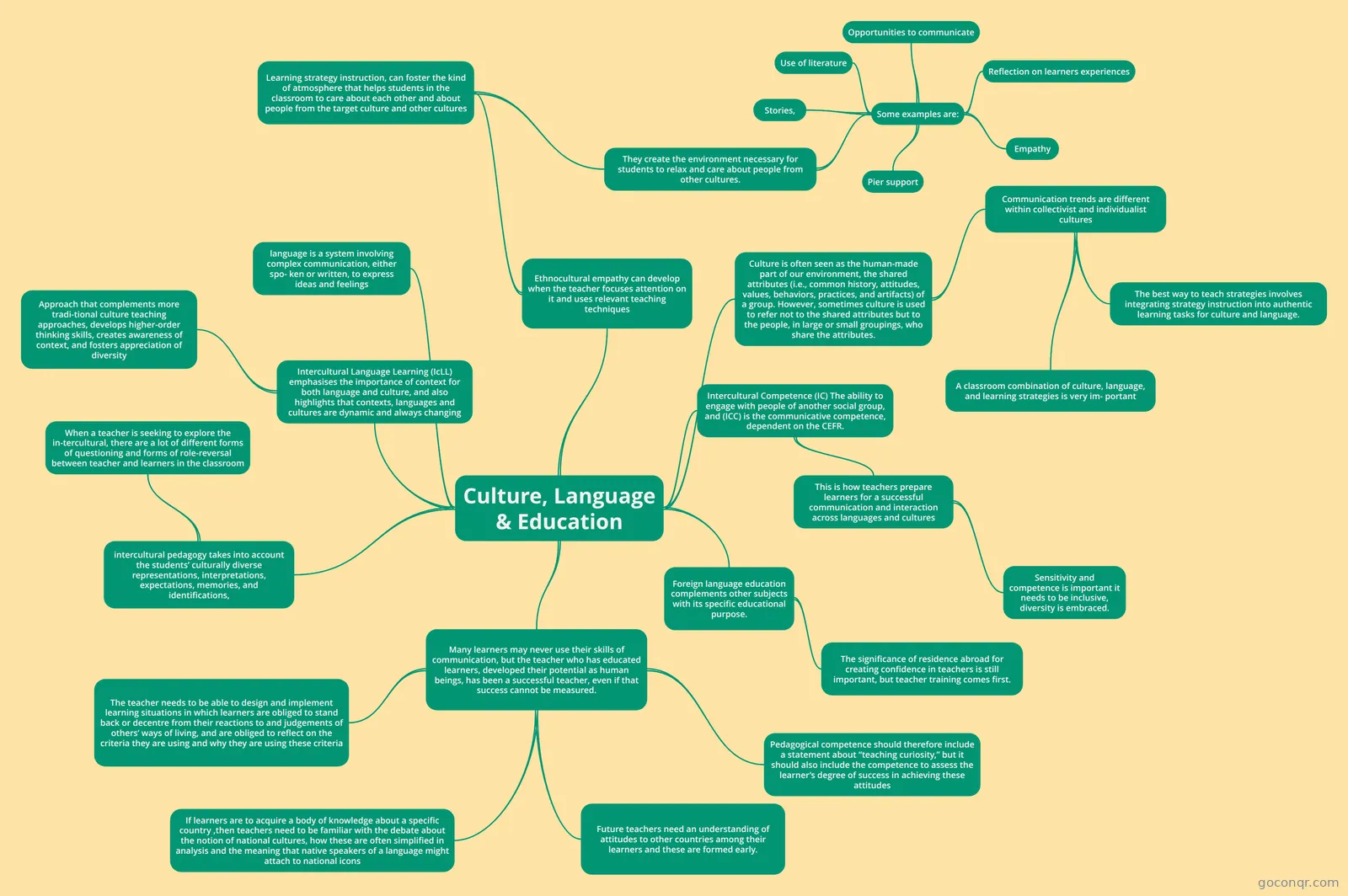
Mind map: Culture, language & education
Contenido del mapa
Culture, Language & Education
Intercultural Competence (IC) The ability to engage with people of another social group, and (ICC) is the communicative competence, dependent on the CEFR.
- This is how teachers prepare learners for a successful communication and interaction across languages and cultures
- Sensitivity and competence is important it needs to be inclusive, diversity is embraced.
- This is how teachers prepare learners for a successful communication and interaction across languages and cultures
Foreign language education complements other subjects with its specific educational purpose.
- The significance of residence abroad for creating confidence in teachers is still important, but teacher training comes first.
Many learners may never use their skills of communication, but the teacher who has educated learners, developed their potential as human beings, has been a successful teacher, even if that success cannot be measured.
- Pedagogical competence should therefore include a statement about “teaching curiosity,” but it should also include the competence to assess the learner’s degree of success in achieving these attitudes
- Future teachers need an understanding of attitudes to other countries among their learners and these are formed early.
- If learners are to acquire a body of knowledge about a specific country ,then teachers need to be familiar with the debate about the notion of national cultures, how these are often simplified in analysis and the meaning that native speakers of a language might attach to national icons
- The teacher needs to be able to design and implement learning situations in which learners are obliged to stand back or decentre from their reactions to and judgements of others’ ways of living, and are obliged to reflect on the criteria they are using and why they are using these criteria
intercultural pedagogy takes into account the students’ culturally diverse representations, interpretations, expectations, memories, and identifications,
- When a teacher is seeking to explore the in-tercultural, there are a lot of different forms of questioning and forms of role-reversal between teacher and learners in the classroom
Intercultural Language Learning (IcLL) emphasises the importance of context for both language and culture, and also highlights that contexts, languages and cultures are dynamic and always changing
- Approach that complements more tradi-tional culture teaching approaches, develops higher-order thinking skills, creates awareness of context, and fosters appreciation of diversity
language is a system involving complex communication, either spo- ken or written, to express ideas and feelings
Culture is often seen as the human-made part of our environment, the shared attributes (i.e., common history, attitudes, values, behaviors, practices, and artifacts) of a group. However, sometimes culture is used to refer not to the shared attributes but to the people, in large or small groupings, who share the attributes.
- Communication trends are different within collectivist and individualist cultures
- The best way to teach strategies involves integrating strategy instruction into authentic learning tasks for culture and language.
- A classroom combination of culture, language, and learning strategies is very im- portant
- Communication trends are different within collectivist and individualist cultures
Ethnocultural empathy can develop when the teacher focuses attention on it and uses relevant teaching techniques
- Learning strategy instruction, can foster the kind of atmosphere that helps students in the classroom to care about each other and about people from the target culture and other cultures
- They create the environment necessary for students to relax and care about people from other cultures.
- Some examples are:
- Stories,
- Opportunities to communicate
- Pier support
- Reflection on learners experiences
- Use of literature
- Empathy
- Some examples are:
- They create the environment necessary for students to relax and care about people from other cultures.
- Learning strategy instruction, can foster the kind of atmosphere that helps students in the classroom to care about each other and about people from the target culture and other cultures
Información
- Descripción
- Education Mapa Mental sobre Culture, Language & Education, creado por Liliana Moreno el 03/07/2019.
- Creado por
- Liliana Moreno
- Visitas
- 13
- Valoración
Más sobre Culture and Intercultural Competence in Language Teaching