
Mapa mental
Climate Change
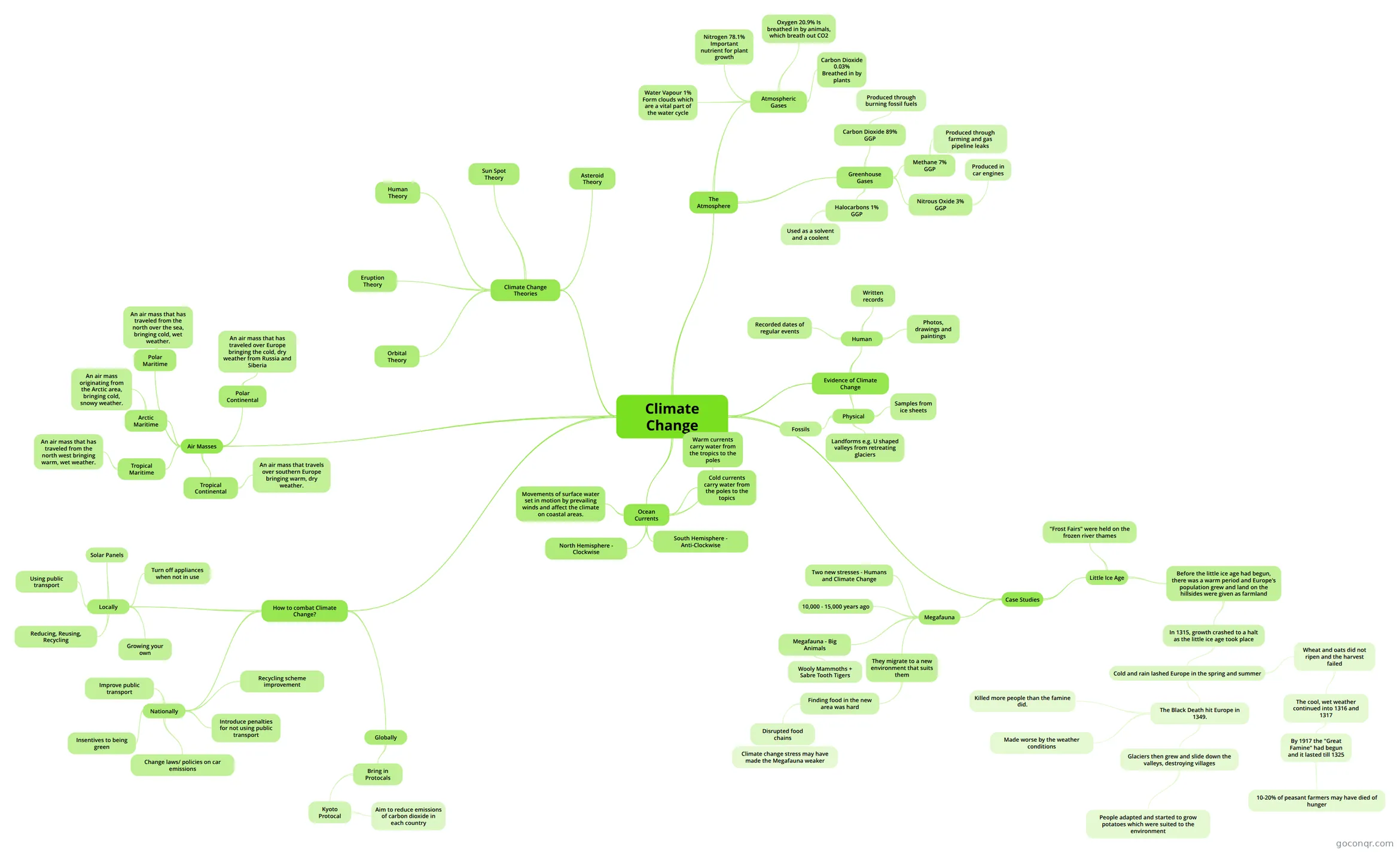
Mind map: Climate change
Contenido del mapa
Climate Change
Evidence of Climate Change
- Physical
- Fossils
- Landforms e.g. U shaped valleys from retreating glaciers
- Samples from ice sheets
- Human
- Photos, drawings and paintings
- Written records
- Recorded dates of regular events
- Physical
Climate Change Theories
- Asteroid Theory
- Human Theory
- Eruption Theory
- Orbital Theory
- Sun Spot Theory
Case Studies
- Megafauna
- Megafauna - Big Animals
- Wooly Mammoths + Sabre Tooth Tigers
- 10,000 - 15,000 years ago
- Two new stresses - Humans and Climate Change
- They migrate to a new environment that suits them
- Finding food in the new area was hard
- Disrupted food chains
- Climate change stress may have made the Megafauna weaker
- Disrupted food chains
- Finding food in the new area was hard
- Megafauna - Big Animals
- Little Ice Age
- "Frost Fairs" were held on the frozen river thames
- Before the little ice age had begun, there was a warm period and Europe's population grew and land on the hillsides were given as farmland
- In 1315, growth crashed to a halt as the little ice age took place
- Cold and rain lashed Europe in the spring and summer
- Wheat and oats did not ripen and the harvest failed
- The cool, wet weather continued into 1316 and 1317
- By 1917 the "Great Famine" had begun and it lasted till 1325
- 10-20% of peasant farmers may have died of hunger
- By 1917 the "Great Famine" had begun and it lasted till 1325
- The cool, wet weather continued into 1316 and 1317
- The Black Death hit Europe in 1349.
- Killed more people than the famine did.
- Made worse by the weather conditions
- Glaciers then grew and slide down the valleys, destroying villages
- People adapted and started to grow potatoes which were suited to the environment
- Wheat and oats did not ripen and the harvest failed
- Cold and rain lashed Europe in the spring and summer
- In 1315, growth crashed to a halt as the little ice age took place
- Megafauna
The Atmosphere
- Atmospheric Gases
- Nitrogen 78.1% Important nutrient for plant growth
- Oxygen 20.9% Is breathed in by animals, which breath out CO2
- Carbon Dioxide 0.03% Breathed in by plants
- Water Vapour 1% Form clouds which are a vital part of the water cycle
- Greenhouse Gases
- Carbon Dioxide 89% GGP
- Produced through burning fossil fuels
- Methane 7% GGP
- Produced through farming and gas pipeline leaks
- Nitrous Oxide 3% GGP
- Produced in car engines
- Halocarbons 1% GGP
- Used as a solvent and a coolent
- Carbon Dioxide 89% GGP
- Atmospheric Gases
Air Masses
- Polar Maritime
- An air mass that has traveled from the north over the sea, bringing cold, wet weather.
- Arctic Maritime
- An air mass originating from the Arctic area, bringing cold, snowy weather.
- Polar Continental
- An air mass that has traveled over Europe bringing the cold, dry weather from Russia and Siberia
- Tropical Maritime
- An air mass that has traveled from the north west bringing warm, wet weather.
- Tropical Continental
- An air mass that travels over southern Europe bringing warm, dry weather.
- Polar Maritime
How to combat Climate Change?
- Locally
- Solar Panels
- Using public transport
- Reducing, Reusing, Recycling
- Growing your own
- Turn off appliances when not in use
- Nationally
- Improve public transport
- Insentives to being green
- Recycling scheme improvement
- Change laws/ policies on car emissions
- Introduce penalties for not using public transport
- Globally
- Bring in Protocals
- Kyoto Protocal
- Aim to reduce emissions of carbon dioxide in each country
- Kyoto Protocal
- Bring in Protocals
- Locally
Ocean Currents
- Movements of surface water set in motion by prevailing winds and affect the climate on coastal areas.
- North Hemisphere - Clockwise
- South Hemisphere - Anti-Clockwise
- Warm currents carry water from the tropics to the poles
- Cold currents carry water from the poles to the topics
Información
- Descripción
- (Climate Change) Geography Mapa Mental sobre Climate Change, creado por Matthew Jones el 03/09/2013.
- Creado por
- Matthew Jones
- Visitas
- 205
- Etiquetas
- Valoración