
Mapa mental
Makkah 610-622 CE
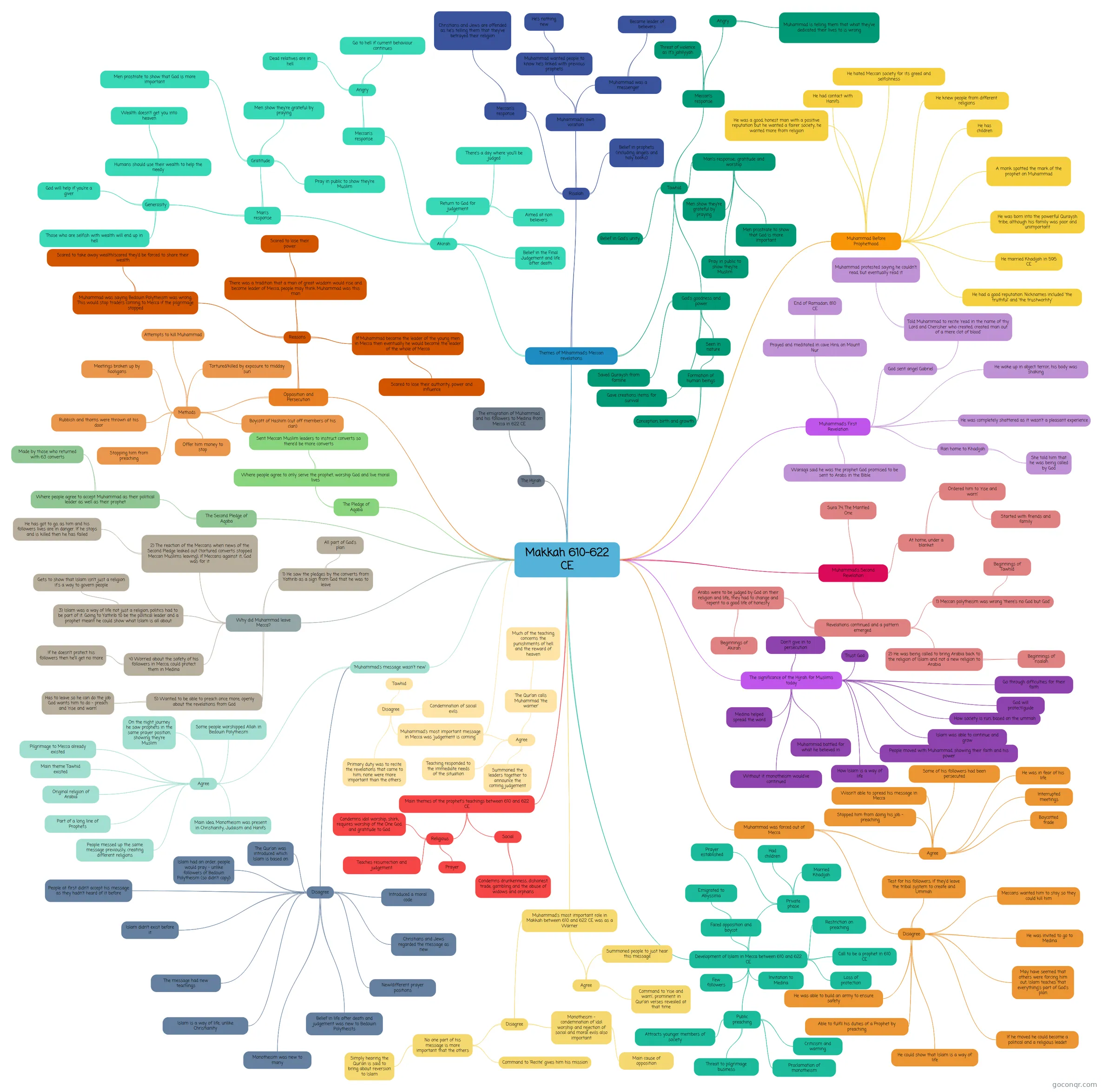
Mind map: Makkah 610-622 CE
Contenido del mapa
Makkah 610-622 CE
Muhammad Before Prophethood
- He was born into the powerful Quraysh tribe, although his family was poor and unimportant
- A monk spotted the mark of the prophet on Muhammad
- He married Khadijah in 595 CE
- He had a good reputation. Nicknames included 'the truthful' and 'the trustworhty'
- He has children
- He knew people from different religions
- He hated Meccan society for its greed and selfishness
- He had contact with Hanifs
- He was a good, honest man with a positive reputation but he wanted a fairer society, he wanted more from religion
Muhammad's First Revelation
- Prayed and meditated in cave Hira, on Mount Nur
- End of Ramadan, 810 CE
- God sent angel Gabriel
- Told Muhammad to recite 'read in the name of thy Lord and Cherisher who created, created man out of a mere clot of blood'
- Muhammad protested saying he couldn't read, but eventually read it
- Told Muhammad to recite 'read in the name of thy Lord and Cherisher who created, created man out of a mere clot of blood'
- He woke up in abject terror, his body was shaking
- He was completely shattered as it wasn't a pleasant experience
- Ran home to Khadijah
- She told him that he was being called by God
- Waraqa said he was the prophet God promised to be sent to Arabs in the Bible
- Prayed and meditated in cave Hira, on Mount Nur
Themes of Mihammad's Meccan revelations
- Tawhid
- Belief in God's unity
- Meccan's response
- Angry
- Muhammad is telling them that what they've dedicated their lives to is wrong
- Threat of violence as it's jahilyyah
- Angry
- Man's response,: gratitude and worship
- Pray in public to show they're Muslim
- Men show they're grateful by praying
- Men prostrate to show that God is more important
- God's goodness and power
- Saved Quraysh from famine
- Seen in nature
- Formation of human beings
- Conception, birth and growth
- Formation of human beings
- Gave creations items for survval
- Risalah
- Belief in prophets (including angels and holy books)
- Muhammad's own vocation
- Muhammad was a messenger
- Became leader of believers
- Muhammad wanted people to know he's linked with previous prophets
- He's nothing new
- Muhammad was a messenger
- Meccan's response
- Christians and Jews are offended as he's telling them that they've betrayed their religion
- Akirah
- Belief in the Final Judgement and life after death
- Return to God for judgement
- Aimed at non believers
- There's a day where you'll be judged
- Meccan's response
- Angry
- Go to hell if current behaviour continues
- Dead relatives are in hell
- Angry
- Man's response
- Gratitude
- Pray in public to show they're Muslim
- Men show they're grateful by praying
- Men prostrate to show that God is more important
- Generosity
- Humans should use their wealth to help the needy
- Wealth doesn't get you into heaven
- God will help if you're a giver
- Those who are selfish with wealth will end up in hell
- Humans should use their wealth to help the needy
- Gratitude
- Tawhid
Muhammad's Second Revelation
- At home, under a blanket
- Ordered him to 'rise and warn'
- Started with friends and family
- Ordered him to 'rise and warn'
- Sura 74, The Mantled One
- Revelations continued and a pattern emerged
- 1) Meccan polytheism was wrong 'there's no God but God'
- Beginnings of Tawhid
- 2) He was being called to bring Arabia back to the religion of Islam and not a new religion to Arabia
- Beginnings of risalah
- Arabs were to be judged by God on their religion and life,, they had to change and repent to a good life of honesty
- Beginnings of Akirah
- 1) Meccan polytheism was wrong 'there's no God but God'
- At home, under a blanket
Opposition and Persecution
- Reasons
- If Muhammad became the leader of the young men in Mecca then eventually he would become the leader of the whole of Mecca
- Scared to lose their authority, power and influence
- There was a tradition that a man of great wisdom would rise and become leader of Mecca, people may think Muhammad was this man
- Scared to lose their power
- Muhammad was saying Bedouin Polytheism was wrong. This would stop traders coming to Mecca if the pilgrimage stopped
- Scared to take away wealth/scared they'd be forced to share their wealth
- If Muhammad became the leader of the young men in Mecca then eventually he would become the leader of the whole of Mecca
- Methods
- Tortured/killed by exposure to midday sun
- Attempts to kill Muhammad
- Meetings broken up by hooligans
- Rubbish and thorns were thrown at his door
- Boycott of Hashim (cut off members of his clan)
- Stopping him from preaching
- Offer him money to stop
- Reasons
The Pledge of Aqaba
- Where people agree to only serve the prophet, worship God and live moral lives
- Sent Meccan Muslim leaders to instruct converts so there'd be more converts
- Where people agree to only serve the prophet, worship God and live moral lives
The Second Pledge of Aqaba
- Where people agree to accept Muhammad as their political leader as well as their prophet
- Made by those who returned with 63 converts
- Where people agree to accept Muhammad as their political leader as well as their prophet
Why did Muhammad leave Mecca?
- 1) He saw the pledges by the converts from Yathrib as a sign from God that he was to leave
- All part of God's plan
- 2) The reaction of the Meccans when news of the Second Pledge leaked out (tortured converts stopped Meccan Muslims leaving), if Meccans against it, God was for it
- He has got to go, as him and his followers lives are in danger. If he stops and is killed then he has failed
- 3) Islam was a way of life not just a religion, politics had to be part of it. Going to Yathrib to be the political leader and a prophet meant he could show what Islam is all about
- Gets to show that Islam isn't just a religion it's a way to govern people
- 4) Worried about the safety of his followers in Mecca, could protect them in Medina
- If he doesn't protect his followers then he'll get no more
- 5) Wanted to be able to preach once more, openly about the revelations from God
- Has to leave so he can do the job God wants him to do - preach and 'rise and warn'
- 1) He saw the pledges by the converts from Yathrib as a sign from God that he was to leave
The Hijrah
- The emigration of Muhammad and his followers to Medina from Mecca in 622 CE
The significance of the Hijrah for Muslims today
- Don't give in to persecution
- Go through difficulties for their faith
- Trust God
- God will protect/guide
- How society is run, based on the ummah
- Islam was able to continue and grow
- People moved with Muhammad, showing their faith and his power
- How Islam is a way of life
- Muhammad battled for what he believed in
- Without it monotheism would've continued
- Medina helped spread the word
'Muhammad's message wasn't new'
- Agree
- Some people worshipped Allah in Bedouin Polytheism
- On the night journey he saw prophets in the same prayer position, showing they're Muslim
- Pilgrimage to Mecca already existed
- Main theme Tawhid existed
- Original religion of Arabia
- Part of a long line of Prophets
- People messed up the same message previously, creating different religions
- Main idea, Monotheism was present in Christianity, Judaism and Hanifs
- Disagree
- The Qur'an was introduced which Islam is based on
- Islam had an order, people would pray - unlike followers of Bedouin Polytheism (so didn't copy)
- People at first didn't accept his message as they hadn't heard of it before
- Islam didn't exist before it
- The message had new teachings
- Islam is a way of life, unlike Christianity
- Monotheism was new to many
- Belief in life after death and judgement was new to Bedouin Polytheists
- New/different prayer positions
- Christians and Jews regarded the message as new
- Introduced a moral code
- Agree
Muhammad was forced out of Mecca
- Agree
- He was in fear of his life
- Some of his followers had been persecuted
- Wasn't able to spread his message in Mecca
- Stopped him from doing his job - preaching
- Interrupted meetings
- Boycotted trade
- Disagree
- Meccans wanted him to stay so they could kill him
- He was invited to go to Medina
- May have seemed that others were forcing him out, Islam teaches that everything's part of God's plan
- If he moved he could become a political and a religious leadet
- He could show that Islam is a way of life
- Able to fulfil his duties of a Prophet by preaching
- He was able to build an army to ensure safety
- Test for his followers, if they'd leave the tribal system to create and Ummah
- Agree
Development of Islam in Mecca between 610 and 622 CE
- Call to be a prophet in 610 CE
- Private phase
- Married Khadijah
- Had children
- Prayer established
- Public preaching
- Criticism and warning
- Proclamation of monotheism
- Threat to pilgrimage business
- Attracts younger members of society
- Faced opposition and boycot
- Emigrated to Abyssinia
- Loss of protection
- Restriction on preaching
- Invitation to Medina
- Few followers
Muhammad's most important role in Makkah between 610 and 622 CE was as a Warner
- Agree
- Command to 'rise and warn'; prominent in Qur'an verses revealed at that time
- Summoned people to just hear this message
- Disagree
- Monotheism - condemnation of idol worship and rejection of social and moral evils also important
- Main cause of opposition
- No one part of his message is more important that the others
- Command to 'Recite' gives him his mission
- Simply hearing the Qur'an is said to bring about reversion to Islam
- Monotheism - condemnation of idol worship and rejection of social and moral evils also important
- Agree
Main themes of the prophet's teachings between 610 and 622 CE
- Social
- Condemns drunkenness, dishonest trade, gambling and the abuse of widows and orphans
- Religious
- Condemns idol worship, shirk, requires worship of the One God, and gratitude to God
- Teaches resurrection and judgement
- Prayer
- Social
Muhammad's most important message in Mecca was 'judgement is coming'
- Agree
- The Qur'an calls Muhammad 'the warner'
- Much of the teaching concerns the punishments of hell and the reward of heaven
- Summoned the leaders together to announce the coming judgement
- Teaching responded to the immediate needs of the situation
- The Qur'an calls Muhammad 'the warner'
- Disagree
- Primary duty was to recite the revelations that came to him; none were more important than the others
- Condemnation of social evils
- Tawhid
- Agree
Información
- Descripción
- Mapa Mental sobre Makkah 610-622 CE, creado por Emma Robinson el 01/02/2015.
- Creado por
- Emma Robinson
- Visitas
- 98
- Etiquetas
- Valoración