
Mapa mental
INTELLECTUAL PROPERTY: COPYRIGHTS
Contenido del mapa
INTELLECTUAL PROPERTY: COPYRIGHTS
Is a form of Intellectual Property designed to protect the rights of a creator of literary and artistic works, computer programs and databases. Copyright allows the creators to control the use and exploitation of their works, and derivative works there of, and covers the copying, adapting, publishing, performing and broadcasting of such works.
- Granting of Copyright
- Copyright does not require any formal application or registration for protection of a creative work, comes into operation automatically the moment a work is completed – that is, it subsists in that work for the creator.
- Works Protected by Copyright
- Typical works covered by copyright are: original literary, dramatic, musical and artistic works, published editions of works, sound recordings, films, videos, broadcasts and cable programmes, computer programs and databases.
- International Protection
- While there is no all-governing ‘international copyright’ to protect a creator’s work worldwide, there are international treaties that deal with copyright and to which most countries have signed up.
- Berne Convention for the protection of literary and artistic works, and the Universal Copyright Convention (UCC).
- WIPO Copyright Treaty (WCT) of 1996, under which protection of works transmitted by digital means, including the Internet, has been provided for.
- While there is no all-governing ‘international copyright’ to protect a creator’s work worldwide, there are international treaties that deal with copyright and to which most countries have signed up.
- Registration of Copyright
- There is no requirement to register a work in order to obtain copyright protection, however, the laws of some countries do require registration in order to have a formal record of the work that is protected by copyright.
- Although it is not a requirement in most countries for asserting copyright in a work, it is advisable that a work be marked with the international © mark, followed by the name of the copyright owner and the year of publication.
- There is no requirement to register a work in order to obtain copyright protection, however, the laws of some countries do require registration in order to have a formal record of the work that is protected by copyright.
- Ownership of Copyright
- The rights covered by copyright can be divided into economic rights and moral rights.
- Economic rights are those rights dealing with the ownership, use and exploitation of the work covered by the copyright.
- Moral rights are the rights of the author of the work to be identified as the author, as well as to object to any derogatory treatment of the work, even if the author is not ultimately the owner of the work.
- The rights covered by copyright can be divided into economic rights and moral rights.
- Duration of Copyright
- Copyright is an asset, just like other forms of IP, and as such, it may be licensed or sold and also may form part of the estate of the author after death. In this latter case, it may be transferred to family or other third parties in accordance with the author’s testament and can continue to be managed and exploited for up to 70 years after the author’s death.
- Granting of Copyright
Unlike patent protection, where a patent provides the owner with a monopoly on the invention, copyright does not provide the creator with a monopoly on his work. Copyright typically is enforced to prevent copying, plagiarism, and misuse of a work, but it does not prevent a third party from independent development of the idea or a similar work.
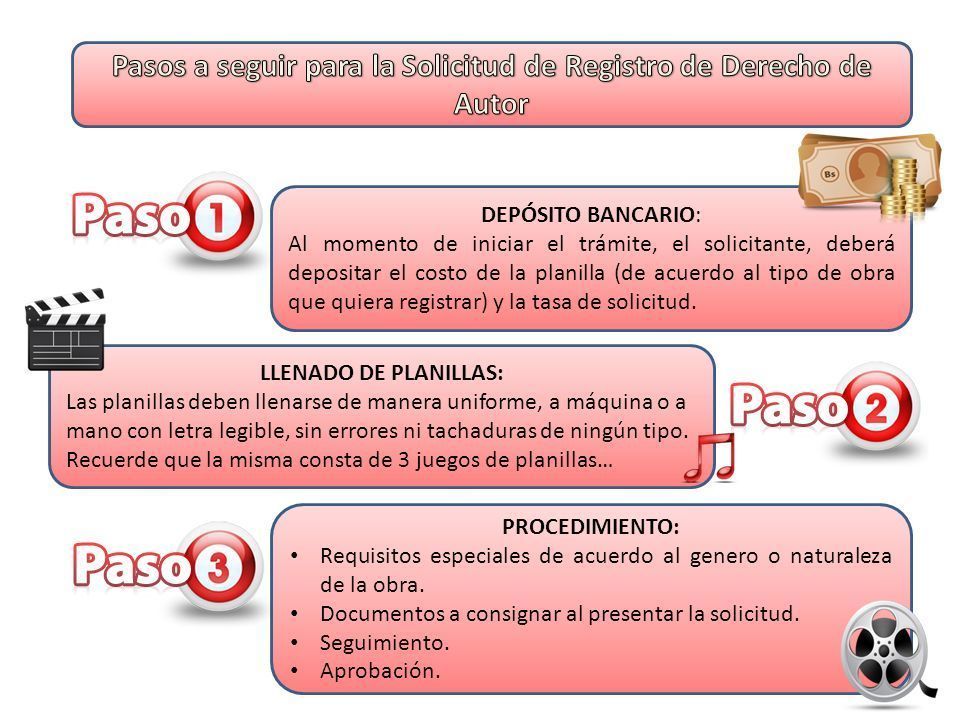
The National Copyright Directorate is an organism of the Colombian State, which has the legal structure of a Special Administrative Unit attached to the Ministry of Interior and Justice, is responsible for the administration of the National Registry of Copyright, which aims to register all kinds of works in the literary and artistic field, as well as the acts and contracts related to the subject; all in order to grant a title of publicity and legal certainty to the various holders in this special field of law.
- All types of literary and artistic works may be registered before the National Copyright Registry as determined by Article 3 of Law 44 of 1993, which states: "They may be registered in the National Copyright Register". (a) Literary, scientific and artistic works:
- The following works registration forms are available:
- Literary Works Registration Form.
- Requirements: Attach copy of the instance to be registered.
- Artistic Works Registration Form. (Scores, Architecture, Choreography, Sketch, Drawing, Dramatic, Sculpture, Photography, Engraving, Lithography, Maps, Painting, Pantomime, Plans, Applied Artworks, Others).
- Requirements: Attach a copy of the work to be recorded and a written description of the work.
- Music Work Registration Form.
- Requirements: Attach score and lyrics or only the score or melodic script.
- Logical Support or Software Registration Form.
- Attach the computer program, program description or auxiliary material.
- Audiovisual Work Registration Form.
- Requirements: Attach the audiovisual format to be registered.
- Literary Works Registration Form.
- The following works registration forms are available:
- The procedure is carried out before the National Copyright Directorate, Registration Office and is completely free of charge.
- All types of literary and artistic works may be registered before the National Copyright Registry as determined by Article 3 of Law 44 of 1993, which states: "They may be registered in the National Copyright Register". (a) Literary, scientific and artistic works:
Imágenes y archivos del mapa
Información
- Descripción
- Valoración y negociación tecnológica Mapa Mental sobre INTELLECTUAL PROPERTY: COPYRIGHTS, creado por Miguel Sánchez Gómez el 29/09/2019.
- Creado por
- Miguel Sánchez Gómez
- Visitas
- 0
- Valoración