
Mapa mental
ASSESSMENT AND TESTING
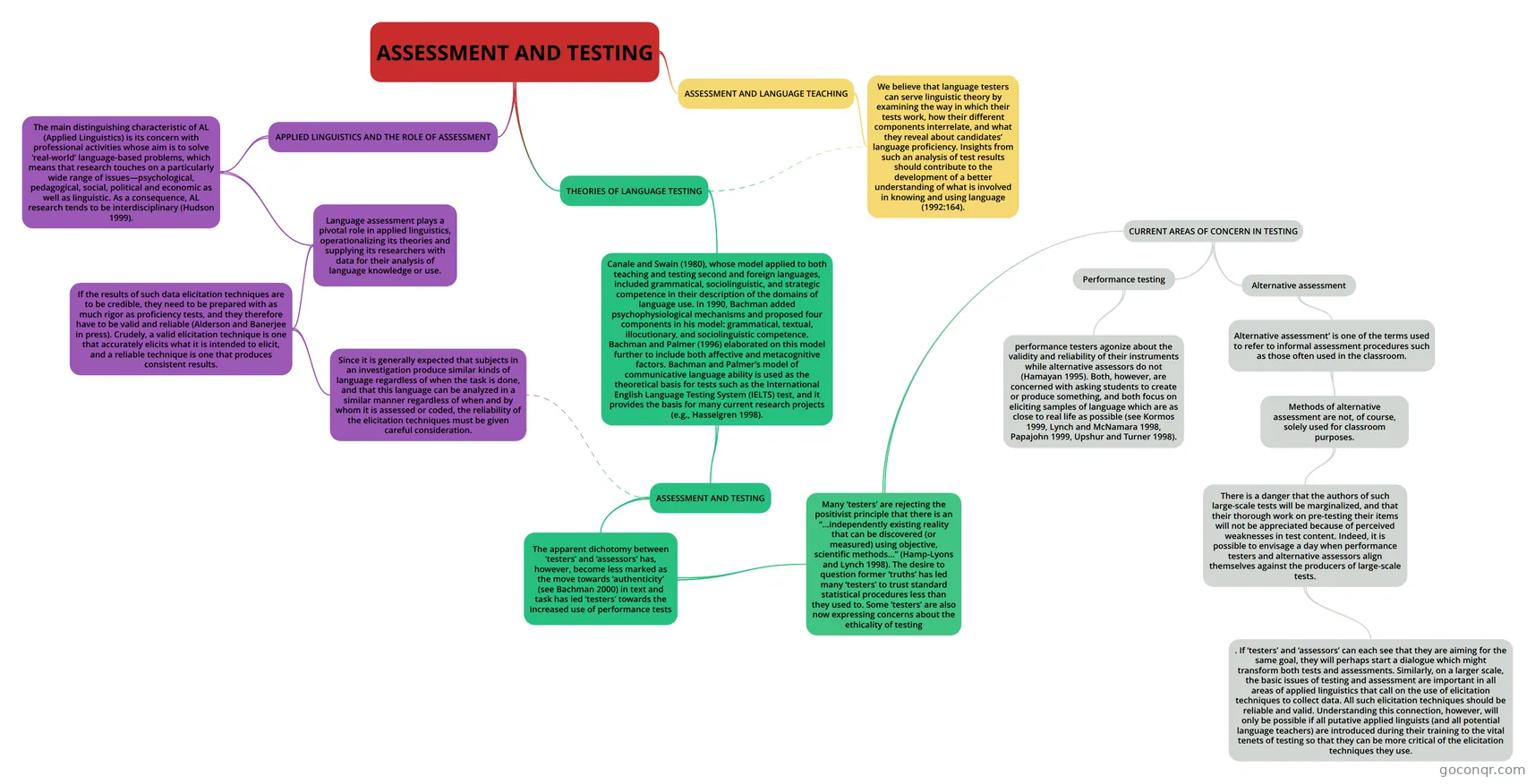
Mind map: Assessment and testing
Contenido del mapa
ASSESSMENT AND TESTING
APPLIED LINGUISTICS AND THE ROLE OF ASSESSMENT
- The main distinguishing characteristic of AL (Applied Linguistics) is its concern with professional activities whose aim is to solve ‘real-world’ language-based problems, which means that research touches on a particularly wide range of issues—psychological, pedagogical, social, political and economic as well as linguistic. As a consequence, AL research tends to be interdisciplinary (Hudson 1999).
- Language assessment plays a pivotal role in applied linguistics, operationalizing its theories and supplying its researchers with data for their analysis of language knowledge or use.
- If the results of such data elicitation techniques are to be credible, they need to be prepared with as much rigor as proficiency tests, and they therefore have to be valid and reliable (Alderson and Banerjee in press). Crudely, a valid elicitation technique is one that accurately elicits what it is intended to elicit, and a reliable technique is one that produces consistent results.
- Since it is generally expected that subjects in an investigation produce similar kinds of language regardless of when the task is done, and that this language can be analyzed in a similar manner regardless of when and by whom it is assessed or coded, the reliability of the elicitation techniques must be given careful consideration.
- If the results of such data elicitation techniques are to be credible, they need to be prepared with as much rigor as proficiency tests, and they therefore have to be valid and reliable (Alderson and Banerjee in press). Crudely, a valid elicitation technique is one that accurately elicits what it is intended to elicit, and a reliable technique is one that produces consistent results.
- Language assessment plays a pivotal role in applied linguistics, operationalizing its theories and supplying its researchers with data for their analysis of language knowledge or use.
- The main distinguishing characteristic of AL (Applied Linguistics) is its concern with professional activities whose aim is to solve ‘real-world’ language-based problems, which means that research touches on a particularly wide range of issues—psychological, pedagogical, social, political and economic as well as linguistic. As a consequence, AL research tends to be interdisciplinary (Hudson 1999).
ASSESSMENT AND LANGUAGE TEACHING
- We believe that language testers can serve linguistic theory by examining the way in which their tests work, how their different components interrelate, and what they reveal about candidates’ language proficiency. Insights from such an analysis of test results should contribute to the development of a better understanding of what is involved in knowing and using language (1992:164).
THEORIES OF LANGUAGE TESTING
- Canale and Swain (1980), whose model applied to both teaching and testing second and foreign languages, included grammatical, sociolinguistic, and strategic competence in their description of the domains of language use. In 1990, Bachman added psychophysiological mechanisms and proposed four components in his model: grammatical, textual, illocutionary, and sociolinguistic competence. Bachman and Palmer (1996) elaborated on this model further to include both affective and metacognitive factors. Bachman and Palmer’s model of communicative language ability is used as the theoretical basis for tests such as the International English Language Testing System (IELTS) test, and it provides the basis for many current research projects (e.g., Hasselgren 1998).
- ASSESSMENT AND TESTING
- The apparent dichotomy between ‘testers’ and ‘assessors’ has, however, become less marked as the move towards ‘authenticity’ (see Bachman 2000) in text and task has led ‘testers’ towards the increased use of performance tests
- Many ‘testers’ are rejecting the positivist principle that there is an “…independently existing reality that can be discovered (or measured) using objective, scientific methods…” (Hamp-Lyons and Lynch 1998). The desire to question former ‘truths’ has led many ‘testers’ to trust standard statistical procedures less than they used to. Some ‘testers’ are also now expressing concerns about the ethicality of testing
- CURRENT AREAS OF CONCERN IN TESTING
- Performance testing
- performance testers agonize about the validity and reliability of their instruments while alternative assessors do not (Hamayan 1995). Both, however, are concerned with asking students to create or produce something, and both focus on eliciting samples of language which are as close to real life as possible (see Kormos 1999, Lynch and McNamara 1998, Papajohn 1999, Upshur and Turner 1998).
- Alternative assessment
- Alternative assessment’ is one of the terms used to refer to informal assessment procedures such as those often used in the classroom.
- Methods of alternative assessment are not, of course, solely used for classroom purposes.
- There is a danger that the authors of such large-scale tests will be marginalized, and that their thorough work on pre-testing their items will not be appreciated because of perceived weaknesses in test content. Indeed, it is possible to envisage a day when performance testers and alternative assessors align themselves against the producers of large-scale tests.
- . If ‘testers’ and ‘assessors’ can each see that they are aiming for the same goal, they will perhaps start a dialogue which might transform both tests and assessments. Similarly, on a larger scale, the basic issues of testing and assessment are important in all areas of applied linguistics that call on the use of elicitation techniques to collect data. All such elicitation techniques should be reliable and valid. Understanding this connection, however, will only be possible if all putative applied linguists (and all potential language teachers) are introduced during their training to the vital tenets of testing so that they can be more critical of the elicitation techniques they use.
- There is a danger that the authors of such large-scale tests will be marginalized, and that their thorough work on pre-testing their items will not be appreciated because of perceived weaknesses in test content. Indeed, it is possible to envisage a day when performance testers and alternative assessors align themselves against the producers of large-scale tests.
- Methods of alternative assessment are not, of course, solely used for classroom purposes.
- Alternative assessment’ is one of the terms used to refer to informal assessment procedures such as those often used in the classroom.
- Performance testing
- CURRENT AREAS OF CONCERN IN TESTING
- Many ‘testers’ are rejecting the positivist principle that there is an “…independently existing reality that can be discovered (or measured) using objective, scientific methods…” (Hamp-Lyons and Lynch 1998). The desire to question former ‘truths’ has led many ‘testers’ to trust standard statistical procedures less than they used to. Some ‘testers’ are also now expressing concerns about the ethicality of testing
- The apparent dichotomy between ‘testers’ and ‘assessors’ has, however, become less marked as the move towards ‘authenticity’ (see Bachman 2000) in text and task has led ‘testers’ towards the increased use of performance tests
- ASSESSMENT AND TESTING
- Canale and Swain (1980), whose model applied to both teaching and testing second and foreign languages, included grammatical, sociolinguistic, and strategic competence in their description of the domains of language use. In 1990, Bachman added psychophysiological mechanisms and proposed four components in his model: grammatical, textual, illocutionary, and sociolinguistic competence. Bachman and Palmer (1996) elaborated on this model further to include both affective and metacognitive factors. Bachman and Palmer’s model of communicative language ability is used as the theoretical basis for tests such as the International English Language Testing System (IELTS) test, and it provides the basis for many current research projects (e.g., Hasselgren 1998).
Información
- Descripción
- Mapa Mental sobre ASSESSMENT AND TESTING, creado por Jaime M el 04/10/2019.
- Creado por
- Jaime M
- Visitas
- 2
- Valoración