
Mapa mental
MODAL VERBS
Contenido del mapa
MODAL VERBS
They are verbs to express different functions as obligation, ability, advice, opinion, prohibition
- features
- Always going to appear in its form simple
- They can be used as auxiliary verbs
- They do not conjugate. I dont know add "es" or an "s" in the third person of the singular
- Cómo se pronuncia They will be accompanied by an infinitive in a sentence affirmative
- features
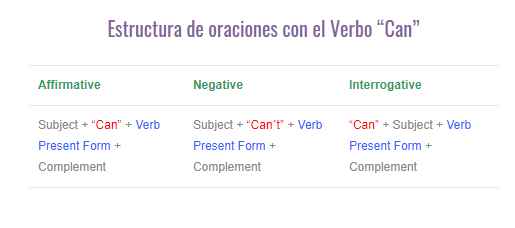
can
- Can is a modal verb that expresses ability.
- example
- affirmative
- I can drive your car.
- negative
- I can´t drive your car
- Interrogative
- Can I drive your car?
- affirmative
- example
- Can is a modal verb that expresses ability.
rules
- When we make negative sentences, we must add the negation particle "not" to the modal verb. we will continue adding the base form of the infinitive verb that is, its form nowadays
- when it comes to asking questions, we must use the modal verb at the beginning of the question
- We should point out, that "-s" is not added to the verb when referring to third parties people, as long as this is preceded by the verb
Could
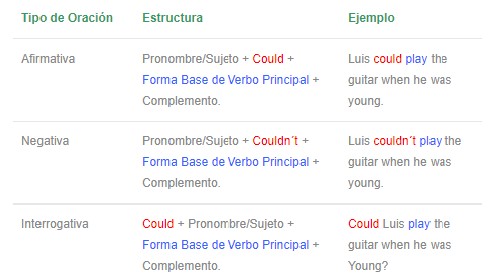
- Could indicates possibility or ability in the past.
- Use of the verb "Could"
- example
- affirmative
- He could not lend us the money which we need
- negative
- She could not take the children with her to Houston
- interrogative
- Could you lend me your pen?
- affirmative
- Could indicates possibility or ability in the past.
May
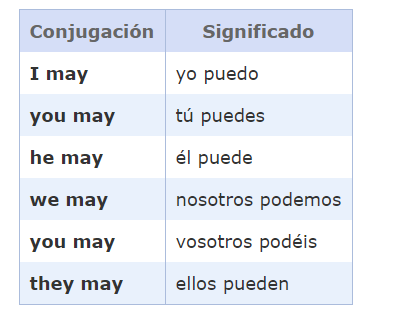
- May indicates permission and possibility
- The conjugation of may is very special can only be combined in 3 verb tenses: the present simple, past simple English and the conditional.
- Present Simple
- Conditional
- Past Simple
- example
- affirmative
- She may take the children with her to Houston
- nagative
- She may not take the children with her to Houston.
- interrogative
- May she be back by noon?
- affirmative
- The conjugation of may is very special can only be combined in 3 verb tenses: the present simple, past simple English and the conditional.
- May indicates permission and possibility
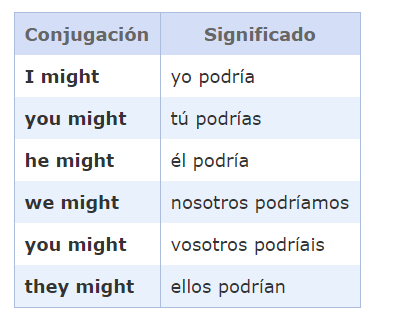
Might
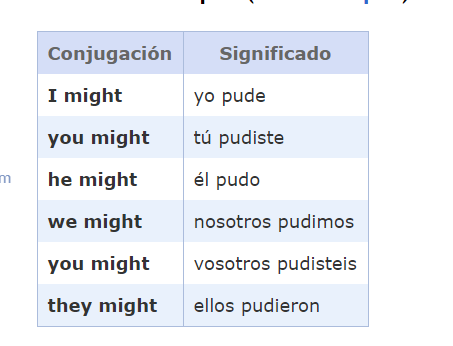
- Might expresses remote possibility.
- For the formation of an affirmative sentence with the modal verb might not need any auxiliary or conjugation:
- example
- affirmative
- She might travel to Houston.
- negative
- She might not travel to Houston.
- interrogative
- Might he feel better later?
- affirmative
- example
- For the formation of an affirmative sentence with the modal verb might not need any auxiliary or conjugation:
- Might expresses remote possibility.
Should
- Should express moral obligation and sometimes advice.
- They are the same for all people and are always followed by an infinitive (without ‘to’). In addition, they do not need auxiliary to form the negative and the interrogative
- affirmative
- You should find another job.
- negative
- He shouldn't talk while he is eating.
- interrogative
- Should I open the window?
- affirmative
- They are the same for all people and are always followed by an infinitive (without ‘to’). In addition, they do not need auxiliary to form the negative and the interrogative
- Should express moral obligation and sometimes advice.
Must
- It must also be a modal verb. Indicates an obligation, prohibition or need. In some cases it may indicate probabilitie
- ust is a modal verb that is translated as "duty" and is used in affirmative and negative. As a modal verb, it will follow the rules of all
- affirmative
- She must return later.
- interrogative
- Must she be back by noon?
- negative
- We mustn't stay here at least an hour
- affirmative
- ust is a modal verb that is translated as "duty" and is used in affirmative and negative. As a modal verb, it will follow the rules of all
- It must also be a modal verb. Indicates an obligation, prohibition or need. In some cases it may indicate probabilitie
Would
- It would be used to declare a preference and to ask for something very formally.
- affirmative
- We would rather come to school by bus than walk
- interrogative
- Would anybody be kind enough to shut the door?
- negative
- They wouldn´t have accepted the gift if they had been told about this affair
- affirmative
- It would be used to declare a preference and to ask for something very formally.
Imágenes y archivos del mapa
Información
- Descripción
- Mapa Mental sobre MODAL VERBS, creado por laura galeano el 04/10/2019.
- Creado por
- laura galeano
- Visitas
- 171
- Valoración