
Mapa mental
DATA ANALYTICS
Contenido del mapa
DATA ANALYTICS
The main aim is to extract useful information from rough data and transfer it to effective knowledge to improve product and process understanding and to support decisions
·
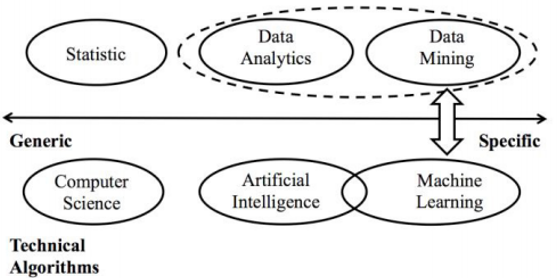
- DATA MINING: construct numerical algorithms that investigate datasets to extract hidden patterns and regularities, the ones that reveal strong structures can be used to predict future outcomes.
- MACHINE LEARNING: represents the technology instruments of data mining. ML is a subfield of computer science that evolved from the study of pattern recognition and computational learning theory in artificial intelligence.
- According to ISO (International Organization for Standarization) and IEC (International Electrotechnical Commision) the meaning of MACHINE LEARNING is "automatic learning, process by which a functional unit improves its performance by acquiring new knowledge or skills, or by reorganizing existing knowledge or skills".
- 1) Supervised learning 2) Unsupervised learning
- TECHNIQUES (currently used in manufacturing)
- SUPERVISED LEARNING.
- 1. Linear Methods for Regression 2. Linear Method for Classification 3. Decision Tree Based Method and 4. Neural Networks
- UNSUPERVISED LEARNING.
- 1. Principal Component Analysis, 2. Association Rules, 3. Cluster Analysis, 4. Self-Organizing Maps (SOM)
- SUPERVISED LEARNING.
- DATA ANALYTICS: is composed of initial standard statistical techniques, such as visualization of data, selections of attributes, discarding outliers, in order to construct the initial example set, then, machine learning algorithms construct rules and statistical tests are used to validate them.
- ARTIFICIAL INTELLIGENCE: ISO and IEC defined AI as the "branch of computer science devoted to developing data processing systems that perform functions normally associated with human intelligence, such as reasoning, learning and self-improvement".
- BIG DATA: refer to a type of datasets, in which variables are different in type and nature, for this reason, they compel to be analysed with a number of specific techniques, models and algorithms, that belong to the data analytics, data mining and machine learning, in this way being directly linked with the main concepts.
- In 2012, Beyer and Laney proposed a quite cited definition of BIG DATA, known as the "3-V's" definition, which introduces the framework of the 3-dimensional increase in data: VOLUME, VELOCITY, VARIETY.
Imágenes y archivos del mapa
Información
- Descripción
- Mapa Mental sobre DATA ANALYTICS, creado por Regina Flores el 04/02/2020.
- Creado por
- Regina Flores
- Visitas
- 0
- Valoración