
Mapa mental
Thermochemistry
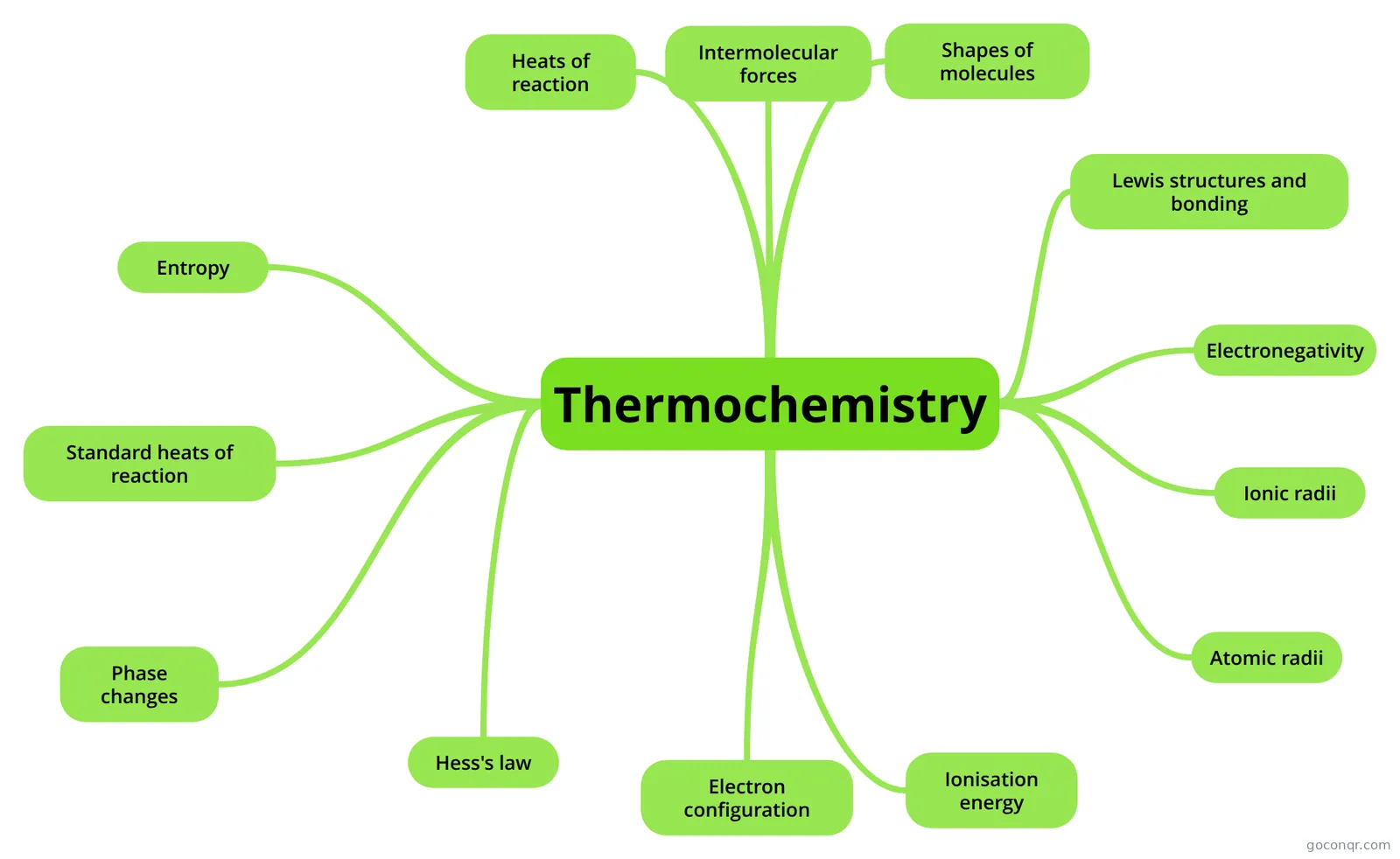
Mind map: Thermochemistry
Contenido del mapa
Thermochemistry
Electron configuration
- An electron configuration is the arrangement of electrons within an atom or ion. Use s, p, and d notations.
Ionisation energy
- The amount of energy (in joules needed to remove an electron from each of one mole of atoms or ions in the gaseous state.
Atomic radii
- The size of an atom of an element decreases with increasing atomic number of an element across a period of the periodic table. The size of an atom of an element increases with increasing atomic number of an element down a group of the periodic table.
Ionic radii
- Positive ions are always smaller then their parent atoms. Negative ions are always larger than their parent atoms.
Electronegativity
- Is the measure of the relative tendency of an atom to attract a pair of bonding electrons. This can be used to predict the degree of polarity or ionic character of chemical bonds.
Lewis structures and bonding
- A Lewis structure is a representation of either an individual or bonded atom, that shows all the electrons in the outer energy level.
Shapes of molecules
- The shape of a molecule or covalently bonded ion is determined by the number of regions of negative charge there are around an atom. See page 33 of Year 13 chemistry book by Graeme Abbot and Bev Cooper
Intermolecular forces
- There are three types of intermolecular forces of varying strength. Temporary Dipole Forces (Van Der Waals' Forces) which is the weakest, Permanent Dipole-Permanent Dipole Forces, and Hydrogen Bonding which is the strongest.
Heats of reaction
- Exothermic reactions give out heat and form new bonds. Endothermic reactions absorb heat and break bonds.
Entropy
- The measure of disorder in a system or a chemical reaction.
Standard heats of reaction
- Standard enthalpy (heat) of reaction. Standard enthalpy of combustion is the enthalpy change when 1 mole of a substance is burnt completely with all reactants and products in their standard states. Standard enthalpy of formation is the enthalpy change when 1 mole of a substance is formed from its elements with all reactants and products in their standard states.
Phase changes
- Melting point is the temperature at which a solid changes to a liquid. Boiling point is the temperature at which a liquid changes to a gas.
Hess's law
- He said "The energy change in converting reactants A and B, to products X and , is the same, regardless of the route by which the chemical change occurs, provided the initial and final conditions are the same.
Información
- Descripción
- NCEA Level 3 Chemistry Mapa Mental sobre Thermochemistry, creado por japaneseguy48 el 13/09/2013.
- Creado por
- japaneseguy48
- Visitas
- 462
- Etiquetas
- Valoración