
Mapa mental
Aversive vs Appetitive Conditioning
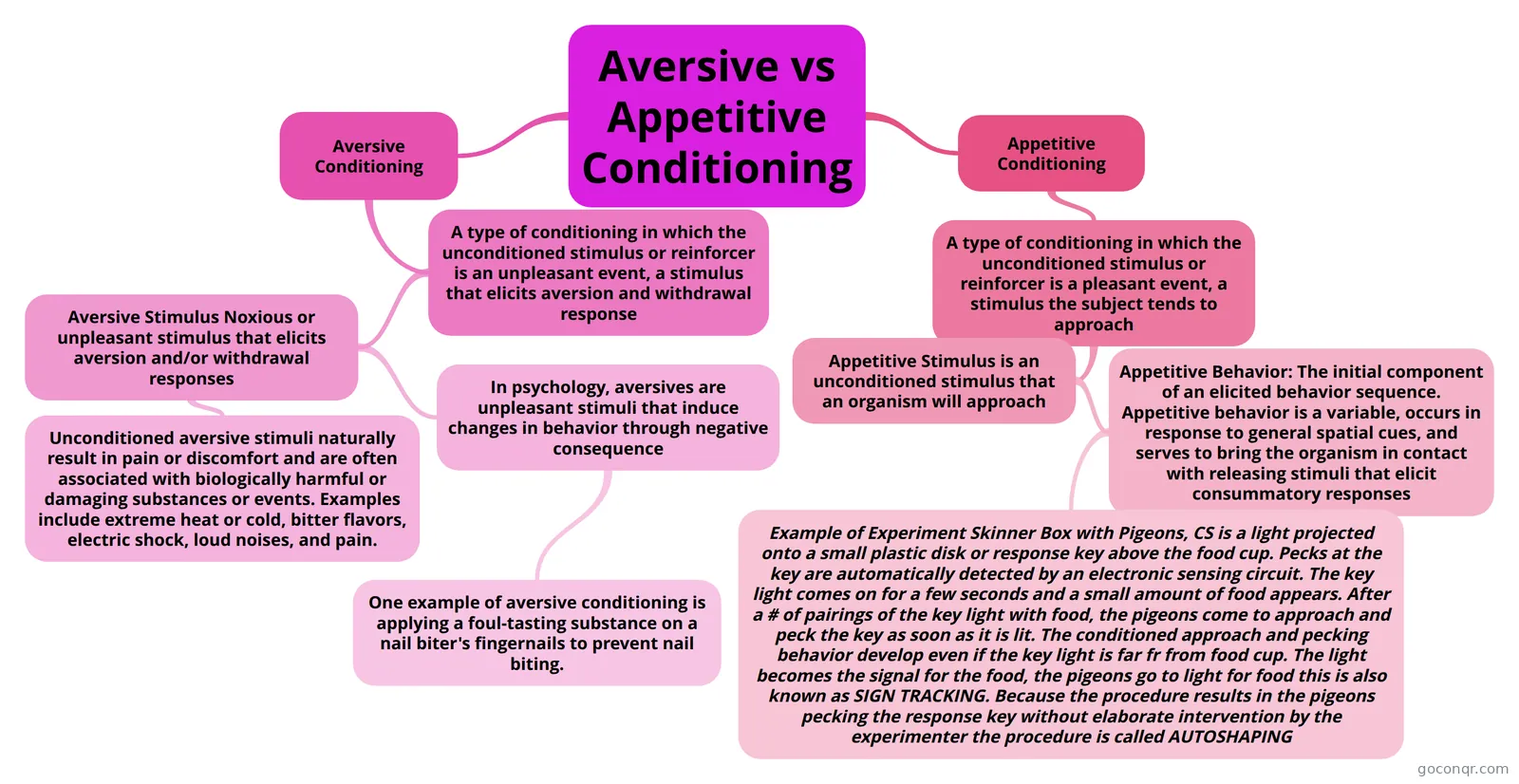
Mind map: Aversive vs Appetitive Conditioning
Contenido del mapa
Aversive vs Appetitive Conditioning
Aversive Conditioning
- A type of conditioning in which the unconditioned stimulus or reinforcer is an unpleasant event, a stimulus that elicits aversion and withdrawal response
- Aversive Stimulus Noxious or unpleasant stimulus that elicits aversion and/or withdrawal responses
- In psychology, aversives are unpleasant stimuli that induce changes in behavior through negative consequence
- One example of aversive conditioning is applying a foul-tasting substance on a nail biter's fingernails to prevent nail biting.
- Unconditioned aversive stimuli naturally result in pain or discomfort and are often associated with biologically harmful or damaging substances or events. Examples include extreme heat or cold, bitter flavors, electric shock, loud noises, and pain.
- In psychology, aversives are unpleasant stimuli that induce changes in behavior through negative consequence
- Aversive Stimulus Noxious or unpleasant stimulus that elicits aversion and/or withdrawal responses
- A type of conditioning in which the unconditioned stimulus or reinforcer is an unpleasant event, a stimulus that elicits aversion and withdrawal response
Appetitive Conditioning
- A type of conditioning in which the unconditioned stimulus or reinforcer is a pleasant event, a stimulus the subject tends to approach
- Appetitive Stimulus is an unconditioned stimulus that an organism will approach
- Appetitive Behavior: The initial component of an elicited behavior sequence. Appetitive behavior is a variable, occurs in response to general spatial cues, and serves to bring the organism in contact with releasing stimuli that elicit consummatory responses
- Example of Experiment Skinner Box with Pigeons, CS is a light projected onto a small plastic disk or response key above the food cup. Pecks at the key are automatically detected by an electronic sensing circuit. The key light comes on for a few seconds and a small amount of food appears. After a # of pairings of the key light with food, the pigeons come to approach and peck the key as soon as it is lit. The conditioned approach and pecking behavior develop even if the key light is far fr from food cup. The light becomes the signal for the food, the pigeons go to light for food this is also known as SIGN TRACKING. Because the procedure results in the pigeons pecking the response key without elaborate intervention by the experimenter the procedure is called AUTOSHAPING
- Appetitive Behavior: The initial component of an elicited behavior sequence. Appetitive behavior is a variable, occurs in response to general spatial cues, and serves to bring the organism in contact with releasing stimuli that elicit consummatory responses
- Appetitive Stimulus is an unconditioned stimulus that an organism will approach
- A type of conditioning in which the unconditioned stimulus or reinforcer is a pleasant event, a stimulus the subject tends to approach
Información
- Descripción
- undergraduate (Aversive vs Appetitive Conditioning) Learning & Cognition PSY 318 Mapa Mental sobre Aversive vs Appetitive Conditioning, creado por kellyjeanbean el 14/09/2013.
- Creado por
- kellyjeanbean
- Visitas
- 5.830
- Etiquetas
- Valoración