
Mapa mental
Unit 50. THE VICTORIAN NOVEL
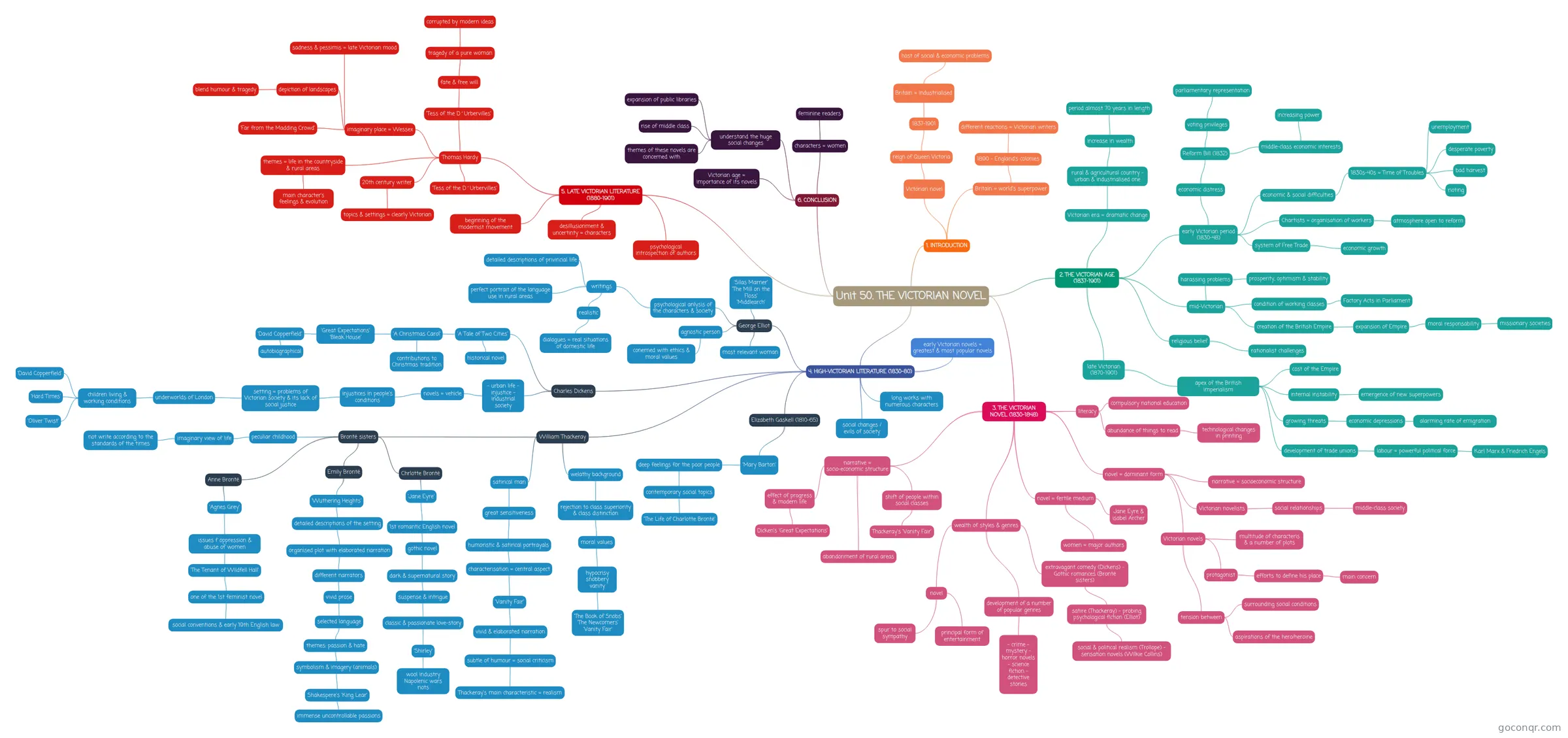
Mind map: The Victorian Novel
Contenido del mapa
Unit 50. THE VICTORIAN NOVEL
1. INTRODUCTION
- Victorian novel
- reign of Queen Victoria
- 1837-1901
- Britain = industrialised
- host of social & economic problems
- Britain = industrialised
- 1837-1901
- reign of Queen Victoria
- Britain = world's superpower
- 1890 - England's colonies
- different reactions = Victorian writers
- 1890 - England's colonies
- Victorian novel
2. THE VICTORIAN AGE (1837-1901)
- Victorian era = dramatic change
- rural & agricultural country - urban & industrialised one
- increase in wealth
- period almost 70 years in length
- increase in wealth
- rural & agricultural country - urban & industrialised one
- early Victorian period (1830-48)
- economic distress
- Reform Bill (1832)
- voting privileges
- parliamentary representation
- middle-class economic interests
- increasing power
- voting privileges
- Reform Bill (1832)
- economic & social difficulties
- 1830s-40s = Time of Troubles
- unemployment
- desperate poverty
- bad harvest
- rioting
- 1830s-40s = Time of Troubles
- Chartists = organisation of workers
- atmosphere open to reform
- system of Free Trade
- economic growth
- economic distress
- mid-Victorian
- harassing problems
- prosperity, optimism & stability
- condition of working classes
- Factory Acts in Parliament
- creation of the British Empire
- expansion of Empire
- moral responsability
- missionary societies
- moral responsability
- expansion of Empire
- harassing problems
- religious belief
- rationalist challenges
- late Victorian (1870-1901)
- apex of the British imperialism
- cost of the Empire
- internal instability
- emergence of new superpowers
- growing threats
- economic depressions
- alarming rate of emigration
- economic depressions
- development of trade unions
- labour = powerful political force
- Karl Marx & Friedrich Engels
- labour = powerful political force
- apex of the British imperialism
- Victorian era = dramatic change
3. THE VICTORIAN NOVEL (1830-1848)
- literacy
- compulsory national education
- abundance of things to read
- technological changes in printing
- novel = dominant form
- narrative = socioeconomic structure
- Victorian novelists
- social relationships
- middle-class society
- social relationships
- Victorian novels
- multitude of characteris & a number of plots
- protagonist
- efforts to define his place
- main concern
- efforts to define his place
- tension between
- surrounding social conditions
- aspirations of the hero/heroine
- novel = fertile medium
- Jane Eyre & isabel Archer
- women = major authors
- wealth of styles & genres
- extravagant comedy (Dickens) - Gothic romances (Brontë sisters)
- satire (Thackeray) - probing psychological fiction (Elliot)
- social & political realism (Trollope) - sensation novels (Wilkie Collins)
- satire (Thackeray) - probing psychological fiction (Elliot)
- development of a number of popular genres
- - crime - mystery - horror novels - science fiction - detective stories
- novel
- principal form of entertainment
- spur to social sympathy
- extravagant comedy (Dickens) - Gothic romances (Brontë sisters)
- narrative = socio-economic structure
- shift of people within social classes
- Thackeray's 'Vanity Fair'
- abandonment of rural areas
- effect of progress & modern life
- Dicken's 'Great Expectations'
- shift of people within social classes
- literacy
4. HIGH-VICTORIAN LITERATURE (1830-80)
- early Victorian novels = greatest & most popular novels
- long works with numerous characters
- social changes / evils of society
- Elizabeth Gaskell (1810-65)
- 'Mary Barton'
- deep feelings for the poor people
- contemporary social topics
- 'The Life of Charlotte Brontë'
- contemporary social topics
- deep feelings for the poor people
- 'Mary Barton'
- William Thackeray
- welathy background
- rejection to class superiority & class distinction
- moral values
- hypocrisy snobbery vanity
- 'The Book of Snobs' 'The Newcomers' 'Vanity Fair'
- hypocrisy snobbery vanity
- moral values
- rejection to class superiority & class distinction
- satirical man
- great sensitiveness
- humoristic & satirical portrayals
- characterisation = central aspect
- 'Vanity Fair'
- vivid & elaborated narration
- subtle of humour = social criticism
- Thackeray's main characteristic = realism
- subtle of humour = social criticism
- vivid & elaborated narration
- 'Vanity Fair'
- characterisation = central aspect
- humoristic & satirical portrayals
- great sensitiveness
- Brontë sisters
- peculiar childhood
- imaginary view of life
- not write according to the standards of the times
- imaginary view of life
- Chrlotte Brontë
- 'Jane Eyre'
- 1st romantic English novel
- gothic novel
- dark & supernatural story
- suspense & intrigue
- classic & passionate love-story
- 'Shirley'
- wool industry Napolenic wars riots
- 'Shirley'
- classic & passionate love-story
- suspense & intrigue
- dark & supernatural story
- gothic novel
- 1st romantic English novel
- 'Jane Eyre'
- Emily Brontë
- 'Wuthering Heights'
- detailed descriptions of the setting
- organised plot with elaborated narration
- different narrators
- vivid prose
- selected language
- themes: passion & hate
- symbolism & imagery (animals)
- Shakespere's 'King Lear'
- immense uncontrollable passions
- Shakespere's 'King Lear'
- symbolism & imagery (animals)
- themes: passion & hate
- selected language
- vivid prose
- different narrators
- organised plot with elaborated narration
- detailed descriptions of the setting
- 'Wuthering Heights'
- Anne Brontë
- 'Agnes Grey'
- issues f oppression & abuse of women
- 'The Tenant of Wildfell Hall'
- one of the 1st feminist novel
- social conventions & early 19th English law
- one of the 1st feminist novel
- 'The Tenant of Wildfell Hall'
- issues f oppression & abuse of women
- 'Agnes Grey'
- peculiar childhood
- welathy background
- Charles Dickens
- - urban life - injustice - industrial society
- novels = vehicle
- injustices in people's conditions
- setting = problems of Victorian society & its lack of social justice
- underworlds of London
- children living & working conditions
- 'David Copperfield'
- 'Hard Times'
- 'Oliver Twist'
- children living & working conditions
- underworlds of London
- setting = problems of Victorian society & its lack of social justice
- injustices in people's conditions
- novels = vehicle
- 'A Tale of Two Cities'
- historical novel
- 'A Christmas Carol'
- contributions to Christmas tradition
- 'Great Expectations' 'Bleak House'
- 'David Copperfield'
- autobiographical
- 'David Copperfield'
- - urban life - injustice - industrial society
- George Elliot
- most relevant woman
- agnostic person
- conerned with ethics & moral values
- psychological anlysis of the characters & society
- writings
- detailed descriptions of privincial life
- perfect portrait of the language use in rural areas
- realistic
- dialogues = real situations of domestic life
- writings
- 'Silas Marner' 'The Mill on the Floss' 'Middlearch'
5. LATE VICTORIAN LITERATURE (1880-1901)
- psychological introspection of authors
- desillusionment & uncertinty = characters
- beginning of the modernist movement
- Thomas Hardy
- 'Tess of the D´Urbervilles'
- 20th century writer
- topics & settings = clearly Victorian
- themes = life in the countryside & rural areas
- main character's feelings & evolution
- imaginary place = Wessex
- 'Far from the Madding Crowd'
- depiction of landscapes
- blend humour & tragedy
- sadness & pessimis = late Victorian mood
- 'Tess of the D´Urbervilles'
- fate & free will
- tragedy of a pure woman
- corrupted by modern ideas
- tragedy of a pure woman
- fate & free will
6. CONCLUSION
- Victorian age = importance of its novels
- understand the huge social changes
- expansion of public libraries
- rise of middle class
- themes of these novels are concerned with
- characters = women
- feminine readers
Información
- Descripción
- Mapa Mental sobre Unit 50. THE VICTORIAN NOVEL, creado por Natalia García Díaz el 22/03/2020.
- Creado por
- Natalia García Díaz
- Visitas
- 2
- Valoración