
Mapa mental
Chemistry Mind Map
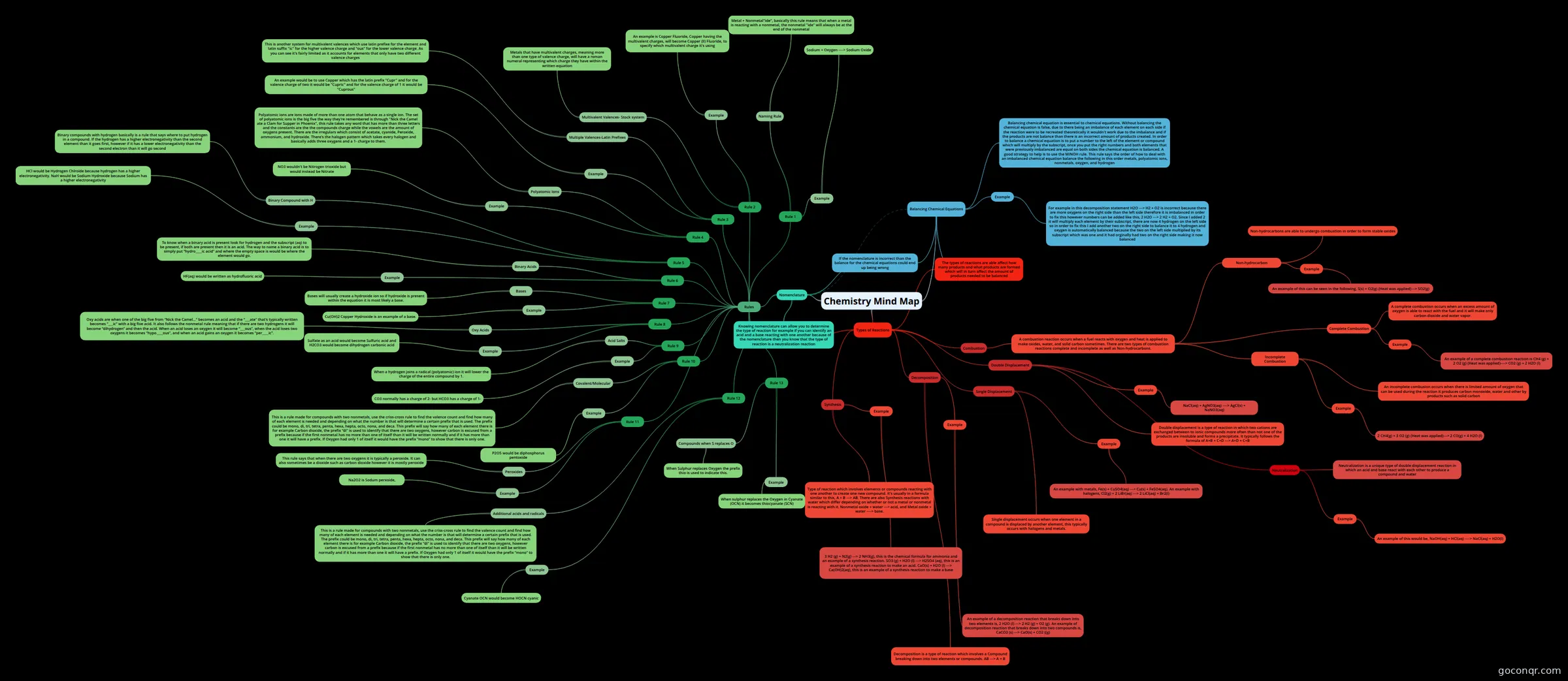
Mind map: Chemistry mind map
Contenido del mapa
Chemistry Mind Map
Balancing Chemical Equations
- If the nomenclature is incorrect than the balance for the chemical equations could end up being wrong
- Balancing chemical equation is essential to chemical equations. Without balancing the chemical equation is false, due to there being an imbalance of each element on each side if the reaction were to be recreated theoretically it wouldn't work due to the imbalance and if the products are not balance than there is an incorrect amount of products created. In order to balance a chemical equation is to put a number to the left of the element or compound which will multiply by the subscript, once you put the right numbers and both elements that were previously imbalanced are equal on both sides the chemical equation is balanced. A good strategy to help is to use the MINOH rule. This rule says the order of how to deal with an imbalanced chemical equation balance the following in this order metals, polyatomic ions, nonmetals, oxygen, and hydrogen
- Example
- For example in this decomposition statement H2O ---> H2 + O2 is incorrect because there are more oxygens on the right side than the left side therefore it is imbalanced in order to fix this however numbers can be added like this, 2 H2O ---> 2 H2 + O2. Since I added 2 it will multiply each element by their subscript, there are now 4 hydrogen on the left side so in order to fix this I add another two on the right side to balance it to 4 hydrogen and oxygen is automatically balanced because the two on the left side multiplied by its subscript which was one and it had orginally had two on the right side making it now balanced
Types of Reactions
- Synthesis
- Type of reaction which involves elements or compounds reacting with one another to create one new compound. It's usually in a formula similar to this, A + B ---> AB. There are also Synthesis reactions with water which differ depending on whether or not a metal or nonmetal is reacting with it. Nonmetal oxide + water ---> acid, and Metal oxide + water ----> base.
- Example
- 3 H2 (g) + N2(g) ---> 2 NH3(g), this is the chemical formula for ammonia and an example of a synthesis reaction. SO3 (g) + H2O (l) ---> H2SO4 (aq), this is an example of a synthesis reaction to make an acid. CaO(s) + H2O (l) ---> Ca(OH)2(aq), this is an example of a synthesis reaction to make a base
- Decomposition
- Decomposition is a type of reaction which involves a Compound breaking down into two elements or compounds. AB ---> A + B
- Example
- An example of a decomposition reaction that breaks down into two elements is, 2 H2O (l) ---> 2 H2 (g) + O2 (g). An example of decomposition reaction that breaks down into two compounds is, CaCO3 (s) ---> CaO(s) + CO2 ((g)
- Single Displacement
- Single displacement occurs when one element in a compound is displaced by another element, this typically occurs with halogens and metals.
- Example
- An example with metals, Fe(s) + CuSO4(aq) ---> Cu(s) + FeSO4(aq). An example with halogens, Cl2(g) + 2 LiBr(aq) ---> 2 LiCl(aq) + Br2(l)
- Double Displacement
- Double displacement is a type of reaction in which two cations are exchanged between to ionic compounds more often than not one of the products are insoluble and forms a precipitate. It typically follows the formula of A+B + C+D ---> A+D + C+B
- Example
- NaCl(aq) + AgNO3(aq) ----> AgCl(s) + NaNO3(aq)
- Neutralization
- Neutralization is a unique type of double displacement reaction in which an acid and base react with each other to produce a compound and water
- Example
- An example of this would be, NaOH(aq) + HCl(aq) ----> NaCl(aq) + H2O(l)
- Combustion
- A combustion reaction occurs when a fuel reacts with oxygen and heat is applied to make oxides, water, and solid carbon sometimes. There are two types of combustion reactions complete and incomplete as well as Non-hydrocarbons.
- Complete Combustion
- A complete combustion occurs when an excess amount of oxygen is able to react with the fuel and it will make only carbon dioxide and water vapor.
- Example
- An example of a complete combustion reaction is CH4 (g) + 2 O2 (g) (Heat was applied)----> CO2 (g) + 2 H2O (l)
- Incomplete Combustion
- An incomplete combusion occurs when there is limited amount of oxygen that can be used during the reaction it produces carbon monoxide, water and other by products such as solid carbon
- Example
- 2 CH4(g) + 3 O2 (g) (Heat was applied)---> 2 CO(g) + 4 H2O (l)
- Non-hydrocarbon
- Non-hydrocarbons are able to undergo combustion in order to form stable oxides
- Example
- An example of this can be seen in the following, S(s) + O2(g) (Heat was applied)---> SO2(g)
- Complete Combustion
- A combustion reaction occurs when a fuel reacts with oxygen and heat is applied to make oxides, water, and solid carbon sometimes. There are two types of combustion reactions complete and incomplete as well as Non-hydrocarbons.
- The types of reactions are able affect how many products and what products are formed which will in turn affect the amount of products needed to be balanced
- Synthesis
Nomenclature
- Rules
- Rule 2
- Multivalent Valences- Stock system
- Metals that have multivalent charges, meaning more than one type of valence charge, will have a roman numeral representing which charge they have within the written equation
- Example
- An example is Copper Fluoride, Copper having the multivalent charges, will become Copper (ll) Fluoride, to specify which multivalent charge it's using
- Multivalent Valences- Stock system
- Rule 3
- Example
- An example would be to use Copper which has the latin prefix "Cupr" and for the valence charge of two it would be "Cupric" and for the valence charge of 1 it would be "Cuprous"
- Multiple Valences-Latin Prefixes
- This is another system for multivalent valences which use latin prefixe for the element and latin suffix "ic" for the higher valence charge and "ous" for the lower valence charge. As you can see it's fairly limited as it accounts for elements that only have two different valence charges
- Example
- Rule 4
- Example
- NO3 wouldn't be Nitrogen trioxide but would instead be Nitrate
- Polyatomic Ions
- Polyatomic ions are ions made of more than one atom that behave as a single ion. The set of polyatomic ions is the big five the way they're remembered is through "Nick the Camel ate a Clam for Supper in Phoenix", this rule takes any word that has more than three letters and the constants are the the compounds charge while the vowels are the amount of oxygens present. There are the irregulars which consist of acetate, cyanide, Peroxide, ammonium, and hydroxide. There's the halogen pattern which takes every halogen and basically adds three oxygens and a 1- charge to them.
- Example
- Rule 5
- Example
- HCl would be Hydrogen Chlroide because hydrogen has a higher electronegativity. NaH would be Sodium Hydroxide because Sodium has a higher electronegativity
- Binary Compound with H
- Binary compounds with hydrogen basically is a rule that says where to put hydrogen in a compound. If the hydrogen has a higher electronegativity than the second element than it goes first, however if it has a lower electronegativity than the second electron than it will go second
- Example
- Rule 6
- Example
- HF(aq) would be written as hydrofluoric acid
- Binary Acids
- To know when a binary acid is present look for hydrogen and the subscript (aq) to be present, if both are present then it is an acid. The way to name a binary acid is to simply put “hydro____ic acid” and where the empty space is would be where the element would go.
- Example
- Rule 7
- Bases
- Bases will usually create a hydroxide ion so if hydroxide is present within the equation it is most likely a base.
- Example
- Cu(OH)2 Copper Hydroxide is an example of a base.
- Bases
- Rule 8
- Oxy Acids
- Oxy acids are when one of the big five from “Nick the Camel…” becomes an acid and the “___ate” that's typically written becomes “___ic” with a big five acid. It also follows the nonmetal rule meaning that if there are two hydrogens it will become “dihydrogen” and then the acid. When an acid loses an oxygen it will become “___ous”, when the acid loses two oxygens it becomes “hypo____ous”, and when an acid gains an oxygen it becomes “per____ic”.
- Example
- Sulfate as an acid would become Sulfuric acid and H2CO3 would become dihydrogen carbonic acid
- Oxy Acids
- Rule 9
- Acid Salts
- When a hydrogen joins a radical (polyatomic) ion it will lower the charge of the entire compound by 1.
- Example
- CO3 normally has a charge of 2- but HCO3 has a charge of 1-
- Acid Salts
- Rule 10
- Covalent/Molecular
- This is a rule made for compounds with two nonmetals, use the criss-cross rule to find the valence count and find how many of each element is needed and depending on what the number is that will determine a certain prefix that is used. The prefix could be mono, di, tri, tetra, penta, hexa, hepta, octo, nona, and deca. This prefix will say how many of each element there is for example Carbon dioxide, the prefix “di” is used to identify that there are two oxygens, however carbon is excused from a prefix because if the first nonmetal has no more than one of itself than it will be written normally and if it has more than one it will have a prefix. If Oxygen had only 1 of itself it would have the prefix “mono” to show that there is only one.
- Example
- P2O5 would be diphosphorus pentoxide
- Covalent/Molecular
- Rule 11
- Peroxides
- This rule says that when there are two oxygens it is typically a peroxide. It can also sometimes be a dioxide such as carbon dioxide however it is mostly peroxide
- Example
- Na2O2 is Sodum perxoide,
- Peroxides
- Rule 12
- Additional acids and radicals
- This is a rule made for compounds with two nonmetals, use the criss-cross rule to find the valence count and find how many of each element is needed and depending on what the number is that will determine a certain prefix that is used. The prefix could be mono, di, tri, tetra, penta, hexa, hepta, octo, nona, and deca. This prefix will say how many of each element there is for example Carbon dioxide, the prefix “di” is used to identify that there are two oxygens, however carbon is excused from a prefix because if the first nonmetal has no more than one of itself than it will be written normally and if it has more than one it will have a prefix. If Oxygen had only 1 of itself it would have the prefix “mono” to show that there is only one.
- Example
- Cyanate OCN would become HOCN cyanic
- Additional acids and radicals
- Rule 13
- Compounds when S replaces O
- When Sulphur replaces Oxygen the prefix thio is used to indicate this.
- Example
- When sulphur replaces the Oxygen in Cyanate (OCN) it becomes thiocyanate (SCN)
- Compounds when S replaces O
- Rule 1
- Naming Rule
- Metal + Nonmetal"ide", basically this rule means that when a metal is reacting with a nonmetal, the nonmetal "ide" will always be at the end of the nonmetal
- Example
- Sodium + Oxygen ----> Sodium Oxide
- Naming Rule
- Rule 2
- Knowing nomenclature can allow you to determine the type of reaction for example if you can identify an acid and a base reacting with one another because of the nomenclature then you know that the type of reaction is a neutralization reaction
- Rules
Información
- Descripción
- Mapa Mental sobre Chemistry Mind Map, creado por ABODY MAJEED el 14/04/2020.
- Creado por
- ABODY MAJEED
- Visitas
- 1
- Valoración
Más sobre Chemical Equations and Stoichiometry