
Mapa mental
The Business Model Pattern Cards
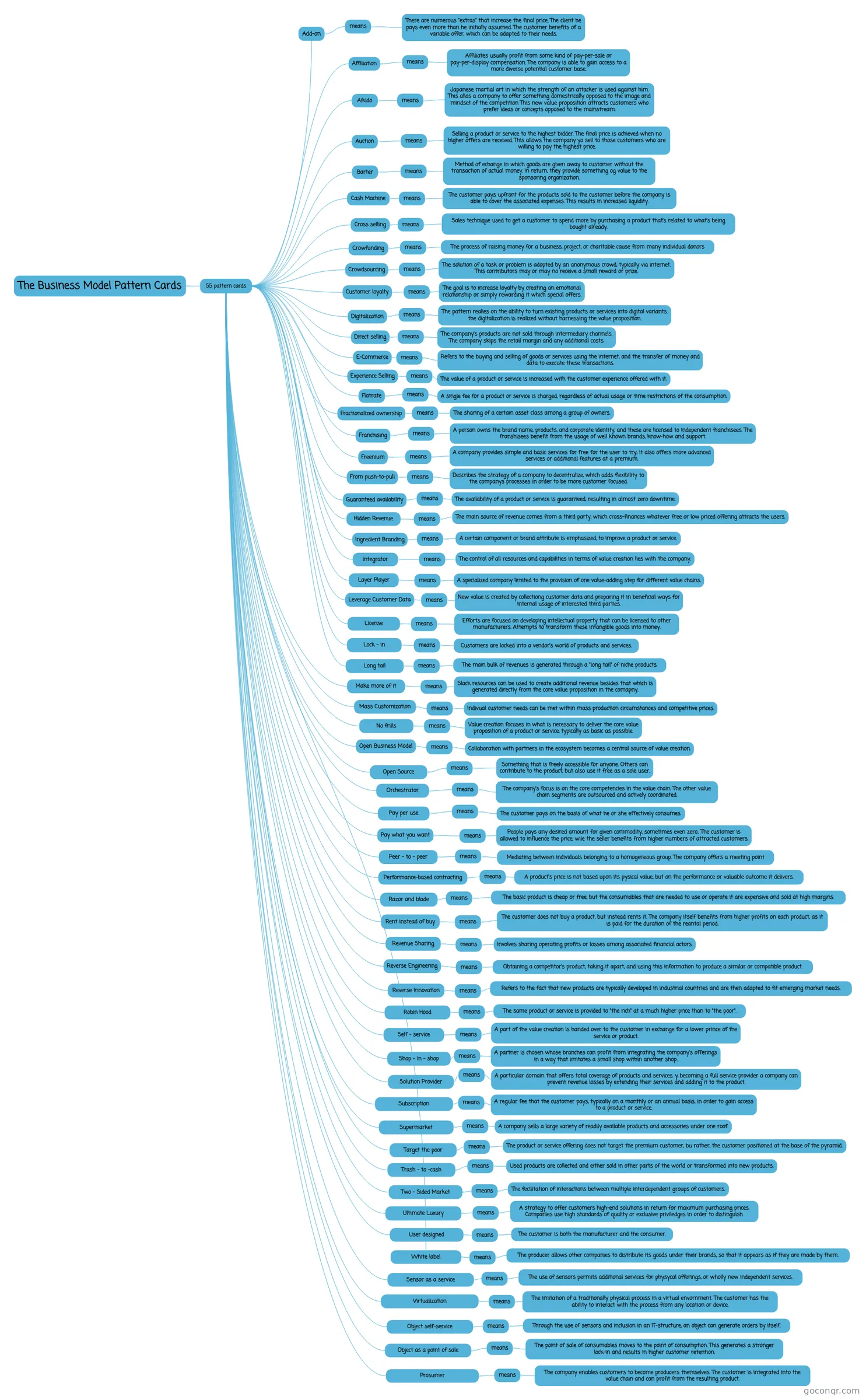
Mind map: The Business Model Pattern Cards
Contenido del mapa
The Business Model Pattern Cards
55 pattern cards
- Add-on
- means
- There are numerous "extras" that increase the final price. The client he pays even more than he initially assumed. The customer benefits of a variable offer, which can be adapted to their needs.
- means
- Affiliation
- means
- Affiliates usually profit from some kind of pay-per-sale or pay-per-display compensation. The company is able to gain access to a more diverse potential customer base.
- means
- Aikido
- means
- Japanese martial art in which the strength of an attacker is used against him. This allos a company to offer something domestrically opposed to the image and mindset of the competition This new value proposition attracts customers who prefer ideas or concepts opposed to the mainstream.
- means
- Auction
- means
- Selling a product or service to the highest bidder. The final price is achieved when no higher offers are received. This allows the company yo sell to those customers who are willing to pay the highest price.
- means
- Barter
- means
- Method of echange in which goods are given away to customer without the transaction of actual money. In return, they provide something og value to the sponsoring organization.
- means
- Cash Machine
- means
- The customer pays upfront for the products sold to the customer before the company is able to cover the associated expenses. This results in increased liquidity.
- means
- Cross selling
- means
- Sales technique used to get a customer to spend more by purchasing a product that’s related to what’s being bought already.
- means
- Crowfunding
- means
- The process of raising money for a business, project, or charitable cause from many individual donors
- means
- Crowdsourcing
- means
- The solution of a task or problem is adopted by an anonymous crowd, typically via internet. This contributors may or may no receive a small reward or prize.
- means
- Customer loyalty
- means
- The goal is to increase loyalty by creating an emotional relationship or simply rewarding it which special offers.
- means
- Digitalization
- means
- The pattern realies on the ability to turn existing products or services into digital variants. the digitalization is realized without harnessing the value proposition.
- means
- Direct selling
- means
- The company's products are not sold through intermediary channels. The company skips the retail margin and any additional costs.
- means
- E-Commerce
- means
- Refers to the buying and selling of goods or services using the internet, and the transfer of money and data to execute these transactions.
- means
- Experience Selling
- means
- The value of a product or service is increased with the customer experience offered with it.
- means
- Flatrate
- means
- A single fee for a product or service is charged, regardless of actual usage or time restrictions of the consumption.
- means
- Fractionalized ownership
- means
- The sharing of a certain asset class among a group of owners.
- means
- Franchising
- means
- A person owns the brand name, products, and corporate identity, and these are licensed to independent franchisees. The franshisees benefit from the usage of well known brands, know-how and support.
- means
- Freenium
- means
- A company provides simple and basic services for free for the user to try; it also offers more advanced services or additional features at a premium.
- means
- From push-to-pull
- means
- Describes the strategy of a company to decentralize, which adds flexibility to the companys processes in order to be more customer focused.
- means
- Guaranteed availability
- means
- The availability of a product or service is guaranteed, resulting in almost zero downtime.
- means
- Hidden Revenue
- means
- The main source of revenue comes from a third party, which cross-finances whatever free or low priced offering attracts the users.
- means
- Ingredient Branding
- means
- A certain component or brand attribute is emphasized, to improve a product or service.
- means
- Integrator
- means
- The control of all resources and capabilities in terms of value creation lies with the company.
- means
- Layer Player
- means
- A specialized company limited to the provision of one value-adding step for different value chains.
- means
- Leverage Customer Data
- means
- New value is created by collectiong customer data and preparing it in beneficial ways for internal usage of interested third parties.
- means
- License
- means
- Efforts are focused on developing intellectual property that can be licensed to other manufacturers. Attempts to transform these intangible goods into money.
- means
- Lock - in
- means
- Customers are locked into a vendor's world of products and services.
- means
- Long tail
- means
- The main bulk of revenues is generated through a "long tail" of niche products.
- means
- Make more of it
- means
- Slack resources can be used to create additional revenue besides that which is generated directly from the core value proposition in the comapny.
- means
- Mass Customization
- means
- Indivual customer needs can be met within mass production circumstances and competitive prices.
- means
- No frills
- means
- Value creation focuses in what is necessary to deliver the core value proposition of a product or service, typically as basic as possible.
- means
- Open Business Model
- means
- Collaboration with partners in the ecosystem becomes a central source of value creation.
- means
- Pay what you want
- means
- People pays any desired amount for given commodity, sometimes even zero.. The customer is allowed to influence the price, wile the seller benefits from higher numbers of attracted customers.
- means
- Pay per use
- means
- The customer pays on the basis of what he or she effectively consumes.
- means
- Orchestrator
- means
- The company's focus is on the core competencies in the value chain. The other value chain segments are outsourced and actively coordinated.
- means
- Open Source
- means
- Something that is freely accessible for anyone. Others can contribute to the product, but also use it free as a sole user.
- means
- Rent instead of buy
- means
- The customer does not buy a product, but instead rents it. The company itself benefits from higher profits on each product, as it is paid for the duration of the reantal period.
- means
- Performance-based contracting
- means
- A product's price is not based upon its pysical value, but on the performance or valuable outcome it delivers.
- means
- Razor and blade
- means
- The basic product is cheap or free, but the consumables that are needed to use or operate it are expensive and sold at high margins.
- means
- Peer - to - peer
- means
- Mediating between individuals belonging to a homogeneous group. The company offers a meeting point
- means
- Robin Hood
- means
- The same product or service is provided to "the rich" at a much higher price than to "the poor".
- means
- Reverse Innovation
- means
- Refers to the fact that new products are typically developed in industrial countries and are then adapted to fit emerging market needs.
- means
- Reverse Engineering
- means
- Obtaining a competitor's product, taking it apart, and using this information to produce a similar or compatible product.
- means
- Revenue Sharing
- means
- Involves sharing operating profits or losses among associated financial actors.
- means
- Self - service
- means
- A part of the value creation is handed over to the customer in exchange for a lower prince of the service or product.
- means
- Shop - in - shop
- means
- A partner is chosen whose branches can profit from integrating the company's offerings in a way that imitates a small shop within another shop.
- means
- Solution Provider
- means
- A particular domain that offers total coverage of products and services. y becoming a full service provider a company can prevent revenue losses by extending their services and adding it to the product.
- means
- Subscription
- means
- A regular fee that the customer pays, typically on a monthly or an annual basis, in order to gain access to a product or service.
- means
- Ultimate Luxury
- means
- A strategy to offer customers high-end solutions in return for maximum purchasing prices. Companies use high standards of quality or exclusive priviledges in order to distinguish.
- means
- Two - Sided Market
- means
- The fecilitation of interactions between multiple interdependent groups of customers.
- means
- Trash - to -cash
- means
- Used products are collected and either sold in other parts of the world or transformed into new products.
- means
- Target the poor
- means
- The product or service offering does not target the premium customer, bu rather, the customer positioned at the base of the pyramid.
- means
- Supermarket
- means
- A company sells a large variety of readily available products and accessories under one roof.
- means
- User designed
- means
- The customer is both the manufacturer and the consumer.
- means
- White label
- means
- The producer allows other companies to distribute its goods under their brands, so that it appears as if they are made by them.
- means
- Sensor as a service
- means
- The use of sensors permits additional services for physycal offerings, or wholly new independent services.
- means
- Virtualization
- means
- The imitation of a traditionally physical process in a virtual envornment. The customer has the ability to interact with the process from any location or device.
- means
- Object as a point of sale
- means
- The point of sale of consumables moves to the point of consumption. This generates a stronger lock-in and results in higher customer retention.
- means
- Object self-service
- means
- Through the use of sensors and inclusion in an IT-structure, an object can generate orders by itself.
- means
- Prosumer
- means
- The company enables customers to become producers themselves. The customer is integrated into the value chain and can profit from the resulting product.
- means
- Add-on
Información
- Descripción
- Mapa Mental sobre The Business Model Pattern Cards, creado por Andres Baez el 05/06/2020.
- Creado por
- Andres Baez
- Visitas
- 0
- Valoración
Más sobre Business Model Patterns