
Mapa mental
Particles
Contenido del mapa
Particles
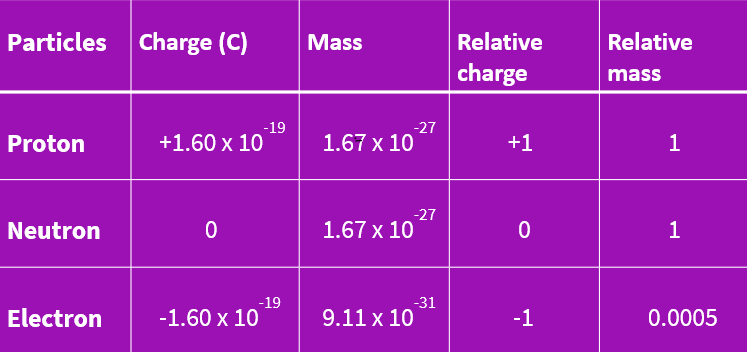
Constituents of the Atom
- Proton number, sometimes called the atomic number, is the number of protons in a atom and is represented by the symbol Z, as shown in this notation ---->
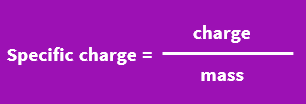
- The specfic charge of a particle is its ratio of charge to mass given in coulobms per kilogram
- Isotopes are atoms with the same number of protons but a different number of neutrons
- Proton number, sometimes called the atomic number, is the number of protons in a atom and is represented by the symbol Z, as shown in this notation ---->
Stable and Unstable Nuclei
- The strong nuclear force is the force responsible for holding nucleus of an atom together. It's strong attractive force in the range between 0.5fm - 3fm, around the size of a nucleus, keeping it together. Any smaller and it's repulsive, preventing the atom from collapsing in on itself
- The force must be an attractive force, strong enough to overcome repulsion by the electrostatic force
- Unstable nuclei occurs when the nucleus of an atom is too big for the strong nuclear force to keep them stable or when there's an overabundance of neutrons in nucleus. This is resolved through alpha emission and beta minus emission respectivly
- Alpha emission is when an alpha particle is ejected from a large, unstable nucleus. When an alpha particle is emitted, the proton number of the atom decreases by 2 and the nucleon number by 4
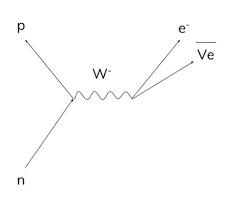
- Beta minus (or simply beta) decay is the emission of an electron and a antineutrino from the nucleus. When an atom undergos beta decay, a neutron in the nucleus becoms a proton
- The antineutrino is used to make up for the loss of energy found in beta decay. Since the loss of energy did not work with the conservation of energy, a zero charge, small mass object would be reponsible for the missing energy
- The strong nuclear force is the force responsible for holding nucleus of an atom together. It's strong attractive force in the range between 0.5fm - 3fm, around the size of a nucleus, keeping it together. Any smaller and it's repulsive, preventing the atom from collapsing in on itself
Particles, Antiparticles and Photons
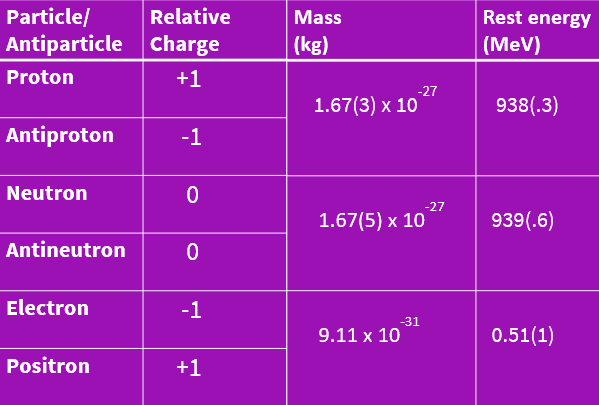
- Every particle has a corresponding antiparticle with an equal mass and rest energy, but oppisite charges
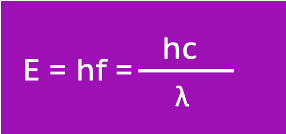
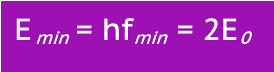
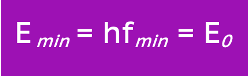
- All frequencies of Electromagnetic radiation exists as photons of energy.That energy can be calculated using this formula
- Pair production is when a photon of enough energy (usually a gamma photon) produces a particle and anti particle pair
- The opposite of this is annihilation, when a particle and it's anti particle meet, collide and have their masses converted to energy in the form of a photon pair
- Every particle has a corresponding antiparticle with an equal mass and rest energy, but oppisite charges
Particle Interactions
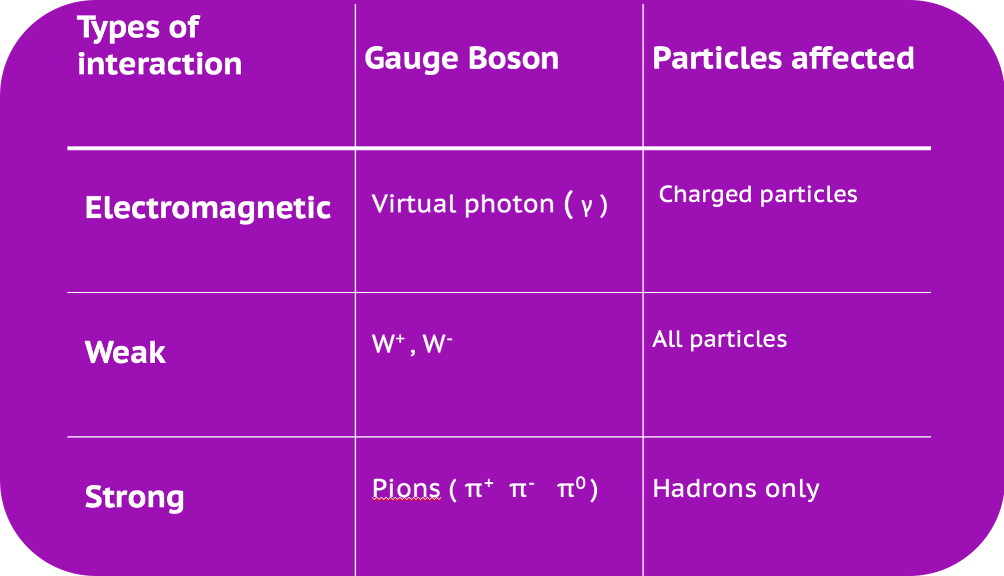
- There are four fundamental interactions: gravity, electromagnetic, weak nuclear, strong nuclear. These interactions use exchange particles called guage bosons
- Some important interactions are Electromagnetic repulsion, Beta plus/minus decay and Electron capture and electron-proton collision. You can show all of these interactions in diagrams called a Feynman diagram. Below is the one for Beta plus decay
- There are four fundamental interactions: gravity, electromagnetic, weak nuclear, strong nuclear. These interactions use exchange particles called guage bosons
Classification of Particles
- Hadrons are particles that feel the strong nuclear force. They are not fundmental particles and thus are made from smaller particles called quarks
- Mesons are particles with a quark and anti quark. The most noteable ones are the Pions and Kaons. Kaons eventually decay into pions. They have no baryon number
- Baryons are particles that have 3 quarks, notable examples being protons and neutrons. Protons are the most stable baryon and all other baryons eventually decay into protons The number of baryons in a reaction is called a baryon number and it must be conserved in any interaction
- Leptons are fundamental particles that don't interact with the strong nuclear force. Notable leptons include electrons, muons and all neutrinos. Muons decay into electrons and neutrinos have no charge and are almost massless and are only involved in weak interactions
- There is a lepton number that must be conserved in interactions, with all leptons having +1 and their anti particle having -1
- Strange particles are particles that are produced through the strong interaction and decay through the weak interaction (eg kaons). Theres a property called strangness that is conserved in the strong interaction but can change by +1 or -1 in the weak interaction
- Hadrons are particles that feel the strong nuclear force. They are not fundmental particles and thus are made from smaller particles called quarks
Quarks and Antiquarks
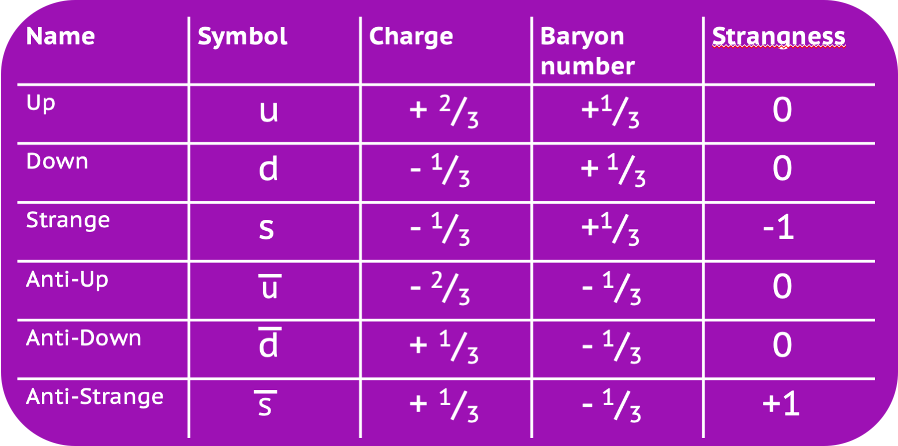
- Quarks are fundamental particles that create hadrons. There are 12 but for a-level we only need to know Up, Down strange and their antiparticles
- A proton is 2 up 1 down, anti-proton is 2 anti-up 1 anti-down. A neutron is 2 down 1up and a anti-neutron is 2 anti-down 1 anti-up
- Quarks are fundamental particles that create hadrons. There are 12 but for a-level we only need to know Up, Down strange and their antiparticles
Applications of Conservation Law
- In every interaction, baryon number, charge momentum and energy is conserved
- The only way to change a quark is within the weak interaction, so in strong interactions strangness stays the same but in the werak interaction the strangness can can by +1, 0 or -1
- Different types of lepton numbers must be conserved separately (e.g electrons and muons have different lepton numbers)
- In beta plus/minus decay a proton changes into a neutron (or vice versa). This happens due to a change in quark character ( uud -> udd)(udd -> uud)
Imágenes y archivos del mapa

Información
- Descripción
- A level Physics Mapa Mental sobre Particles, creado por Grace was here el 30/06/2020.
- Creado por
- Grace was here
- Visitas
- 0
- Valoración