
Mapa mental
DO AND MAKE
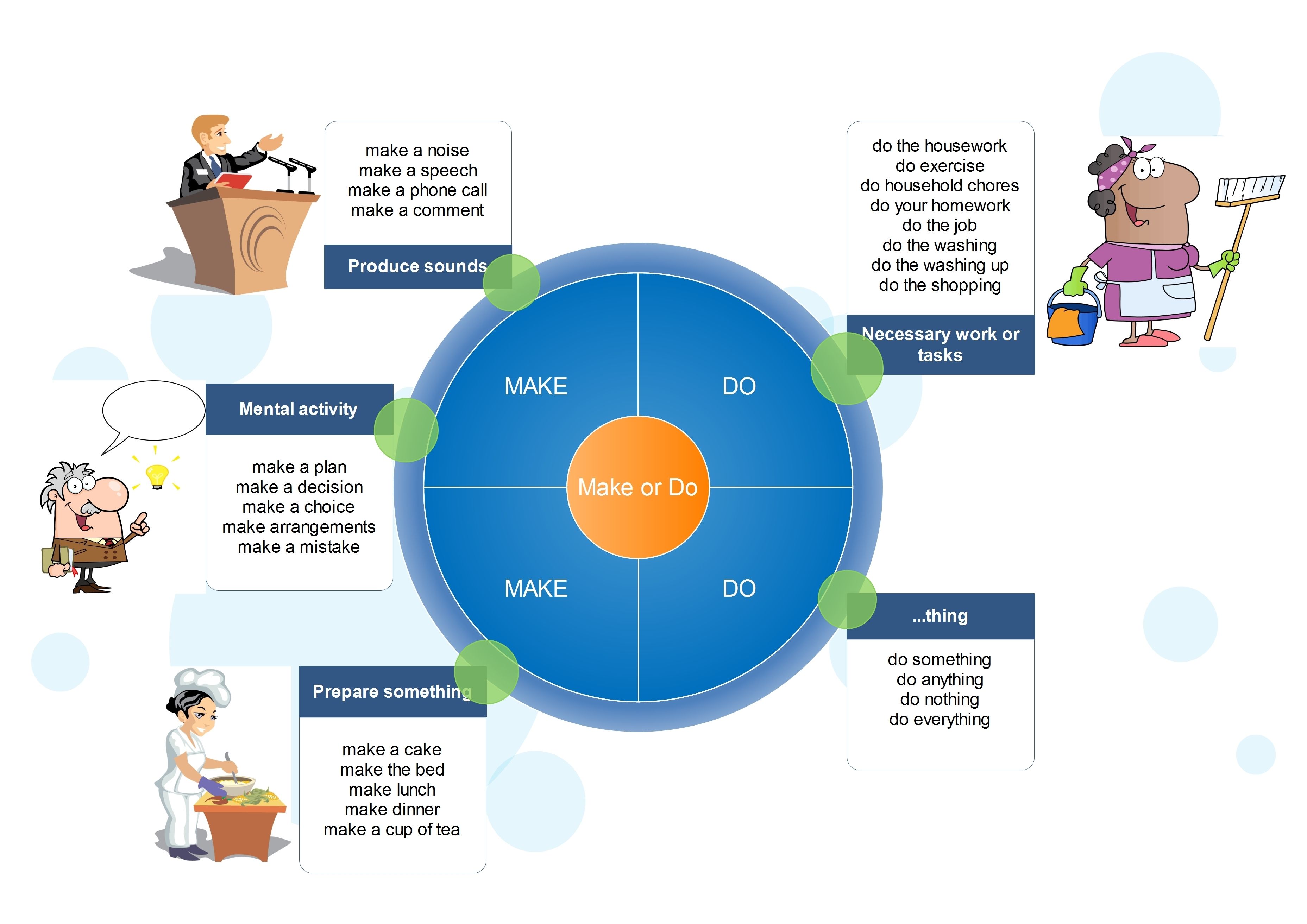
Contenido del mapa
DO AND MAKE
What is the difference between make and do? Make or do? – that is the question! These two short words are famous for confusing learners of English. Most errors appear where there are differences in how and when ‘make’ and ‘do’ are used in English vs. your native language. Let’s look at some basic theory to understand the general meaning of ‘make’ vs. ‘do’ in English.
- HOW TO USE MAKE
- I make He/She makes – We/They make I will make – I am making – I made – I have made The verb make is used when talking about creation or production in a process.
- In other words, it is used to refer to the result of an action. For example: ‘Make a cup of tea’, ‘Make plans for the future’ or ‘Make a model boat out of wood’.
- Made can be used to indicate the material of a product. For example, we can say that a spoon is ‘made of steel’. In this case, we would say made, as in the past tense of make. The creation has already taken place and now the spoon is made of steel.
- In other words, it is used to refer to the result of an action. For example: ‘Make a cup of tea’, ‘Make plans for the future’ or ‘Make a model boat out of wood’.
- COMUNICACIÓN
- Make an objection
- (= Complain or dispute something) ‘If anyone would like to make an objection, please raise your hand now.’
- Make an agreement
- (= Reach consensus, create legislation) ‘Politicians at the summit are eager to make an agreement on climate change.’
- Make a phone call
- (= Call someone on the phone) ‘I need to make a quick phone call. Can I use your landline?’
- Make an excuse
- (= Justify an action) ‘The boss made an excuse and left the meeting early.’
- Make a point
- (= State an argument, advocate an idea) ‘John made some good points in his presentation, but I didn’t agree with everything he said.
- Make an observation
- (= Give your view on a topic, state what you have noticed) ‘Following our exam results, the teacher made several observations about our lack of progress!’
- Make an objection
- FOOD & DRINK
- Make a cake (= Bake a cake) ‘My mum makes me a cake for my birthday every year.
- Make a cup of tea (= Brew tea, make a cuppa) ‘Work has been an absolute nightmare today! Make me a nice cuppa, would you?’
- Make a snack (= Prepare a snack) ‘Dave was supposed to be on a diet, but I found him in the kitchen making a snack!’
- Make a meal (= Cook a meal, make breakfast/lunch/dinner) ‘Would you mind making some meals for my granddad while I’m away on holiday?’ ‘I’ll make dinner tonight if you make breakfast tomorrow morning, ok?’
- MONEY & WORK
- Make money (= Earn money) ‘I heard that if you start your own business, you can make some serious money!’ ‘There are many ways to make money. Robbing a bank is just one of them!’
- Make a loss (= Loose money in a business context) ‘If a company makes a loss, it can be in danger of running up debts or going bankrupt.’
- Make a fortune (= Become rich by earning money) ‘I friend of mine has recently made a fortune in the property business.’
- Make a law (= Set a rule, introduce new legislation) ‘The government has made a law to stop people smoking in the workplace.’
- Make room/way (= Accommodate, compromise to make something fit) ‘I’m super busy this week! Any chance you could make room for me on the 16th?’ ‘Several older members of staff have been fired to make way for the new recruits.’
- HUMAN RELATIONSHIPS
- Make (someone) smile/laugh (= Cause to smile or laugh) ‘John’s a funny guy! When we’re down the pub, he always makes me laugh.’
- Make a good impression (= Show your best side) ‘When you go on a first date, it’s important to make a good impression (on the person).’
- Make friends (= Become friends with someone) ‘Maggie’s really outgoing so she makes friends easily at home and abroad.’
- Make war/peace (= Start/stop conflict) ‘Some countries make war, while others make peace.’
- Make trouble (= Create a problem for others, antagonise) ‘On match days, football fans are often blamed for making trouble in the city.’
- PLANNING & CHOICES
- Make the best/most of (= Take advantage, seize the opportunity, tolerate) ‘Ronaldo made the most of the defender’s mistake and rounded the goalkeeper to score.’ ‘Tomorrow’s weather isn’t great for our walk, but we’ll just have to make the most of it.’
- Make an exception (= Allow a rule to be broken due to special circumstances) ‘We don’t usually allow babies in the pool, but I’ll ask if we can make an exception.’
- Make progress (= Advance, develop) ‘I really feel like I’m making progress with my book. It should be ready to publish soon!’
- Make a change (= Start something new, change your life or behaviour) ‘I’ve been living in London for 2 years, but now I feel it’s time to make a change.’
- DAILY ROUTINE
- Make the bed (= Make fit for use/sleep, tidy up) ‘I’ll make the bed if you go downstairs and make breakfast.’
- Make a mess (= Create an untidy, dirty or disorganised situation) ‘If you give kids brushes and paint, they are bound to make a mess!’ ‘My boss has made a total mess of this paperwork! I’ll have to do it all again tomorrow.’
- PHYSICAL OBJECTS & PRODUCTION
- Make a new product (= Invent, think up) ‘Apple is always making new products. That’s what makes it such a great tech company.’
- Make a fire (= Build and light a fire) ‘When trying to survive in the wilderness, the first thing to do is make a fire.’
- Make furniture (= Create furniture through carpentry or woodwork)‘ My grandfather used to make furniture for a living. These days it’s all made in factories.’
- MIND & IMAGINATION
- Make believe (= Imaginary, fantasy, ideal but not real) ‘The government has promised to invest in public services, but that’s just make believe!’ ‘Alice in Wonderland is a children’s book that is set in a make-believe world.’ (Adjective)
- Make a discovery (= Find something new, invent, realise) ‘Scientists from NASA have made a new discovery on Mars!’
- Make sense (= Be sensible, reasonable, understood) ‘I don’t think it makes sense to earn a lot of money if you then have no time to enjoy it.’ ‘Did you have a bit to drink last night? You weren’t making any sense on the phone!’
- Make a wish (= Will something to happen, hope something will come true) ‘When you blow out the candles on your birthday cake, don’t forget to make a wish!’’
- APPOINTMENTS & TRAVEL
- Make a visit (Go to, travel to) ‘The Queen will make a state visit to France while she is in Europe.’
- Make an appointment (= Schedule an individual consultation or meeting) ‘All patients wishing to make an appointment should phone to book in advance.’
- Make a list (= Have an agenda of tasks) ‘My wife has made a list of all the things I’ve done wrong. As you can imagine, it’s quite long!’
- Make it (= Get to a place, attend) ‘I’m really busy next weekend, but I’ll do my best to make it to the party!’ ‘I’m afraid I’m not going to make it back in time for dinner.’(Get home)
- I make He/She makes – We/They make I will make – I am making – I made – I have made The verb make is used when talking about creation or production in a process.
- HOW TO USE DO
- I do – She/He does – They/We do I will do – I am doing – I did – I have done
- The verb ‘do’ is used when we talk about tasks, duties, obligations and routine work.
- It refers to the process of carrying out these actions.
- This verb is similar to the formal words perform or execute (as in: execute a command). For example: ‘I did my homework yesterday evening.’ (completed task).
- Another use of the verb do is to replace a different verb in the context of a clear or straightforward result. For example: ‘Do the dishes’ (vs. wash the dishes). ‘Do my hair’ means cut, dye, style or perform another similar action on my hair.
- The word ‘do’ can also be used for recreational and individual sports, such as martial arts. For example: ‘Do karate twice a week’ (take part in this sporting activity, perhaps by attending a class).
- Another use of the verb do is to replace a different verb in the context of a clear or straightforward result. For example: ‘Do the dishes’ (vs. wash the dishes). ‘Do my hair’ means cut, dye, style or perform another similar action on my hair.
- This verb is similar to the formal words perform or execute (as in: execute a command). For example: ‘I did my homework yesterday evening.’ (completed task).
- It refers to the process of carrying out these actions.
- The verb ‘do’ is used when we talk about tasks, duties, obligations and routine work.
- DAILY ROUTINE
- Do the dishes/washing/ironing (= Wash the dishes, wash and iron clothes) ‘I really hate doing the dishes, but I don’t mind mowing the lawn.’
- Do your nails (= Have a manicure) ‘Do you do your own nails or do you go to a beauty salon?’
- Do 60 miles per hour (= Drive or travel at 60 mph) ‘When I commute to London, I want to be doing 70 (mph), but I’m usually stuck in traffic!’
- STUDY & THOUGHT
- Do maths/biology/English (= Study a subject) ‘What’s your son doing at school now? Mine is doing A-Level Maths and Biology?’
- Do a translation (= Convert from one language to another) ‘On the final exam, you have to do a translation from French into English.’
- Do a course (= Attend a class or study programme) ‘If I have time, I’d like to do a Spanish course abroad next summer.’
- CRIMINAL
- Do a robbery (= Commit an armed theft) ‘The police were unaware that the gang was planning to do a robbery in the area.’
- Do a raid (= Police attack to arrest criminals) ‘The police did a raid on a local warehouse early this morning.’
- Do drugs (= Take illegal narcotics) ‘At British schools they teach teenagers about the dangers of doing drugs.’
- WORK & BUSINESS
- What do you do? (= What is your job? I work for a large law firm. What do you do (for a living)?’
- Do business (= Trade, buy or sell) ‘Doing business internationally can be a real challenge.’ ‘Our company mostly does business with local suppliers.’
- Do a presentation (= Conduct a formal talk on a subject) ‘I’m super nervous because I have to do a presentation at our next conference.’
- SPORTS & HOBBIES
- Do sport (= Engage in sports, USA = ‘play sports’) ‘How often do kids do sport at your school?’ (Informal)
- Do Karate/Judo (= Train in martial arts) ‘I used to do karate when I was a uni, but I don’t have time these days.’
- Do a drawing (= Sketch or draw something) ‘My daughter did a beautiful drawing for me so I put it up on the wall at work.’
- ACTIONS: GOOD, BAD & GENERAL
- Do your best (= Try your hardest) ‘I know you didn’t have enough time to revise for the exam, but just do your best!’
- Do a lot (= Perform frequently, make a valuable contribution) ‘George does a lot for the local community through his volunteer work.’ ‘Do you do a lot of cycling during the week?’
- Do everything (= Complete all tasks, try your hardest) ‘I promise to do everything I can to help.’
- Do nothing (= Be idle, ignore) ‘My favourite hobby is doing nothing.’
- I do – She/He does – They/We do I will do – I am doing – I did – I have done
- HOW TO USE MAKE
BY CARLOS BEJARANO AND FABIAN PRIETO
Imágenes y archivos del mapa
Información
- Descripción
- Mapa Mental sobre DO AND MAKE, creado por Carlos Alberto BEJARANO el 17/07/2020.
- Creado por
- Carlos Alberto BEJARANO
- Visitas
- 0
- Valoración