
Mapa mental
Island Biogeography
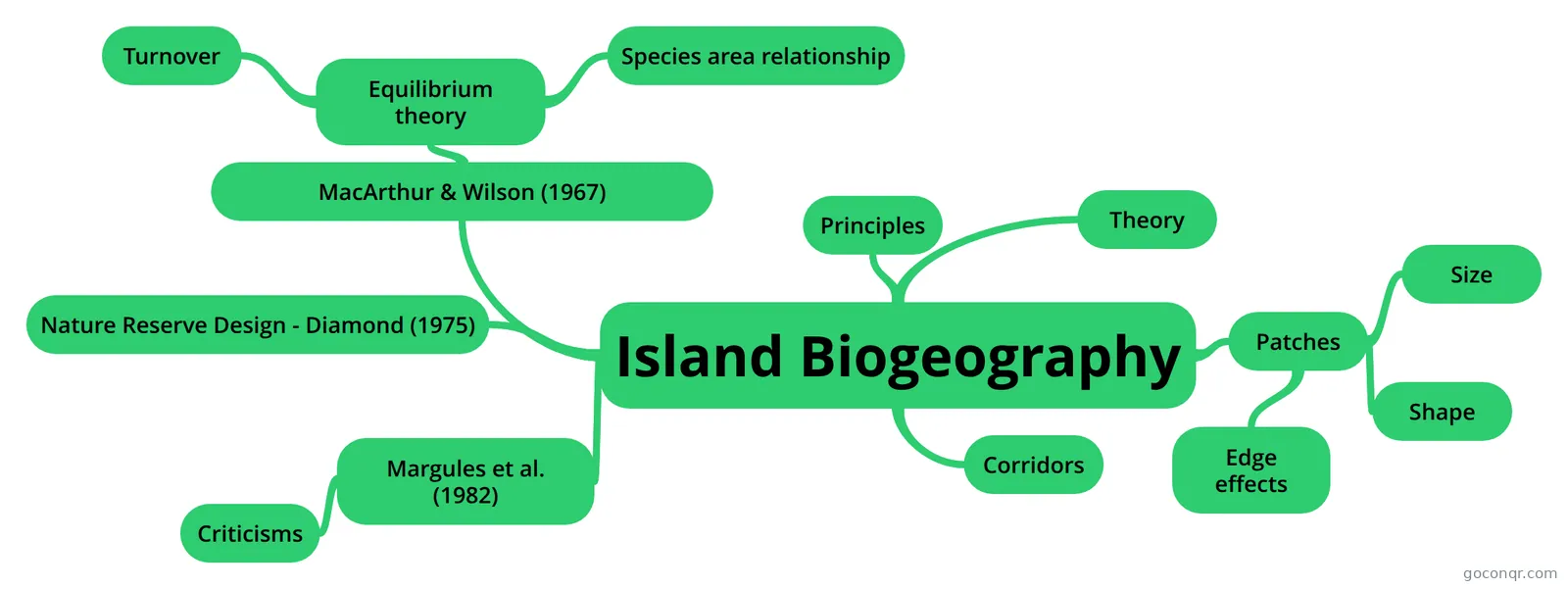
Mind map: Island biogeography
Contenido del mapa
Island Biogeography
Principles
- Larger reserves are better than small, one large reserve is better than a few small ones, several close together are better than several further apart, corridors present better than no corridors, compact shapes are better at minimising boundary lengths, buffer zones better than none.
- Simplistic view but general idea. Principles often used in the design of nature reserves and restored areas.
Theory
- Immigration vs extinction. dynamics of individual landscape elements "islands" importance of element size and shape role of chance Used a lot in nature reserve design, landscape ecology and conservation but need to consider what;s best for each individual scenario and for the particular species in question.
Patches
- Size
- Patches are not uniform habitat within themselves, edge habitat may be different to central habitat and not the optimum habitat for the species you are trying to conserve. Edges can be abrupt or gradual. A small habitat may be all edge, no interior habitat at all as all so close to the edge of the habitat patch.
- Shape
- Restoring larger areas that include more interior habitat is better. Circular shape most efficient ration edge:interior. Some species are edge species so may want to increase area of edge - needs to be considered in planning.
- Edge effects
- The changes in population or community structure that occur at the boundary of two habitats.
- Some species are edge species and environmental conditions allow them to colonise habitat borders. Plants that are edge species are usually shade intolerant and tolerant of dry conditions such as shrubs and vines. Edge species of animals are usually those that require more than one habitat, perhaps one for foraging/feeding and another for mating or nesting. These species include rabbits, blue jays and robins.
- Edges can be abrupt or gradual. Edges are important for many reasons, they can alter the composition of the interior habitat, increase/alter disturbance to the interior, increase the propensity of invasive species amongst many others. Need to make sure edge effects are not detrimental to what you are trying to achieve in a reserve design.
- Size
Corridors
- Links habitat patches in a fragmented landscape. Links local populations within a metapopulation (buffer small populations from extinction - metapopulation dynamics). Provides additional habitat, more area = more biodiversity (normally but not always the goal). Organims have more habitat for foraging, shelter, dispersal etc.
- Different types of corridor; Line corridors - dominated by edge Strip corridors - more interior environment. Trees/hedges may provide corridors through agricultural land.
MacArthur & Wilson (1967)
- Proposed the equilibrium theory of island biogeography. Number of species present in an isolated area is the result of a dynamic balance between two opposing forces of immigration and extinction. The balance between these processess results in an equilibrium number of species.
- Ideas rapidly accepted by a number of conservation bodies in the mid 1970s but there are a number of potential criticisms. May not be best practice to design nature reserves in this way in all situations and for all species.
- Equilibrium theory
- Balance between the forces of immigration and extinction of species in an isolated area. Value depends on the size and isolation of the area.
- Species area relationship
- The equilibrium value of species within an area partly depends on the size of the area. A larger habitat provides more physical niches for more organisms to occupy leading to greater biodiversity. A larger habitat may provide more opportunties for predator avoidance and foraging. A larger area is likely to consist of more heterogenous habitat than a smaller area, again offering more space and niches to a wider variety of organisms.
- Equilibrium value also affected by source/sink population dynamics. A source population is one with a net outflux of individuals and a sink is one where deaths exceed births and extinction is averted by the number of immigrants from a source population exceeding the number of emigrations from the sink. If an island is further from a source population then there is less likelihood of immigration of new species.
- Which species will end up colonising a new habitat is also partly down to the role of chance.
- Turnover
- Under the equilibrium model the number of species present will remain roughly constant over time although actual species present may change due to continuing extinction and immigration events (turnover).
Nature Reserve Design - Diamond (1975)
- Formulated a series of geometric principles for nature reserve design.
Margules et al. (1982)
- Paper provides a balanced review of the ideas regarding island biogeography and nature reserves design.
- Criticisms
- Main criticism: Conservation implications drawn from these principles are only concerned with maximising species richness. May infer that it is best to conserves only the most species rich sites but this may mean that rare species are neglected. Representative habitats may also be overlooked. Maximising biodiversity not always the main goal in conservation. There can be a variety of conservation aims and they may all not compliment each other. Depends on the habitat and /or species in question you are trying to conserve. Some habitats may be important to conserve but not very species rich e.g., calcareous grasslands. May provide habitat for specialist species though.
- Diamond (1975) was only concerned with the design of reserves in a homogeneous habitat although there has been criticism that no habitat is truly homogeneous.
- The theory itself is unsubstantiated - it is only a theory. MacArthur & Wilson (1967) admitted in the preface of their book that general theories require a good deal of faith.
- Real islands surrounded by an environment that is totally inhospitable to terrestrial species. In terrestrial systems many species found in habitat patches may survive in surrounding environment or have major populations in neighbouring (different) habitat types. Some species can be found in more than one terrestrial habitat. Nature reserve design would need to incorporate all habitats in a species range so a network of island reserves may not work.
Información
- Descripción
- Mapa Mental sobre Island Biogeography, creado por amyycartwright el 07/04/2015.
- Creado por
- amyycartwright
- Visitas
- 0
- Valoración