
Mapa mental
Stellar Remnants
Contenido del mapa
Stellar Remnants
Under-mass Nebula
- less than 0.08 solar mass (80 Jupiter's masses)
- the nebula will NOT become hot enough to initiate hydrogen fusion
- the nebula will FAIL to form a star
- => Brown Dwarf
- the nebula will FAIL to form a star
- the nebula will NOT become hot enough to initiate hydrogen fusion
- less than 0.08 solar mass (80 Jupiter's masses)
Contracting Nebula
- a star begins to form when a nebula starts to collapse under the influence of its own gravity
- as the nebula contracts, it becomes hotter
- as the carob core contracts, the electrons in it are squeezed close tgt, raising the electron degeneracy pressure
- eventually, the electron degeneracy pressure balances the gravity, & the contraction of the nebula ceases
- a star begins to form when a nebula starts to collapse under the influence of its own gravity
Mass of nebula > 0.08 solar mass
- the nebula will become hot enough to initiate H fusion
- the nebula will form a main-sequence star
- H fusion occurs in the core of a main-sequence star
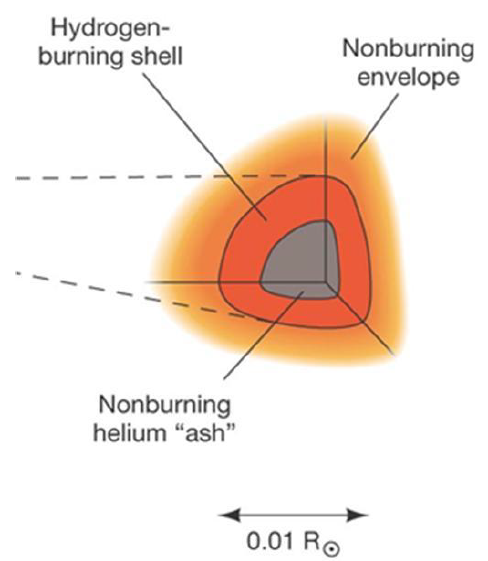
- as H fusion proceeds, eventually, a helium core starts to grow
- this non-burning He core will contract under the inward pull of gravity & heat up
- if the star's mass is lower than approx 0.5 solar mass, the He core will NOT become hot enough to initiate He fusion
- as the He core contracts, eventually, the electron degeneracy pressure balances the gravity, & the contraction ceases
- the He core will evolve to become a He white dwarf
- Eg) at the centre of Helix nebula
- the He core will evolve to become a He white dwarf
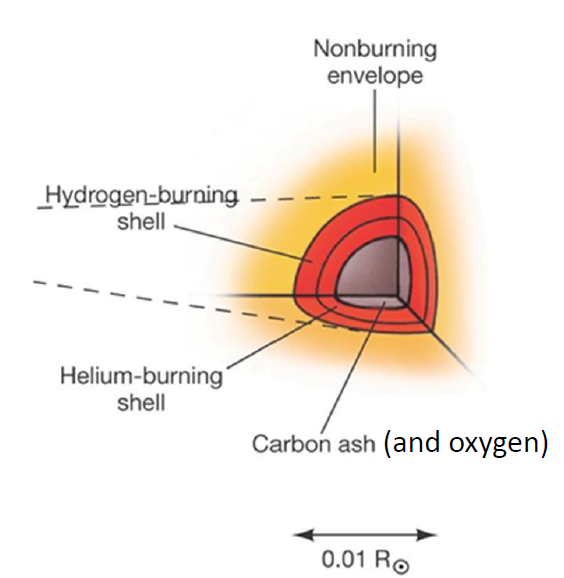
- if the star's mass is between approx 0.5-8 solar masses, the He core will become hot enough to fuse He into C & O
- eventually, the core evolves to become a carbon-oxygen white dwarf
- this non-burning He core will contract under the inward pull of gravity & heat up
- as H fusion proceeds, eventually, a helium core starts to grow
- H fusion occurs in the core of a main-sequence star
- the nebula will form a main-sequence star
- the nebula will become hot enough to initiate H fusion
Chandrasekhar Limit
- the physics of degeneracy yields max mass for a non-rotating white dwarf, the Chandrasekhar limit
- approx 1.4 solar masses - beyond which it canNOT be supported by electron degen pressure
- the modern value of the limit was first published in 1931 by Subrahmanyan Chnadrasekhar
- tgt with William Alfred Fowler, Chandrasekhar received the Nobel prize for this & other work in 1983
- the physics of degeneracy yields max mass for a non-rotating white dwarf, the Chandrasekhar limit
High-mass Star
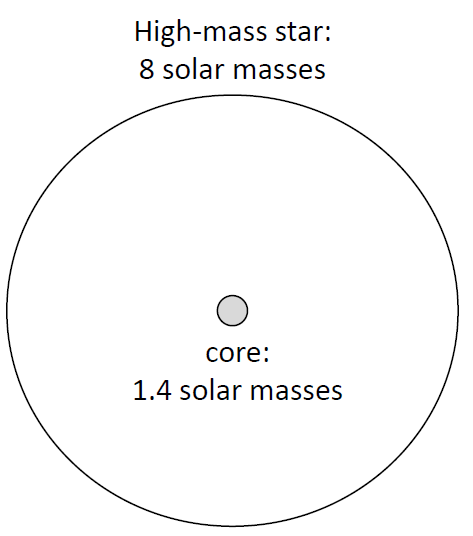
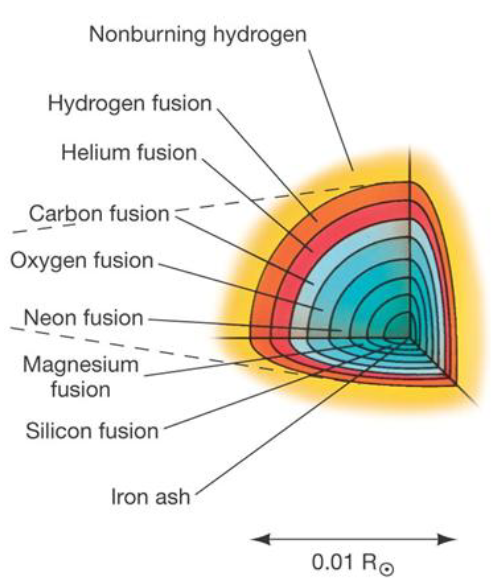
- if the star's mass is HIGHER than approx 8 solar mass
- the star's core will exceed the Chandrasekhar limit
- electron degeneracy pressure is overcome & the star's core collapses further
- eventually, a core of non-burning pure NEUTRON starts to grow
- Neutron Degeneracy Pressure
- as the neutron core contracts under its own gravity
- the neutron degeneracy pressure eventually halts the neutron core's gravitational contraction
- neutron core will evolve to become a neutron star
- Neutron star
- =dense & tiny
- mass comparable to that of the Sun, but it is only about 10km in radius
- neutron stars are virtually undetectable
- HST observed 1 thermally radiating NS
- neutron stars are virtually undetectable
- mass comparable to that of the Sun, but it is only about 10km in radius
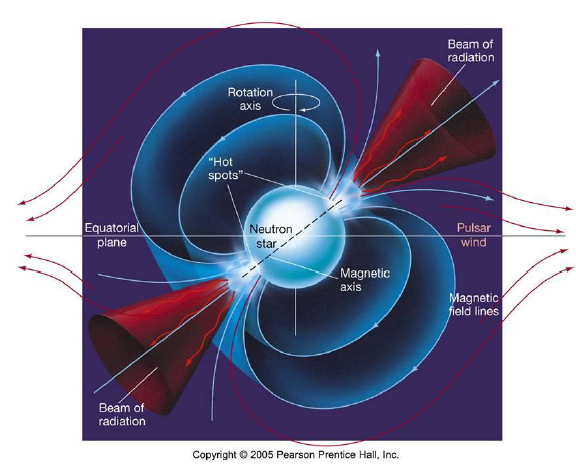
- some neutron stars rotate very rapidly & emit beams of radiation as pulsars
- Formation of Pulsar
- pulsar = NS that is formed with very high rotation speed
- beam of radiation is emitted along the magnetic axis of the pulsar, which spins along with the rotation of the NS
- the magnetic axis is NOT the same as its rotational axis
- this misalignment causes the beam to be seen once for every rotation of the NS, which leads to the "pulsed" nature of its appearance
- pulsar is the short for puslating radio star
- this radiation can only be observed when the beam of emission is pointing toward the Earth
- pulsar is the short for puslating radio star
- this misalignment causes the beam to be seen once for every rotation of the NS, which leads to the "pulsed" nature of its appearance
- the magnetic axis is NOT the same as its rotational axis
- beam of radiation is emitted along the magnetic axis of the pulsar, which spins along with the rotation of the NS
- the 1st pulsar was observed on November 28, 1967 by Jocelyn Bell Burnell & Antony Hewish
- they observed pulses separated by 1.33 seconds
- in 1974, Antony Hewish & Martin Ryle became the first astronomers to be awarded the Nobel Prize in physics, with the Royal Swedish Academy of Sciences noting that Hewish played a "decisive role in the discovery of pulsars"
- Jocelyn did not share the 1974 Nobel Prize for Physics with Hewish, she has been honoured by many other organisations
- pulsar = NS that is formed with very high rotation speed
- Formation of Pulsar
- =dense & tiny
- Neutron star
- neutron core will evolve to become a neutron star
- the neutron degeneracy pressure eventually halts the neutron core's gravitational contraction
- as the neutron core contracts under its own gravity
- Neutron Degeneracy Pressure
- eventually, a core of non-burning pure NEUTRON starts to grow
- electron degeneracy pressure is overcome & the star's core collapses further
- the star's core will exceed the Chandrasekhar limit
- if the star's mass is HIGHER than approx 8 solar mass
TOV Limit
- (Tolman-Oppenheimer-Volkoff Limit)
- =upper bound to the mass of NS
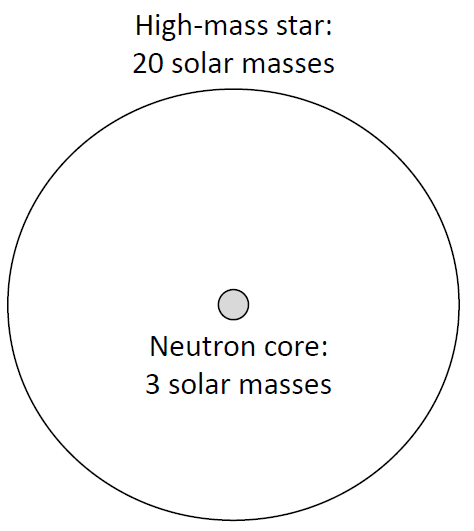
- approx 3.0 solar masses, corresponding to an original stellar mass of 20 solar masses
Black Hole
- if the mass of the stellar remnant is high enough, the neutron degen pressure will be INsufficient to prevent collapse
- the stellar remnants -> black hole
- BH = region of spacetime exhibiting such a strong grav pull that NO particles/radiation can escape from it
- the Theory of GR predicts that a sufficiently compact mas can deform spacetime to form a BH
- by their nature, BH do NOT directly emit any signals (the hypothetical Hawking radiation is predicted to be very weak)
- astrophysicists searching for BH thus have to rely on indirect observations
- BH's existence can be inferred by observing its grav interactions w its surroundings
- Eg) X-ray Binaries
- =binary star systems that are luminous in the X-ray part of the specturm
- Eg) Cygnus X-1 (one of the strongest X-ray sources seen from Earth)
- X-ray emissions are generally thought to be caused by one of the component stars being a BH accreting matter from the other (regular) star
- Accretion Disc
- due to conservation of angular momentum, gas falling into the grav well created by a BH will typically form a disc-like structure around the object
- friction w/i the disc increases the temp of the gas
- the gas in the inner regions becomes so hot that it will emit vast amounts of radiation (mainly X-rays), which may be detected by telescopes
- friction w/i the disc increases the temp of the gas
- due to conservation of angular momentum, gas falling into the grav well created by a BH will typically form a disc-like structure around the object
- Accretion Disc
- =binary star systems that are luminous in the X-ray part of the specturm
- Eg) X-ray Binaries
- BH's existence can be inferred by observing its grav interactions w its surroundings
- astrophysicists searching for BH thus have to rely on indirect observations
- by their nature, BH do NOT directly emit any signals (the hypothetical Hawking radiation is predicted to be very weak)
- the Theory of GR predicts that a sufficiently compact mas can deform spacetime to form a BH
- BH = region of spacetime exhibiting such a strong grav pull that NO particles/radiation can escape from it
- the stellar remnants -> black hole
- predicted by Theory of General Relativity
- according to classical general relativity, NO matter/light can flow from the interior of a black hole to an outside observer
- (although quantum effects may allow deviations from this strict rule)
- General Relativity & current description of gravitation in modern physics - Albert Einstein @ 1915
- Gen Rel provides a unified description of gravity as a geometric property of space & time, or spacetime
- in particular, the curvature of spacetime is directly related to the E of whatever matter is present
- Gen Rel provides a unified description of gravity as a geometric property of space & time, or spacetime
- General Relativity & current description of gravitation in modern physics - Albert Einstein @ 1915
- (although quantum effects may allow deviations from this strict rule)
- according to classical general relativity, NO matter/light can flow from the interior of a black hole to an outside observer
- if the mass of the stellar remnant is high enough, the neutron degen pressure will be INsufficient to prevent collapse
Imágenes y archivos del mapa
Información
- Descripción
- Mapa Mental sobre Stellar Remnants, creado por hssue94712 el 12/04/2015.
- Creado por
- hssue94712
- Visitas
- 2
- Valoración