
Stellar Evolution and Life Cycle of Stars
115 resources created by 95 users
This Stellar Evolution and Life Cycle of Stars page on GoConqr gathers community-made quizzes, mind maps, flashcards, flowcharts and notes, from nebulae and protostars to supernovae, neutron stars and black holes. It's built for school students revising a topic, university students and professional candidates filling gaps, and teachers after ready-made material. There are over 100 resources here, including more than 30 quizzes and over 40 mind maps, with 20 flashcards on the page. Pick a mind map to see the stages, then try a quiz to find your gaps.
Top Stellar Evolution and Life Cycle of Stars resources
-
180 questionsAstronomy 180 The hydrogen in the outer layers of the Sun cannot undergo fusion because
-
Flowchart Life Cycle of Stars
-
5 questionsCCI02.03.01.- Nebulae: Crash Course Astronomy A nebula is
-
 Mind map Life Cycle of Stars
-
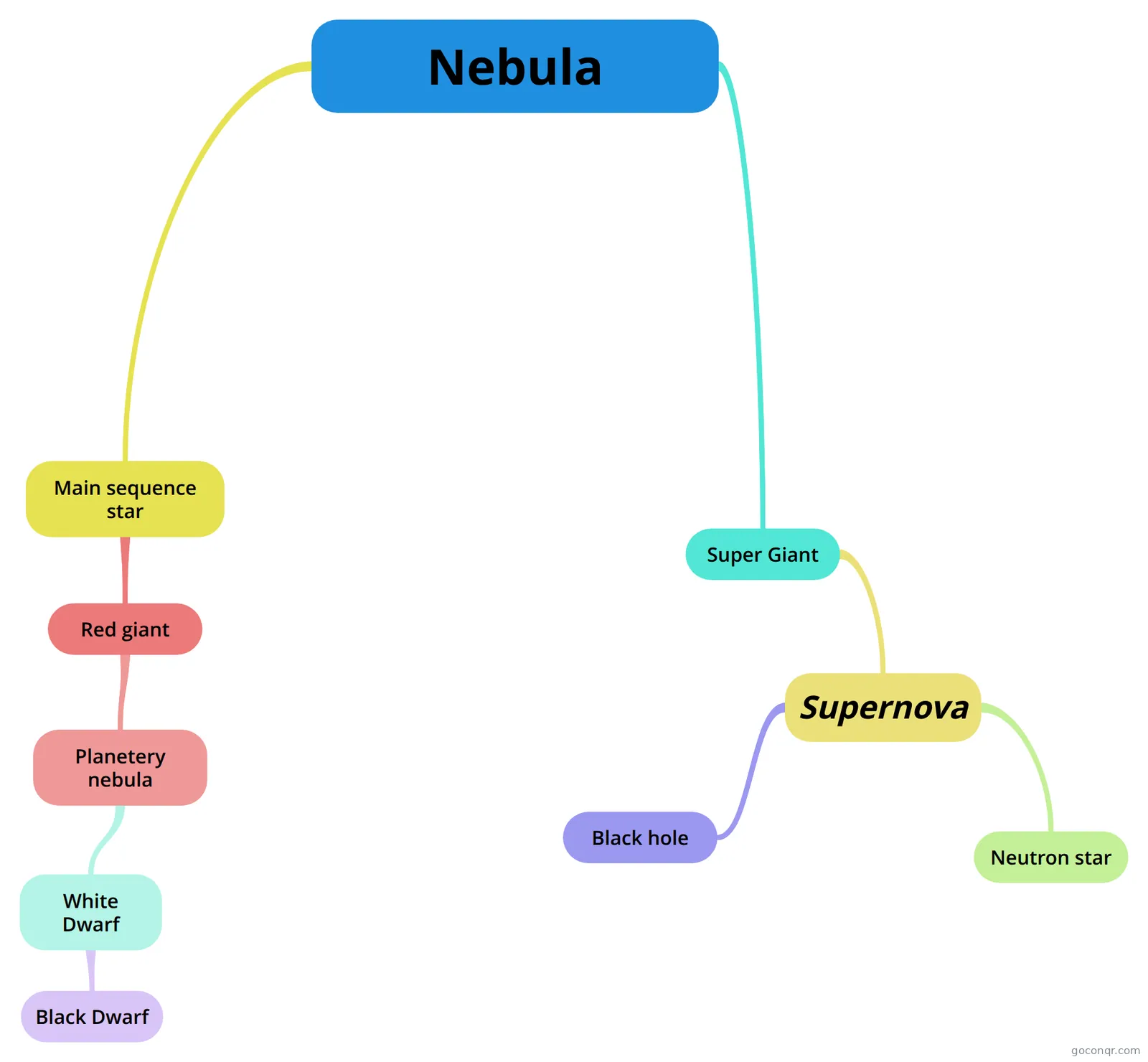 Mind map Nebula
-
105 cardsAstronomy Test 2 During a supernova, how much more luminous can a star get
-
13 cardsCh. 11 - Stellar Explosions Vocab
-
15 cardsGalaxy Lecture 5 - Mass loss Where is mass loss from/in?
Quizzes
See all 34 quizzes-
180 questionsAstronomy 180 The hydrogen in the outer layers of the Sun cannot undergo fusion because
-
5 questionsCCI02.03.01.- Nebulae: Crash Course Astronomy A nebula is
-
40 questionsTB18 1) Degeneracy pressure is the source of the pressure that stops the crush of gravity in all the following e...
-
62 questionsASTR 2020 Quiz 4 A pulsar is:
-
46 questionsTB17 1) What do astronomers mean when they say that we are all "star stuff"?
-
8 questionsLife Cycle of Stars
-
40 questionsTB16 1) Astronomers estimate that new stars form in our galaxy at the rate of about
-
43 questionsPHYS 105 - Test 3 What type of object could be associated with both a nova and a supernova?
Mind maps
See all 46 mind maps
Flashcards
See all 21 flashcards-
105 cardsAstronomy Test 2 During a supernova, how much more luminous can a star get
-
13 cardsCh. 11 - Stellar Explosions Vocab
-
15 cardsGalaxy Lecture 5 - Mass loss Where is mass loss from/in?
-
8 cardsGalaxy Lecture 7 HI Emission and Absorption
-
145 cardsPHYS 1830 What is the Interstellar medium?
-
51 cardsASTR 113 Exam 2 G-Type Star Characteristics
-
29 cardsAstr Q4
-
12 cardsGalaxy Lecture 6 The Interstellar Medium
Flowcharts
Notes
-
Untitled
-
Neutron Stars Neutron stars exist because of the death of stars Stars exist because of a fragile balance. Millions of billions of trillions of tons of whole plasma are being pulled in by gravity and squeezed together. Material sque...
-
Life cycle of a star 1. nebula large bodies of gas and dust contract under its own gravity no fusion occurring 2.Protostar still gathering gas and dust, gets hot as it falls together. A star is formed when it becomes so hot that hy...
-
Birth, Life and death of a star - creado desde un Mapa Mental Its birthplaces are huge cold clouds formed by gas and dust, known as 'nebulas'. These clouds begin to shrink due to their own gravity. Inside every newborn start hydrogen and atoms are fused together to make helium a...
Slides
Topics in Stellar Evolution and Life Cycle of Stars
More Astronomy topics
About Stellar Evolution and Life Cycle of Stars
GoConqr OriginalWhat the page covers
The resources follow a star from birth to death. The flowchart Life Cycle of Stars runs from a cloud of gas to a protostar and a main sequence star. It then splits between stars like our Sun and stars much larger than our Sun. Other resources go on to red giants, planetary nebulae, supernovae, white dwarfs, neutron stars and black holes.
Where to start
Begin with a mind map. One of the maps called Life Cycle of Stars sets out five stages: protostar, average or massive star, red giant or super giant, planetary nebula or supernova, and the final remnant. The mind map The Life Cycle of Stars begins with nebulas and the pull of gravity. If you want a visual route, the flowcharts show the same story as a sequence of steps.
Then test yourself
Next, take the quiz CCI02.03.01.- Nebulae: Crash Course Astronomy, which asks what a nebula is and who lights up the Orion Nebula. The quiz Astronomy 180 goes further, with questions on fusion in the Sun's outer layers and on Mira variables. Quizzes on high mass stars, low mass stars and black holes follow the Crash Course series.
- Read a map, then take a quiz on the same stage.
- Note the questions you miss.
- Go back to the map for those stages only.
Flashcards for the detail
The flashcard decks cover vocabulary and mechanisms. Ch. 11 - Stellar Explosions Vocab defines terms such as nova, accretion disk, type I supernova, type II supernova, pulsar and gamma-ray burst. Galaxy Lecture 5 - Mass loss looks at stellar winds and how mass loss is measured. One resource is labelled P7 - Life of Stars, and GCSE Physics is mentioned among the listed resources.
Where it sits
This unit belongs to the Stars strand of Astronomy, within the Sciences. Pick a resource that matches where you are now, and make your own maps and flashcards as you go.
Frequently asked questions
Which resource should I open first?
Start with the Life Cycle of Stars flowchart or one of the Life Cycle of Stars mind maps. They lay out the stages in order, from a cloud of gas to the final remnant, so the later quizzes and flashcards make more sense.
What do the mind maps cover?
There are over 40 mind maps. They cover star formation, nebulae, protostars, small and large star life cycles, supernovae, neutron stars, black holes, stellar remnants and how elements are formed. Some are short summaries, while others work through the stages step by step.
Are the resources free to use?
Yes. Every resource listed here is free to open, study and take, with no account needed. They were made by GoConqr users, not by GoConqr itself, so styles and depth vary from one resource to the next.
Which levels and exams do these suit?
The mix is mostly secondary and university material. That suits school students revising a topic, university students and professional candidates filling gaps, and teachers looking for ready-made material. GCSE Physics is the one exam mentioned in the listed resources.
Which quizzes cover nebulae and black holes?
The quiz CCI02.03.01.- Nebulae: Crash Course Astronomy covers nebulae. There is also a Crash Course quiz on black holes, one titled Black Holes, and another called 10. Star Formation for the earlier stages.
What if I can't find what I need?
Try a related format. A topic missing as a quiz may exist as a mind map or flashcard deck. You can also make your own quizzes, mind maps, flashcards and notes with a free account, which also saves your quiz scores.