
Mapa mental
Body composition
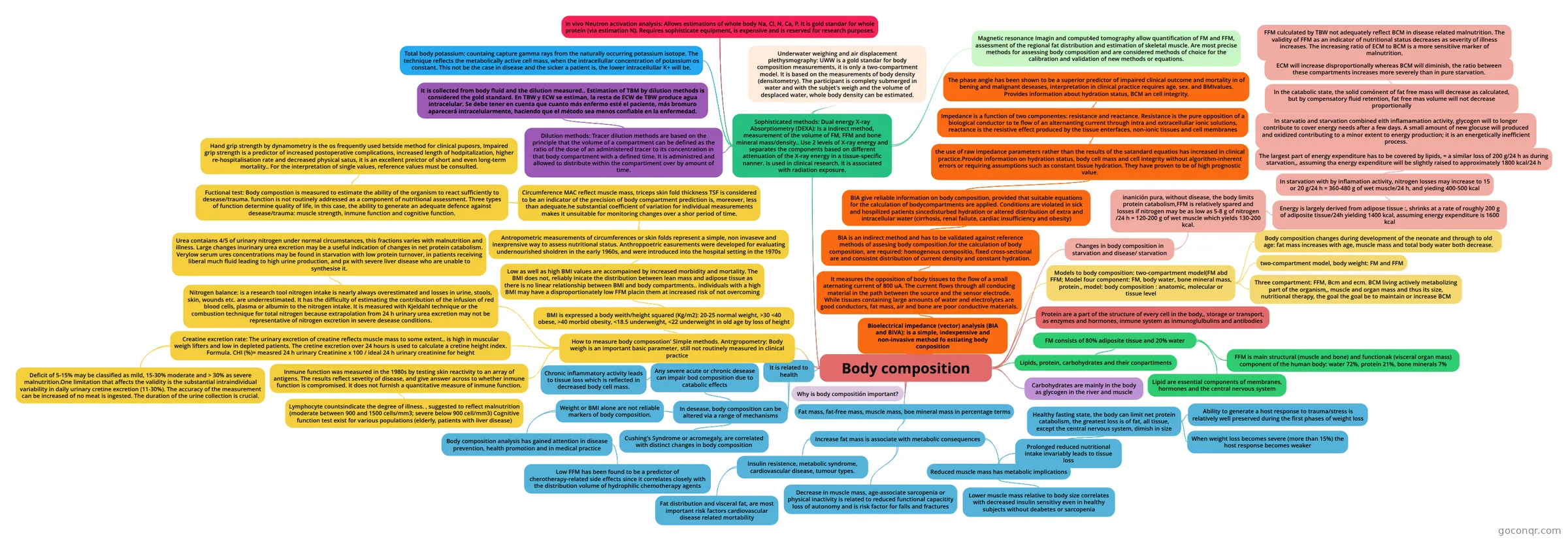
Mind map: Body composition
Contenido del mapa
Body composition
Fat mass, fat-free mass, muscle mass, boe mineral mass in percentage terms
- Increase fat mass is associate with metabolic consequences
- Insulin resistence, metabolic syndrome, cardiovascular disease, tumour types.
- Fat distribution and visceral fat, are most important risk factors cardiovascular disease related mortability
- Decrease in muscle mass, age-associate sarcopenia or physical inactivity is related to reduced functional capacitity loss of autonomy and is risk factor for falls and fractures
- Reduced muscle mass has metabolic implications
- Lower muscle mass relative to body size correlates with decreased insulin sensitivy even in healthy subjects without deabetes or sarcopenia
- Prolonged reduced nutritional intake invariably leads to tissue loss
- Healthy fasting state, the body can limit net protein catabolism, the greatest loss is of fat, all tissue, except the central nervous system, dimish in size
- Ability to generate a host response to trauma/stress is relatively well preserved during the first phases of weight loss
- When weight loss becomes severe (more than 15%) the host response becomes weaker
- Healthy fasting state, the body can limit net protein catabolism, the greatest loss is of fat, all tissue, except the central nervous system, dimish in size
- Insulin resistence, metabolic syndrome, cardiovascular disease, tumour types.
- Increase fat mass is associate with metabolic consequences
It is related to health
- In desease, body composition can be altered via a range of mechanisms
- Cushing's Syndrome or acromegaly, are correlated with distinct changes in body composition
- Any severe acute or chronic desease can impair bod composition due to catabolic effects
- Chronic inflammatory activity leads to tissue loss which is reflected in decreased body cell mass.
- Weight or BMI alone are not reliable markers of body composition.
- Body composition analysis has gained attention in disease prevention, health promotion and in medical practice
- Low FFM has been found to be a predictor of cherotherapy-related side effects since it correlates closely with the distribution volume of hydrophilic chemotherapy agents
- Body composition analysis has gained attention in disease prevention, health promotion and in medical practice
- In desease, body composition can be altered via a range of mechanisms
Why is body compositión important?
Lipids, protein, carbohydrates and their conpartiments
- FM consists of 80% adiposite tissue and 20% water
- Lipid are essential components of membranes, hormones and the central nervous system
- FFM is main structural (muscle and bone) and functionak (visceral organ mass) component of the human body: water 72%, proteín 21%, bone minerals 7%
- FM consists of 80% adiposite tissue and 20% water
Protein are a part of the structure of every cell in the body,, storage or transport, as enzymes and hormones, inmune system as inmunoglulbulins and antibodies
Carbohydrates are mainly in the body as glycogen in the river and muscle
Models to body composition: two-compartment model(FM abd FFM; Model four component: FM, body water, bone mineral mass, protein., model: body composition : anatomic, molecular or tissue level
- two-compartment model, body weight: FM and FFM
- Three compartment: FFM, Bcm and ecm. BCM living actively metabolizing part of the organism,, muscle and organ mass and thus its size, nutritional therapy, the goal the goal be to maintain or increase BCM
- Body composition changes during development of the neonate and through to old age: fat mass increases with age, muscle mass and total body water both decrease.
Changes in body composition in starvation and disease/ starvation
- inanición pura, without disease, the body limits protein catabolism,FFM is relatively spared and losses if nitrogen may be as low as 5-8 g of nitrogen /24 h = 120-200 g of wet muscle which yields 130-200 kcal.
- Energy is largely derived from adipose tissue :, shrinks at a rate of roughly 200 g of adiposite tissue/24h yielding 1400 kcal, assuming energy expenditure is 1600 kcal
- In starvation with by inflamation activity, nitrogen losses may increase to 15 or 20 g/24 h = 360-480 g of wet muscle/24 h, and yieding 400-500 kcal
- The largest part of energy expenditure has to be covered by lipids, = a similar loss of 200 g/24 h as during starvation,, assuming tha energy expenditure will be slightly raised to approximately 1800 kcal/24 h
- In starvatio and starvation combined eith inflamamation activity, glycogen will to longer contribute to cover energy needs after a few days. A small amount of new glocuse will produced and oxidized contributing to a minor extent to energy production; it is an energetically inefficient process.
- In the catabolic state, the solid comónent of fat free mass will decrease as calculated, but by compensatory fluid retention, fat free mas volume will not decrease proportionally
- ECM will increase disproportionally whereas BCM will diminish, the ratio between these compartments increases more severely than in pure starvation.
- FFM culculated by TBW not adequately reflect BCM in disease related malnutrition. The validity of FFM as an indicator of nutritional status decreases as severity of illness increases. The increasing ratio of ECM to BCM is a more sensitiive marker of malnutrition.
- ECM will increase disproportionally whereas BCM will diminish, the ratio between these compartments increases more severely than in pure starvation.
- In the catabolic state, the solid comónent of fat free mass will decrease as calculated, but by compensatory fluid retention, fat free mas volume will not decrease proportionally
- In starvatio and starvation combined eith inflamamation activity, glycogen will to longer contribute to cover energy needs after a few days. A small amount of new glocuse will produced and oxidized contributing to a minor extent to energy production; it is an energetically inefficient process.
- The largest part of energy expenditure has to be covered by lipids, = a similar loss of 200 g/24 h as during starvation,, assuming tha energy expenditure will be slightly raised to approximately 1800 kcal/24 h
- In starvation with by inflamation activity, nitrogen losses may increase to 15 or 20 g/24 h = 360-480 g of wet muscle/24 h, and yieding 400-500 kcal
- Energy is largely derived from adipose tissue :, shrinks at a rate of roughly 200 g of adiposite tissue/24h yielding 1400 kcal, assuming energy expenditure is 1600 kcal
- inanición pura, without disease, the body limits protein catabolism,FFM is relatively spared and losses if nitrogen may be as low as 5-8 g of nitrogen /24 h = 120-200 g of wet muscle which yields 130-200 kcal.
How to measure body composotion' Simple methods. Antrgropometry: Body weigh is an important basic parameter, still not routinely measured in clinical practice
- BMI is expressed a body weith/height squared (Kg/m2): 20-25 normal weight, >30 <40 obese, >40 morbid obesity, <18.5 underweight, <22 underweight in old age by loss of height
- Low as well as high BMI values are accompained by increased morbidity and mortality. The BMI does not, reliably inicate the distribution between lean mass and adipose tissue as there is no linear relationship between BMI and body compartments.. individuals with a high BMI may have a disproportionately low FFM placin them at increased risk of not overcoming
- Antropometric measurements of circumferences or skin folds represent a simple, non invaseve and inexprensive way to assess nutritional status. Anthroppoetric easurements were developed for evaluating undernourished sholdren in the early 1960s, and were introduced into the hospital setting in the 1970s
- Circumference MAC reflect muscle mass, triceps skin fold thickness TSF is considered to be an indicator of the precision of body compartment prediction is, moreover, less than adequate.he substantial coefficient of variation for individual measurements makes it unsuitable for monitoring changes over a shor period of time.
- Fuctional test: Body compostion is measured to estimate the ability of the organism to react sufficiently to desease/trauma. function is not routinely addressed as a component of nutritional assessment. Three types of function determine quality of life, in this case, the ability to generate an adequate defence against desease/trauma: muscle strength, inmune function and cognitive function.
- Hand grip strength by dynamometry is the os frequently used betside method for clinical puposrs, Impaired grip strength is a predictor of increased postoperative complications, increased length of hodpitalization, higher re-hospitalisation rate and decreased physical satus, it is an excellent preictor of short and even long-term mortality.. For the interpretation of single values, reference values must be consulted.
- Fuctional test: Body compostion is measured to estimate the ability of the organism to react sufficiently to desease/trauma. function is not routinely addressed as a component of nutritional assessment. Three types of function determine quality of life, in this case, the ability to generate an adequate defence against desease/trauma: muscle strength, inmune function and cognitive function.
- Circumference MAC reflect muscle mass, triceps skin fold thickness TSF is considered to be an indicator of the precision of body compartment prediction is, moreover, less than adequate.he substantial coefficient of variation for individual measurements makes it unsuitable for monitoring changes over a shor period of time.
- Antropometric measurements of circumferences or skin folds represent a simple, non invaseve and inexprensive way to assess nutritional status. Anthroppoetric easurements were developed for evaluating undernourished sholdren in the early 1960s, and were introduced into the hospital setting in the 1970s
- Low as well as high BMI values are accompained by increased morbidity and mortality. The BMI does not, reliably inicate the distribution between lean mass and adipose tissue as there is no linear relationship between BMI and body compartments.. individuals with a high BMI may have a disproportionately low FFM placin them at increased risk of not overcoming
- Inmune function was measured in the 1980s by testing skin reactivity to an array of antigens. The results reflect sevetity of disease, and give answer across to whether inmune function is compromised. It does not furnish a quantitative measure of inmune function.
- Lymphocyte countsindicate the degree of illness. , suggested to reflect malnutrition (moderate between 900 and 1500 cells/mm3; severe below 900 cell/mm3) Cognitive function test exist for various populations (elderly, patients with liver disease)
- Creatine excretion rate: The urinary excretion of creatine reflects muscle mass to some extent.. is high in muscular weigh lifters and low in depleted patients. The cretine excretion over 24 hours is used to calculate a cretine height index. Formula. CHI (%)= measred 24 h urinary Creatinine x 100 / ideal 24 h urinary creatinine for height
- Deficit of 5-15% may be classified as mild, 15-30% moderate and > 30% as severe malnutrition.One limitation that affects the validity is the substantial intraindividual variability in daily urinary cretine excretion (11-30%). The accuracy of the measurement can be increased of no meat is ingested. The duration of the urine collection is crucial.
- Nitrogen balance: is a research tool nitrogen intake is nearly always overestimated and losses in urine, stools, skin, wounds etc. are underrestimated. It has the difficulty of estimating the contribution of the infusion of red blood cells, plasma or albumin to the nitrogen intake. It is measured with Kjeldahl technique or the combustion technique for total nitrogen because extrapolation from 24 h urinary urea excretion may not be representative of nitrogen excretion in severe desease conditions.
- Urea contaians 4/5 of urinary nitrogen under normal circumstances, this fractions varies with malnutrition and illness. Large changes inurinary urea excretion may be a useful indication of changes in net protein catabolism. Verylow serum ures concentrations may be found in starvation with low protein turnover, in patients receiving liberal much fluid leading to high urine production, and px with severe liver disease who are unable to synthesise it.
- BMI is expressed a body weith/height squared (Kg/m2): 20-25 normal weight, >30 <40 obese, >40 morbid obesity, <18.5 underweight, <22 underweight in old age by loss of height
Bioelectrical impedance (vector) analysis (BIA and BIVA): is a simple, indexpensive and non-invasive method fo estiating body conposition
- It measures the opposition of body tissues to the flow of a small aternating current of 800 uA. The current flows through all conducing material in the path between the source and the sensor electrode. While tissues containing large amounts of water and electrolytes are good conductors, fat mass, air and bone are poor conductive materials.
- BIA is an indirect method and has to be validated against reference methods of assesing body composition.for the calculation of body composition, are required: homogenous compositio, fixed cross-sectional are and consistnt distribution of current density and constant hydration.
- BIA give reliable information on body composition, provided that suitable equations for the calculation of bodycompartments are applied. Conditions are violated in sick and hospilized patients sincedisturbed hydration or altered distribution of extra and intracellular water (cirrhosis, renal failute, cardiac insufficiency and obesity)
- the use of raw impedance parameters rather than the results of the satandard equatios has increased in clinical practice.Provide information on hydration status, body cell mass and cell integrity without algorithm-inherent errors or requiring assumptions such as constant tissue hydration. They have proven to be of high prognostic value.
- Impedance is a function of two componentes: resistance and reactance. Resistance is the pure opposition of a biological conductor to te flow of an alternanting current through intra and extracellullar ionic solutions, reactance is the resistive effect produced by the tissue enterfaces, non-ionic tissues and cell membranes
- The phase angle has been shown to be a superior predictor of impaired clinical outcome and mortality in of bening and malignant deseases, interpretation in clinical practice requires age, sex. and BMIvalues. Provides information about hydration status, BCM an cell integrity.
- Impedance is a function of two componentes: resistance and reactance. Resistance is the pure opposition of a biological conductor to te flow of an alternanting current through intra and extracellullar ionic solutions, reactance is the resistive effect produced by the tissue enterfaces, non-ionic tissues and cell membranes
- the use of raw impedance parameters rather than the results of the satandard equatios has increased in clinical practice.Provide information on hydration status, body cell mass and cell integrity without algorithm-inherent errors or requiring assumptions such as constant tissue hydration. They have proven to be of high prognostic value.
- BIA give reliable information on body composition, provided that suitable equations for the calculation of bodycompartments are applied. Conditions are violated in sick and hospilized patients sincedisturbed hydration or altered distribution of extra and intracellular water (cirrhosis, renal failute, cardiac insufficiency and obesity)
- BIA is an indirect method and has to be validated against reference methods of assesing body composition.for the calculation of body composition, are required: homogenous compositio, fixed cross-sectional are and consistnt distribution of current density and constant hydration.
- It measures the opposition of body tissues to the flow of a small aternating current of 800 uA. The current flows through all conducing material in the path between the source and the sensor electrode. While tissues containing large amounts of water and electrolytes are good conductors, fat mass, air and bone are poor conductive materials.
Sophisticated methods: Dual energy X-ray Absorptiometry (DEXA): Is a indirect method, measurement of the volume of FM, FFM and bone mineral mass/density.. Use 2 levels of X-ray energy and separates the components based on different attenuation of the X-ray energy in a tissue-specific nanner. Is used in clinical research. it is associated with radiation exposure.
- Magnetic resonance Imagin and comput4ed tomography allow quantification of FM and FFM, assessment of the regional fat distribution and estimation of skeletal muscle. Are most precise methods for assessing body composition and are considered methods of choice for the calibration and validation of new methods or equations.
- Dilution methods: Tracer dilution methods are based on the principle that the volume of a compartment can be defined as the ratio of the dose of an administered tracer to its concentration in that body compartment with a defined time. It is administred and allowed to distribute within the compartiment over by amount of time.
- It is collected from body fluid and the dilution measured.. Estimation of TBM by dilution methods is considered the gold standard. En TBW y ECW se estiman, la resta de ECW de TBW produce agua intracelular. Se debe tener en cuenta que cuanto más enfermo esté el paciente, más bromuro aparecerá intracelularmente, haciendo que el método sea menos confiable en la enfermedad.
- Underwater weighing and air displacement plethysmography: UWW is a gold standar for body composition measurements, it is only a two-compartment model. It is based on the measurements of body density (densitometry). The participant is complety submerged in water and with the subjet's weigh and the volume of desplaced water, whole body density can be estimated.
- Total body potassium: countaing capture gamma rays from the naturally occurring potassium isotope. The technique reflects the metabolically active cell mass, when the intracellullar concentration of potassium os constant. This not be the case in disease and the sicker a patient is, the lower intracellullar K+ will be.
- In vivo Neutron activation analysis: Allows estimations of whole body Na, Cl, N, Ca, P. It is gold standar for whole protein (via estimation N). Requires sophisticate equipment, is expensive and is reserved for research purposes.
Información
- Descripción
- Mapa Mental sobre Body composition, creado por María <violeta Suárez Hernández el 09/09/2020.
- Creado por
- María <violeta Suárez Hernández
- Visitas
- 0
- Valoración