
Mapa mental
GLYCOCONJUGATES
Contenido del mapa
GLYCOCONJUGATES
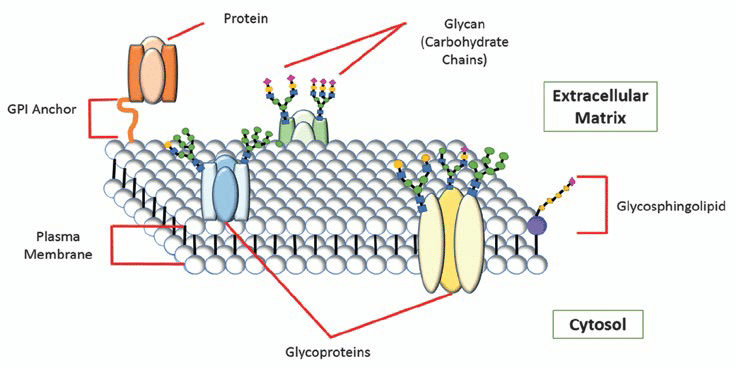
This are organic compounds that consist in the covalent link between carbohydrates (glucose, galactose, mannose, etc.) and macromolecules, mainly lipids and proteins. This compounds can perform several functions in the body depending on their type, ubication or structure
- They are synthesized in the body from the phosphorylated forms of the carbohydrates of the diet, and subsequently get linked with proteins or lipids by the action of enzymes. This link of a carbohydrate can give some advantages to the macromolecules, as they increase their adherence capacity with other molecules and makes them more water soluble, which allow the lipids and proteins to flow on the bloodstream
There are many types of glycoconjugates. In the human body are found, mainly, three types of these compounds, but there are some like the lipopolysaccharides that are bacteria exclusive. However, this can also be found in the body if secreted by a bacterial antigen
- GLYCOPROTEINS
- They are composed by one or more oligosaccharides attached to a protein. They are extended along the body and exert multiple functions as there are several types of these
- They can be structural molecules that help to build and maintain an organic structure in the body
- COLLAGEN
- They can act as a protectant and lubricant agent in certain zones of the body
- MUCIN
- They can be used as tranport molecules for certain compounds that can´t flow through the bloodstream by themselves
- TRANSFERRIN
- They can act as immune molecules that play an important role in the immune response to an infection
- INMUNOGLOBULINS
- They can act as hormones that regulate some functions in the body
- GONADOTROPIN, THYROID STIMULATING HORMONE
- They can act as enzymes that catalyze important reactions in the body processes
- ALKALINE PHOSPHATASE
- Some other functions, are taking part in the hemostasis and some interactions with micro and macro molecules. Some as the NOTCH FACTOR take part in the body growth and development. They can also be part of the cell membrane as receptors of hormones, medicaments, etc.
- They can be structural molecules that help to build and maintain an organic structure in the body
- They are composed by one or more oligosaccharides attached to a protein. They are extended along the body and exert multiple functions as there are several types of these
- GLYCOLIPIDS
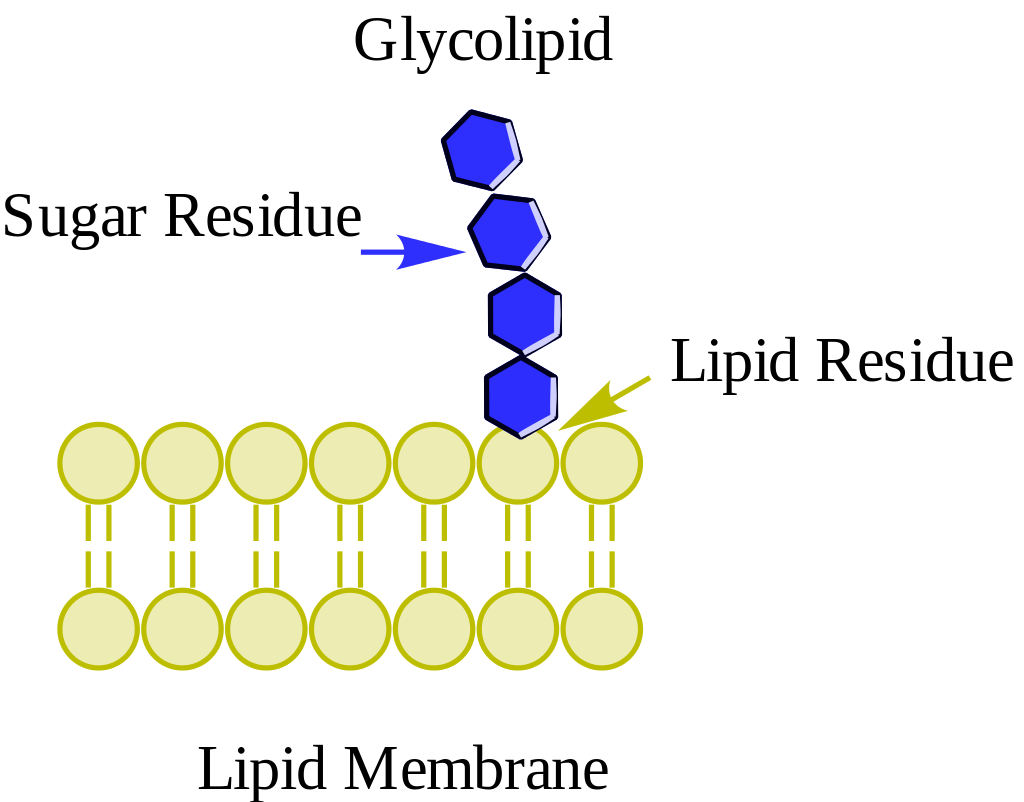
- These are composed by a ceramide (sphingosine + fatty acid) and a glucide, generally, an oligosaccharide. They are part of the polar portion of the membrane cell where they work as specific binding sites for lectins. There are two types of glycolipids, which also divide in some subgroups that perform different functions in the organism
- NEUTRALS
- CEREBROSIDES
- They are components of the brain cells membrane, but can also be found in other tissues depending on their glucide. If the glucide is a galactose, they are known as galactocerebrosides, which are found in the neural tissue, and the glucocerebrosides, which glucide is the glucose, are found in the other tissues.
- GLOBOSIDES
- They are mainly found in the erythrocytes membrane, where they work as receptors, but also participate in cell to cell communication. It can also be a receptor for some toxins
- CEREBROSIDES
- ACIDS
- GANGLIOSIDES
- They are components of the membrane cell, and can be found in a small amount in the brain. They are receptors of the glucoproteic hormones of the pituitary gland, but also of the cholera toxin and some carcinogenic molecules
- SULFATIDES
- They are a component of the membrane cells in most of the body tissues, and it takes part in protein trafficking, cell aggregation and adhesion, neural plasticity, memory, and glial-axon interactions. It also plays a role in several physiological processes and systems, including the nervous system, the immune system, insulin secretion, blood clotting, viral infection, and bacterial infection
- GANGLIOSIDES
- NEUTRALS
- These are composed by a ceramide (sphingosine + fatty acid) and a glucide, generally, an oligosaccharide. They are part of the polar portion of the membrane cell where they work as specific binding sites for lectins. There are two types of glycolipids, which also divide in some subgroups that perform different functions in the organism
- PROTEOGLYCANS
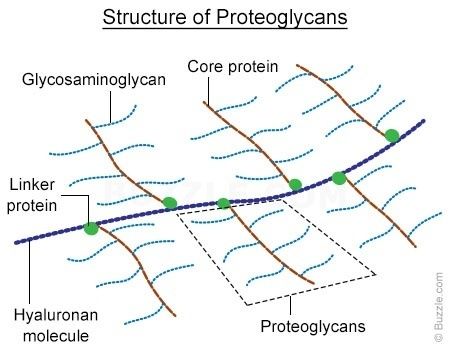
- These are composed by glycosaminoglycans attached to a core protein by a serine residue. Some proteoglycans are aggrecan, versecan, syndecan and perlecan. There are many others though. They are the major component in the extracellular matrix of the connective tissue, and its function is to grant stability and hydratation to the components of this extracellular matrix. They can also bind cations to regulate the movement of molecules through the matrix
- GLYCOSAMINOGLYCANS (GAG)
- Also called Mucopolysaccharides, they are long polysaccharides formed by repeating disaccharides composed by an amino sugar or an uronic sugar. There are 7 types of glycosaminoglycans in the body, and these have a lot of functions
- HYALURONIC ACID
- It´s found in the synovial fluid, vitreous body and in the connective tissue, and it´s very resistant, being able to absorb hits due to their big size and can allow the cartilage compressibility. It also facilitates the cell migration through the ECM (extracellular matrix)
- CHONDROITIN SULFATE
- Can be found in bones, cartilage, and in the heart valves, being the most abundant GAG. Also, they can allow the cartilage compressibility
- DERMATAN SULFATE
- It can be found as a structural component of the skin, blood vessels and heart valves
- KERATAN SULFATE TYPE 1
- It can be found in the cornea. It´s main function is to maintain the cornea transparency
- HEPARIN
- It´s a component of the intracellular granules of mast cells that line the arteries of some organs. It is an anticoagulant, and it can be clinically used as this when needed
- HEPARAN SULFATE
- It´s found in the basal membrane and in the components of the cell surface. It´s function is to determine the charge selectivity in the glomerulus
- KERATAN SULFATE TYPE 2
- It can be found in the cartilage and bones, and as a structural component of the connective tissue
- They all interact with the collagen, elastin, fibronectin, laminin, and other proteins depending their type and function. They are cation attractors as they are negative charged compounds
- HYALURONIC ACID
- Also called Mucopolysaccharides, they are long polysaccharides formed by repeating disaccharides composed by an amino sugar or an uronic sugar. There are 7 types of glycosaminoglycans in the body, and these have a lot of functions
- GLYCOSAMINOGLYCANS (GAG)
- These are composed by glycosaminoglycans attached to a core protein by a serine residue. Some proteoglycans are aggrecan, versecan, syndecan and perlecan. There are many others though. They are the major component in the extracellular matrix of the connective tissue, and its function is to grant stability and hydratation to the components of this extracellular matrix. They can also bind cations to regulate the movement of molecules through the matrix
- GLYCOPROTEINS
The glycoconjugates can lead to several health issues and diseases, which are generally related to genetic disorders which provokes the accumulation of these compounds
- MUCOPOLYSACCHARIDOSIS
- SLY SYNDROME
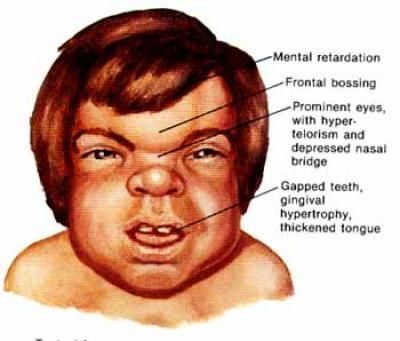
- Accumulation of heparan sulfate, chodroitin sulfate and dermatan sulfate. Symptoms can include an enlarged head, fluid accumulation in the brain, coarse factions, enlarged liver, enlarged spleen, problems with the heart valves, and abdominal hernias. People with Sly syndrome may also suffer from sleep apnea, frequent lung infections, and problems with vision that can lead to cloudy cornea
- SANFILIPPO SYNDROME
- Accumulation of heparan sulfate. It doesn´t cause many physical abnormalities. Its symptoms are related with the mental health, causing behavioral problems and a cognitive degeneration. It can lead to dementia in severe cases
- MORQUIO SYNDROME
- Accumulation of keratan sulfate. It causes progressive changes to the skeleton of the ribs and chest, which may lead to neurological complications such as nerve compression. Patients may also have hearing loss and clouded corneas. Intelligence is usually normal unless a patient suffers from untreated hydrocephalus.
- HUNTER SYNDROME
- Accumulation of Heparan sulfate and dermatan sulfate. It causes many abnormalities in most of the organs, which may affect their functions, and can lead to death in severe cases. This disease also causes the coarsening of the face and provoke thick factions. It´s a sex related syndrome
- HURLER SYNDROME
- Accumulation of heparan sulfate and dermatan sulfate. The symptoms are the face coarsening and thick factions, with some corneal, retinal and cognitive degeneration. This is an autosomic recessive syndrome
- These are inherited conditions related to the accumulation of glycosaminoglycans
- SLY SYNDROME
- GLYCOPROTEINOSIS
- ASPARTYLGLUCOSAMINURIA
- Accumulation of the oligosaccharides attached to glycoproteins. It causes scoliosis, seizures, skin and bones thickening and joint issues. May cause mental disabilities
- These are congenic disorders that cause problems in the glycoprotein degradation
- FUCOSIDOSIS
- Accumulation of glycoproteins and complex sugars. It causes coarse factions, seizures, mental disabilities and degeneration of brain and spinal chord functions. It most of cases leads to death, although, it´s very rare
- MANNOSIDOSIS
- Accumuilation of the oligosaccharides attached to glycoproteins, particurally mannose. It causes mental disabilities, coarse factions, myopathy and ataxia
- SIALIDOSIS
- Accumulation of the sialic acid related to glycoproteins. It causes coarse factions, ataxia, and bone malformations, along with sight degeneration
- ASPARTYLGLUCOSAMINURIA
- GLYCOLIPIDS RELATED
- CEREBROSIDES ACCUMULATION
- The accumulation of glucocerebrosids leads to the Gaucher disease. It causes anemia and thrombocytopenia, along with cirrhosis and neurological issues. On the other hand, there is the accumulation of galactocerebrosides, which leads to the Krabbe disease, that causes neurological issues that affects the white matter of the central nervous system
- SULFATIDES ACCUMULATION
- It causes metachromatic leukodystrophy, which symptoms are related to neurological diseases, leading to paralysis, dementia and seizures. It may also cause myopathy, muscle rigidity and long-term blindness
- GANGLIOSIDOSIS
- It´s the accumulation of gangliosides. There are two types, the GM1 and GM2. The GM1 characterizes for causing psychomotor deterioration along with bone malformations and coarse factions. The GM2 can lead to the Tay–Sachs disease or the Sandhoff disease. The first one causes premature death of brain cells, leading to the degeneration of mental capacity. The second one causes progressive destruction of the brain, spinal chord and the nerve cells.
- GlOBOSIDES ACCUMULATION
- It causes the Fabry disease, that causes acroparesthesia (chronical pain in the body, mainly in the extremities), along with heart and kidney diseases that can lead to the failure of both organs, and subsequently, the death
- CEREBROSIDES ACCUMULATION
- This disorders are caused by the lackness of the enzymes in charge of these compounds degradation. The treatments consist in the supplementation of this enzymes. It can stop the aggravation of the symptoms, but some as the malformations, coarse factions and deterioration can´t be repaired with this treatments
- MUCOPOLYSACCHARIDOSIS
Imágenes y archivos del mapa
Información
- Descripción
- Mapa Mental sobre GLYCOCONJUGATES, creado por Anthony Esteban Gomez Escobar el 12/10/2020.
- Creado por
- Anthony Esteban Gomez Escobar
- Visitas
- 13
- Valoración