
Mapa mental
Cholesterol homeostasis
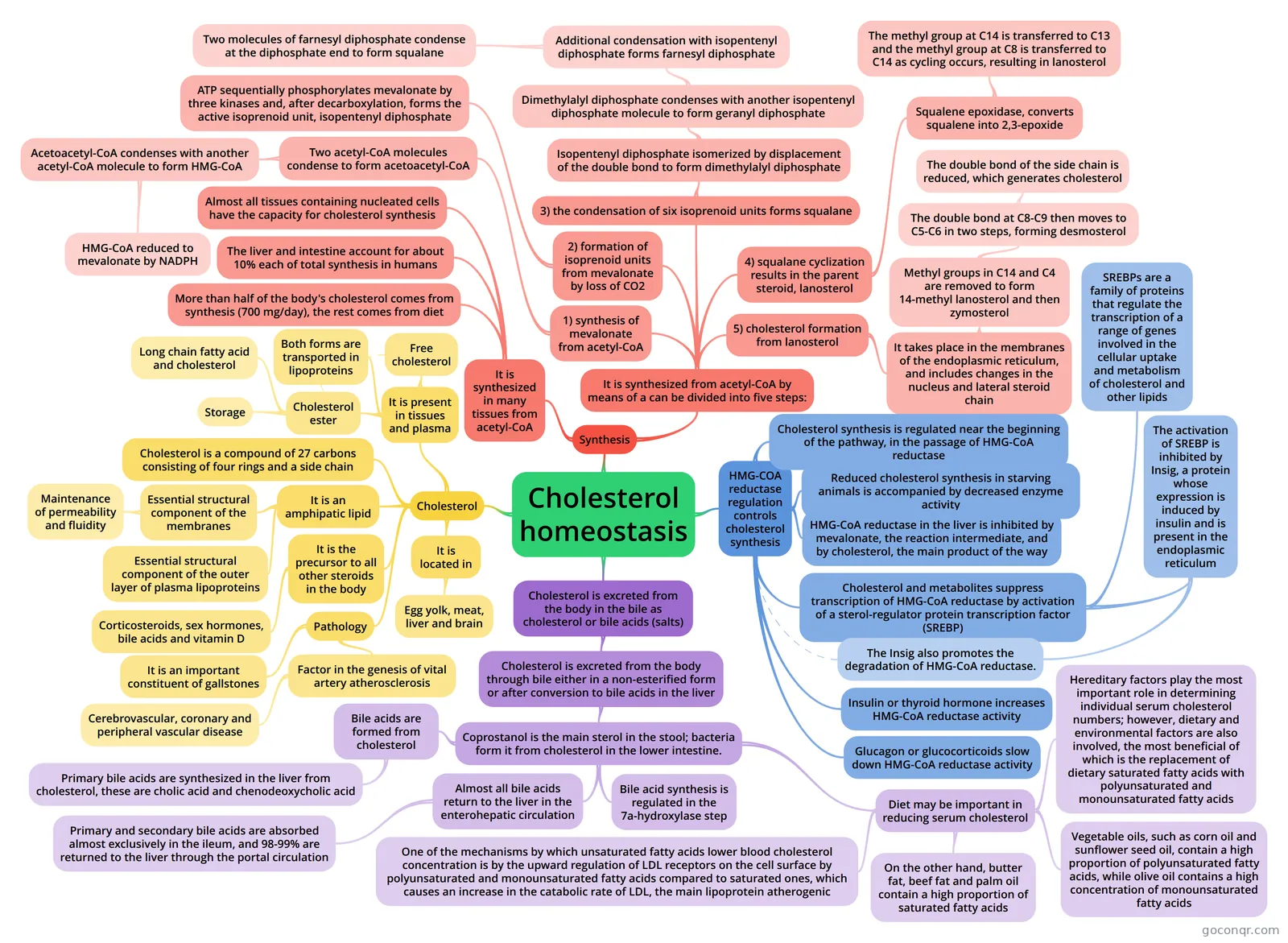
Mind map: Cholesterol homeostasis
Contenido del mapa
Cholesterol homeostasis
Cholesterol
- It is present in tissues and plasma
- Cholesterol ester
- Long chain fatty acid and cholesterol
- Storage
- Both forms are transported in lipoproteins
- Free cholesterol
- Cholesterol ester
- It is an amphipatic lipid
- Essential structural component of the membranes
- Maintenance of permeability and fluidity
- Essential structural component of the outer layer of plasma lipoproteins
- Essential structural component of the membranes
- It is the precursor to all other steroids in the body
- Corticosteroids, sex hormones, bile acids and vitamin D
- It is located in
- Egg yolk, meat, liver and brain
- Pathology
- It is an important constituent of gallstones
- Factor in the genesis of vital artery atherosclerosis
- Cerebrovascular, coronary and peripheral vascular disease
- Cholesterol is a compound of 27 carbons consisting of four rings and a side chain
- It is present in tissues and plasma
Synthesis
- It is synthesized in many tissues from acetyl-CoA
- More than half of the body's cholesterol comes from synthesis (700 mg/day), the rest comes from diet
- The liver and intestine account for about 10% each of total synthesis in humans
- Almost all tissues containing nucleated cells have the capacity for cholesterol synthesis
- It is synthesized from acetyl-CoA by means of a can be divided into five steps:
- 1) synthesis of mevalonate from acetyl-CoA
- Two acetyl-CoA molecules condense to form acetoacetyl-CoA
- Acetoacetyl-CoA condenses with another acetyl-CoA molecule to form HMG-CoA
- HMG-CoA reduced to mevalonate by NADPH
- Acetoacetyl-CoA condenses with another acetyl-CoA molecule to form HMG-CoA
- Two acetyl-CoA molecules condense to form acetoacetyl-CoA
- 2) formation of isoprenoid units from mevalonate by loss of CO2
- ATP sequentially phosphorylates mevalonate by three kinases and, after decarboxylation, forms the active isoprenoid unit, isopentenyl diphosphate
- 3) the condensation of six isoprenoid units forms squalane
- Isopentenyl diphosphate isomerized by displacement of the double bond to form dimethylalyl diphosphate
- Dimethylalyl diphosphate condenses with another isopentenyl diphosphate molecule to form geranyl diphosphate
- Additional condensation with isopentenyl diphosphate forms farnesyl diphosphate
- Two molecules of farnesyl diphosphate condense at the diphosphate end to form squalane
- Additional condensation with isopentenyl diphosphate forms farnesyl diphosphate
- Dimethylalyl diphosphate condenses with another isopentenyl diphosphate molecule to form geranyl diphosphate
- Isopentenyl diphosphate isomerized by displacement of the double bond to form dimethylalyl diphosphate
- 5) cholesterol formation from lanosterol
- It takes place in the membranes of the endoplasmic reticulum, and includes changes in the nucleus and lateral steroid chain
- Methyl groups in C14 and C4 are removed to form 14-methyl lanosterol and then zymosterol
- The double bond at C8-C9 then moves to C5-C6 in two steps, forming desmosterol
- The double bond of the side chain is reduced, which generates cholesterol
- The double bond at C8-C9 then moves to C5-C6 in two steps, forming desmosterol
- Methyl groups in C14 and C4 are removed to form 14-methyl lanosterol and then zymosterol
- It takes place in the membranes of the endoplasmic reticulum, and includes changes in the nucleus and lateral steroid chain
- 4) squalane cyclization results in the parent steroid, lanosterol
- Squalene epoxidase, converts squalene into 2,3-epoxide
- The methyl group at C14 is transferred to C13 and the methyl group at C8 is transferred to C14 as cycling occurs, resulting in lanosterol
- Squalene epoxidase, converts squalene into 2,3-epoxide
- 1) synthesis of mevalonate from acetyl-CoA
- It is synthesized in many tissues from acetyl-CoA
HMG-COA reductase regulation controls cholesterol synthesis
- Cholesterol synthesis is regulated near the beginning of the pathway, in the passage of HMG-CoA reductase
- Reduced cholesterol synthesis in starving animals is accompanied by decreased enzyme activity
- HMG-CoA reductase in the liver is inhibited by mevalonate, the reaction intermediate, and by cholesterol, the main product of the way
- Cholesterol and metabolites suppress transcription of HMG-CoA reductase by activation of a sterol-regulator protein transcription factor (SREBP)
- SREBPs are a family of proteins that regulate the transcription of a range of genes involved in the cellular uptake and metabolism of cholesterol and other lipids
- The activation of SREBP is inhibited by Insig, a protein whose expression is induced by insulin and is present in the endoplasmic reticulum
- The Insig also promotes the degradation of HMG-CoA reductase.
- Insulin or thyroid hormone increases HMG-CoA reductase activity
- Glucagon or glucocorticoids slow down HMG-CoA reductase activity
Cholesterol is excreted from the body in the bile as cholesterol or bile acids (salts)
- Cholesterol is excreted from the body through bile either in a non-esterified form or after conversion to bile acids in the liver
- Coprostanol is the main sterol in the stool; bacteria form it from cholesterol in the lower intestine.
- Bile acids are formed from cholesterol
- Primary bile acids are synthesized in the liver from cholesterol, these are cholic acid and chenodeoxycholic acid
- Almost all bile acids return to the liver in the enterohepatic circulation
- Primary and secondary bile acids are absorbed almost exclusively in the ileum, and 98-99% are returned to the liver through the portal circulation
- Bile acid synthesis is regulated in the 7a-hydroxylase step
- Diet may be important in reducing serum cholesterol
- Hereditary factors play the most important role in determining individual serum cholesterol numbers; however, dietary and environmental factors are also involved, the most beneficial of which is the replacement of dietary saturated fatty acids with polyunsaturated and monounsaturated fatty acids
- Vegetable oils, such as corn oil and sunflower seed oil, contain a high proportion of polyunsaturated fatty acids, while olive oil contains a high concentration of monounsaturated fatty acids
- On the other hand, butter fat, beef fat and palm oil contain a high proportion of saturated fatty acids
- One of the mechanisms by which unsaturated fatty acids lower blood cholesterol concentration is by the upward regulation of LDL receptors on the cell surface by polyunsaturated and monounsaturated fatty acids compared to saturated ones, which causes an increase in the catabolic rate of LDL, the main lipoprotein atherogenic
- Bile acids are formed from cholesterol
- Coprostanol is the main sterol in the stool; bacteria form it from cholesterol in the lower intestine.
- Cholesterol is excreted from the body through bile either in a non-esterified form or after conversion to bile acids in the liver
Información
- Descripción
- Mapa Mental sobre Cholesterol homeostasis, creado por Brayan Stiven Gutiérrez Minota el 01/11/2020.
- Creado por
- Brayan Stiven Gutiérrez Minota
- Visitas
- 0
- Valoración
Más sobre Cholesterol Metabolism