
Mapa mental
Unit 2 - CLIL Concept and Usage
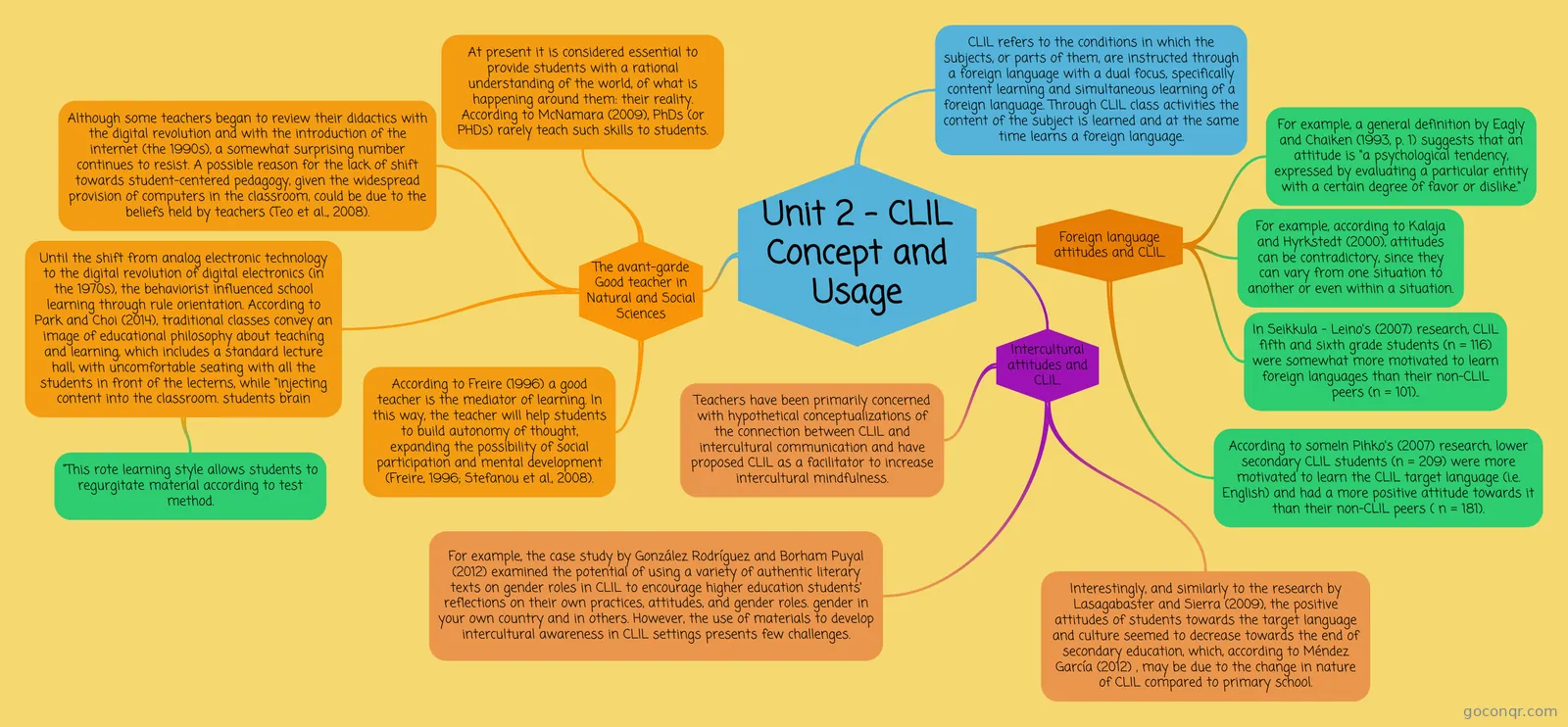
Mind map: CLIL Concept and Usage
Contenido del mapa
Unit 2 - CLIL Concept and Usage
CLIL refers to the conditions in which the subjects, or parts of them, are instructed through a foreign language with a dual focus, specifically content learning and simultaneous learning of a foreign language. Through CLIL class activities the content of the subject is learned and at the same time learns a foreign language.
Foreign language attitudes and CLIL.
- For example, a general definition by Eagly and Chaiken (1993, p. 1) suggests that an attitude is "a psychological tendency, expressed by evaluating a particular entity with a certain degree of favor or dislike."
- For example, according to Kalaja and Hyrkstedt (2000), attitudes can be contradictory, since they can vary from one situation to another or even within a situation.
- According to someIn Pihko's (2007) research, lower secondary CLIL students (n = 209) were more motivated to learn the CLIL target language (i.e. English) and had a more positive attitude towards it than their non-CLIL peers ( n = 181).
- In Seikkula - Leino's (2007) research, CLIL fifth and sixth grade students (n = 116) were somewhat more motivated to learn foreign languages than their non-CLIL peers (n = 101)..
Intercultural attitudes and CLIL.
- Teachers have been primarily concerned with hypothetical conceptualizations of the connection between CLIL and intercultural communication and have proposed CLIL as a facilitator to increase intercultural mindfulness.
- Interestingly, and similarly to the research by Lasagabaster and Sierra (2009), the positive attitudes of students towards the target language and culture seemed to decrease towards the end of secondary education, which, according to Méndez García (2012) , may be due to the change in nature of CLIL compared to primary school.
- For example, the case study by González Rodríguez and Borham Puyal (2012) examined the potential of using a variety of authentic literary texts on gender roles in CLIL to encourage higher education students' reflections on their own practices, attitudes, and gender roles. gender in your own country and in others. However, the use of materials to develop intercultural awareness in CLIL settings presents few challenges.
The avant-garde Good teacher in Natural and Social Sciences
- According to Freire (1996) a good teacher is the mediator of learning. In this way, the teacher will help students to build autonomy of thought, expanding the possibility of social participation and mental development (Freire, 1996; Stefanou et al., 2008).
- Until the shift from analog electronic technology to the digital revolution of digital electronics (in the 1970s), the behaviorist influenced school learning through rule orientation. According to Park and Choi (2014), traditional classes convey an image of educational philosophy about teaching and learning, which includes a standard lecture hall, with uncomfortable seating with all the students in front of the lecterns, while "injecting content into the classroom. students brain
- "This rote learning style allows students to regurgitate material according to test method.
- Although some teachers began to review their didactics with the digital revolution and with the introduction of the internet (the 1990s), a somewhat surprising number continues to resist. A possible reason for the lack of shift towards student-centered pedagogy, given the widespread provision of computers in the classroom, could be due to the beliefs held by teachers (Teo et al.., 2008).
- At present it is considered essential to provide students with a rational understanding of the world, of what is happening around them: their reality. According to McNamara (2009), PhDs (or PHDs) rarely teach such skills to students.
Información
- Descripción
- UNiversidaad nacional UNAD
- Creado por
- Dago Néstor Ropain Martínez
- Visitas
- 1
- Valoración