
Mapa mental
UPPER LIMB EXOSKELETONS
Contenido del mapa
UPPER LIMB EXOSKELETONS
Desing of the upper limb exoskeletons.
- Purposes
- Power amplification.
- Assistance.
- substitucion of the motor function.
- Replicate the kinematics and dynamics of human.
- The design deped from the end user application.
- Complex skeletal structures.
- Classification.
- Degrees of Freedom.
- Single joint.
- Multi joint.
- Type of actuation.
- Electrical.
- Pneumatic.
- Hydraulic.
- Shape memory alloys.
- Passive.
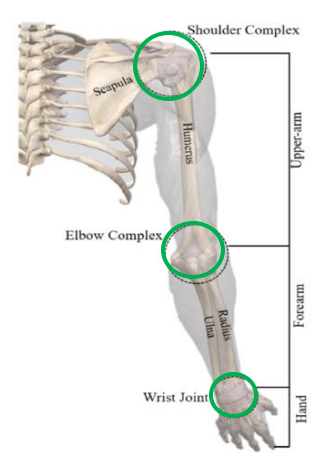
- Joints.
- Shoulder.
- Elbow
- Wrist.
- Hand.
- Applications.
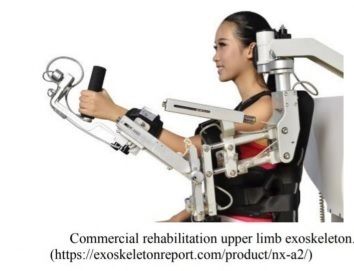
- Used in rehabilitation
- Reduces the need of a therapist.
- Reduces the period of rehabilitation process.
- controlable and safe.
- Used for power assist
- Portable and advantage of mobility.
- Compact, ligh weighted, easy to use and setup.
- Used in rehabilitation
- Degrees of Freedom.
- Control Strategies
- Assistance.
- The robot is supporting the weight of the limb damaged and providing strength to finish the task.
- Passive control.
- The easiest way to control an exoskeleton is to control its motion rigidly along a certain reference trajectory with the help of position feedback control.
- Passive trajectory tracking.
- These references are regulary made by recording the therapist contributions regarding the subject limb joined to the exoskeleton amid a teaching stage.
- Passive mirroring.
- Can be used for the exoskeletos that are intended to support both human arms simultaneosly. it involves the synchronous passive mimicking of the movement and behavior of a healthy limb. it is employed in a master and slave configuration.
- Partially Assistive Control.
- Impedance/admittance control.
- Real-time adaptability between the robotic exoskeleton and contact forces is resquiered to improve the interaction between two bodies.
- Imdance control is a model based force controller with position feedback.
- This techniques is widely used in robotic exoskeletons to improve the pHRI and it has been observed that this method is quite effective in the case of lightweight
- Impedance/admittance control.
- Passive control.
- The robot is supporting the weight of the limb damaged and providing strength to finish the task.
- Correction.
- In the rehabilitacion scenario in which the robot acts only when the patient performs incorrect movements.
- Tunneling
- Comprises making virtual channeles for the end-effector or the joints of the exoskeleton in which the subject movec:once he/she leaves the channels, the input control takes them again into the channel as though a spring impedance as connected from the lim to the focal point of the virtual channel.
- Tunneling
- In the rehabilitacion scenario in which the robot acts only when the patient performs incorrect movements.
- Resistance.
- Is that the robots restricts movement. it increases the complexity of the task so that the patient learns and improves his ability to correct movement errors.
- Assistance.
- Purposes
Possible challenges in Upper Limb exoskeleton development.
- Discomfort and misalignment.
- Human-robot interaction
- Kinematic compatibility.
- Workspace limitation
- Singularity problem of mechanical system.
- Sensing and estimation.
Examples
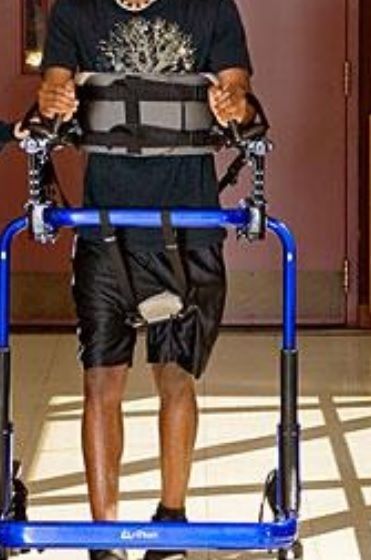
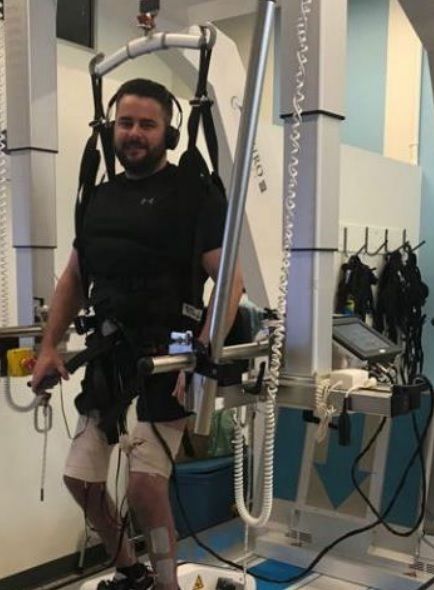
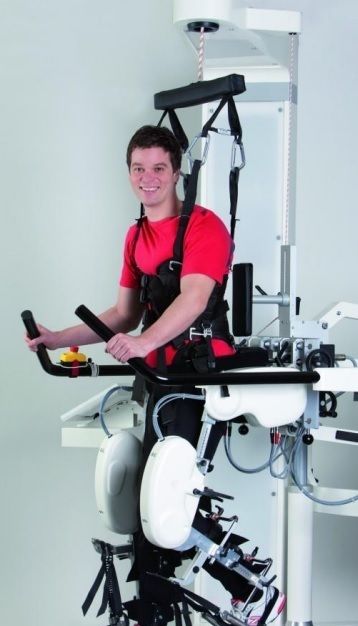
- LOKOMAT16
- Is a robot gait orthosis combined with a harness supported body weiight system, used in combination with a treadmil.
- The patient´s leg joints are guided according to a preprogrammed gait kinematic pattern.
- Is a robot gait orthosis combined with a harness supported body weiight system, used in combination with a treadmil.
- Gait Trainer
- Is based on a double crank and rocker gear system.
- Cosists of two footplates positioned on two bars, two rockers and two cranks which provide the propulsion.
- Is based on a double crank and rocker gear system.
- G-EO System
- Is based on the end-effector principle and was desing to minimoze the therapeutic effort needed for relearning walking and also stair climbing.
- the trajectories of the footplates as well as the vertical and horizontal movements of the center of mass are fully programmable.
- Is based on the end-effector principle and was desing to minimoze the therapeutic effort needed for relearning walking and also stair climbing.
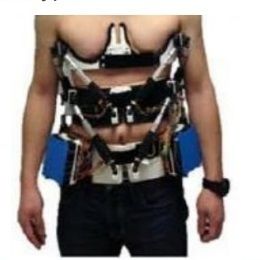
- EXO-SPINE
- Have been developed to support and strengthen the user´s apine and can aso be one of the rehabilitation device too.
- LOKOMAT16
Actuation
- Electric motors.
- High control precision and quick response. focuses more on how to arcchive a better physical human machine interaction high cost.
- Series elastic actuators.
- Archiving stable force control.
- Hydraulic actuators.
- Challenges to the controller´s design. heabypumps and compressed gas containers may sacrifice the system´s portability.
- Pneumatic actuators
- control is less precise. additional this category of actuatos suitable providing assistance or robotic physical therapy to elderly people and patient.
- Electric motors.
Imágenes y archivos del mapa
Información
- Descripción
- Mapa Mental sobre UPPER LIMB EXOSKELETONS, creado por Elsy Garduño el 13/11/2020.
- Creado por
- Elsy Garduño
- Visitas
- 2
- Valoración