
Robotics
104 resources created by 84 users
This Robotics page on GoConqr gathers community-made mind maps, quizzes, flashcards and notes, from industrial robot components and SCARA kinematics to sensors, programming methods and biped walking. It's built for university students working through manipulator theory, school students meeting robots for the first time, and teachers after ready-made material. There are over 90 resources here, including more than 10 quizzes and over 70 mind maps, made by more than 70 contributors. Pick a map, try a quiz to find your gaps, then make your own.
Top Robotics resources
-
Mind map Industrial Robotics
-
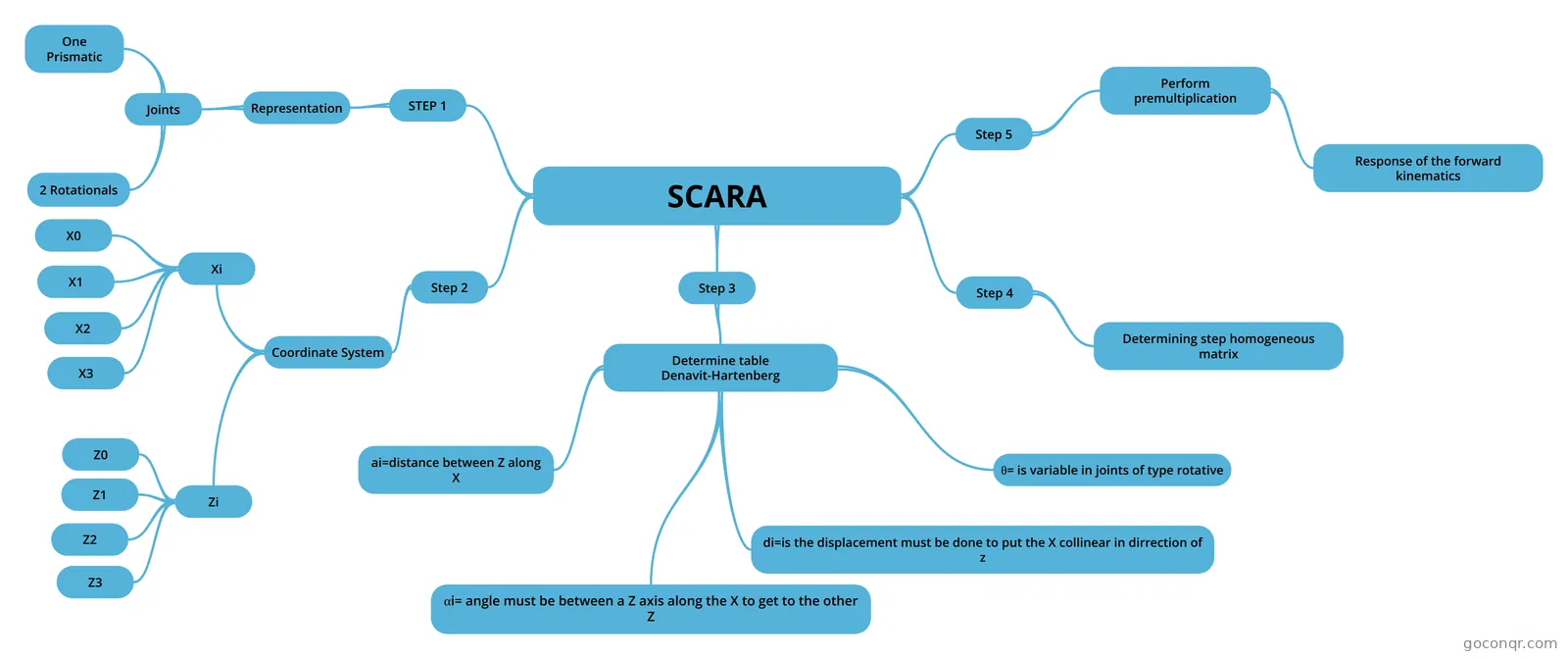 Mind map SCARA Mapa mental Robot SCARA
-
24 cardsMinas Content ! Part 1 (Dexterous Manipulation) Elements of Grasp Planning System?
-
Mind map Adaptive Manipulator Control: A Case Study
-
50 questionsDONE BY HOFFA PART 2 51. The output of the inverse kinematics are
-
41 cards02 Handout 1 refers to a rigid component of a robot that connects two or more joints. A can be like a segment or an arm ...
-
40 questionsQuiz Which one of the following terms refers to the up - down motion of a robot arm?
-
31 questionsChapter 9 - End Effectors Which of the following describes prehensile movements of an end effector?
Quizzes
See all 12 quizzes-
50 questionsDONE BY HOFFA PART 2 51. The output of the inverse kinematics are
-
40 questionsQuiz Which one of the following terms refers to the up - down motion of a robot arm?
-
31 questionsChapter 9 - End Effectors Which of the following describes prehensile movements of an end effector?
-
41 questionsquiz 40. Six different lower-pair joints possible are
-
56 questionsChapter 8 - Sensors
-
50 questionsDONE BY HOFFA PART 3 101. Type of robot is first guided through a sequence of actions by an operator, then repeats the same acti...
-
43 questionsRobo-F What is the name for information sent from robot sensors to robot controllers?
-
13 questionsUntitled
Mind maps
See all 78 mind maps-
Industrial Robotics
-
SCARA Mapa mental Robot SCARA
-
Adaptive Manipulator Control: A Case Study
-
Biped Model Based on Human Gait Pattern Parameters for Sagittal Plane Movement
-
UPPER LIMB EXOSKELETONS
-
Repetitive Control Scheme of Robotic Manipulators Based on Improved B-Spline Function
-
Soft-Robotics and Robotic Hand
-
Industrial Robot Components
Flashcards
-
24 cardsMinas Content ! Part 1 (Dexterous Manipulation) Elements of Grasp Planning System?
-
41 cards02 Handout 1 refers to a rigid component of a robot that connects two or more joints. A can be like a segment or an arm ...
-
31 cards01 Handout 1 an automatically controlled, reprogrammable, multipurpose manipulator with three or more axes.
-
23 cardsLecture 1, euler lagrange modelling What is the euler lagrange equation?
-
4 cardsROBOTS 1. What is a robot?
-
11 cardsWeek 1 Robotics Into
Flowcharts
Notes
-
CURSO DE PATH PLANNING CH1: Sensor Based Planning Problem: Move from point A to point B solution: teh problema depends on robot´s sensor and capabilities Assumptions: (workspace) - a workspace W is a subset of R en 2 d - finite...
-
Fundamentals Of Robotics: Analysis and Control Topics In Fundamentals Of Robotics Robotic Manipulation Drive Kinematics Inverse Kinematics Workspace and Trajectory Planning Differential Motion Statics Manipulator Diagrams Robot Control Robotic Vision Task Planning...
-
Stair climbing robot - created from Mind Map Considertions Motion driver Manufacture
Topics in Robotics
More Mechanical engineering topics
About Robotics
GoConqr OriginalWhat this unit covers
The unit is mostly mind maps, with quizzes, flashcard decks, flowcharts and a few notes alongside. Together they follow a robot from its parts to its movement and control.
Where to start
Begin with the Industrial Robotics mind map. It defines an industrial robot as a reprogrammable device that manipulates and transports parts and tools. Then open Industrial Robot Components, which breaks a robot into controller, arm, driver and end effector, and looks at grippers such as mechanical, vacuum and magnetic types. After that, try Sensors (vision, tactile, range and force/torque) and Programming Methods, which compares teach programming with off-line programming, and point-to-point with continuous motion.
Kinematics and control
Once the basics feel familiar, move on to the maths. The SCARA map walks through a robot with two rotational joints and one prismatic joint, then sets up coordinate systems and a Denavit-Hartenberg table. Other maps and flowcharts cover Denavit-Hartenberg, velocity kinematics and statics, and analytical inverse kinematics. For dynamics and control, look at the Adaptive Manipulator Control case study and the time-optimal control map.
More specialised designs
Some maps look at particular machines: a 30 DOF hyper-redundant robot, biped walking robots, upper limb exoskeletons, medical robots and small flying robots. They suit students who want examples beyond the factory arm.
Using quizzes and maps together
- Read a map and note the terms you cannot explain.
- Take a quiz, such as the one on end effectors or the one on sensors.
- Return to the map for anything you missed.
- Use the flashcard decks to revisit key ideas.
Where it sits
This unit belongs to the Mechatronics and Robotics strand of Mechanical engineering. Pick one map today and see how far it takes you.
Frequently asked questions
Which resource should I open first?
Start with the Industrial Robotics mind map. It sets out what an industrial robot is and what it does. Then move to Industrial Robot Components, Sensors and Programming Methods, which build on those ideas before you reach kinematics and control.
What do the mind maps cover?
They cover robot parts, grippers, sensors and programming methods, then kinematics with SCARA and Denavit-Hartenberg, plus control, power sources and wheels. Others look at hyper-redundant robots, biped walking, exoskeletons and medical robots.
Are there quizzes on this page?
Yes, more than 10. Two are tied to textbook chapters: one on end effectors and one on sensors. Others include Robotic Systems Quick Questions and Robot quiz 1, which work well as short checks after reading a map.
Who are these resources for?
Most are at university level, so they suit university students best, especially on kinematics and control. Some are pitched at school students, and teachers can use the maps and quizzes as ready-made material for lessons.
Do I need to pay or sign in?
No. Every resource listed here is free to open, study and take, with no account. They were made by GoConqr users rather than by GoConqr itself. A free account lets you save quiz scores and make your own.
What if I can't find a topic?
Try the related maps first, since topics such as Denavit-Hartenberg and DH Model appear under several titles. If something is still missing, you can build your own mind map or flashcards from your course notes.