
Mapa mental
Patterns of Reactivity
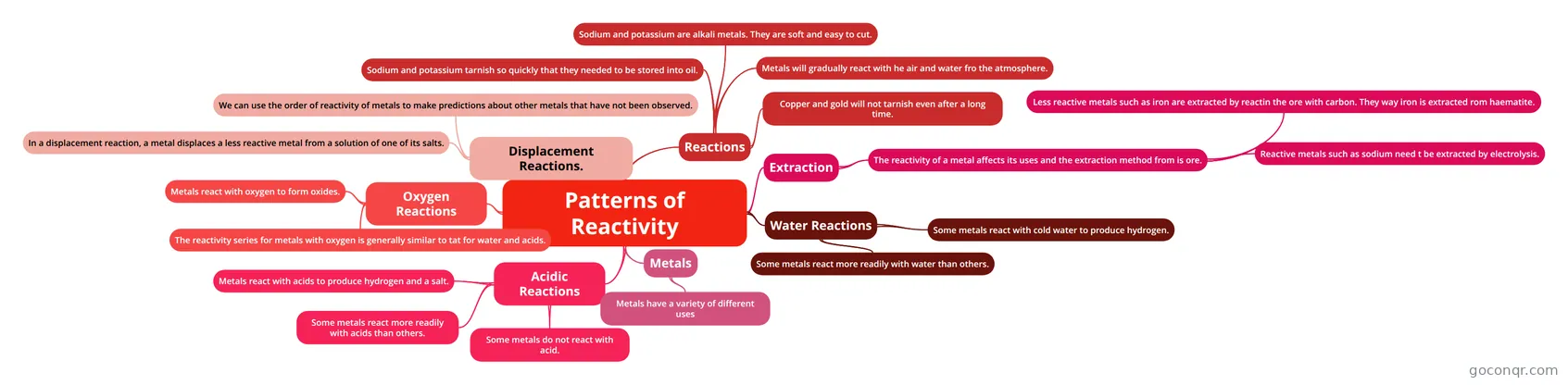
Mind map: Patterns of reactivity
Contenido del mapa
Patterns of Reactivity
Reactions
- Metals will gradually react with he air and water fro the atmosphere.
- Copper and gold will not tarnish even after a long time.
- Sodium and potassium tarnish so quickly that they needed to be stored into oil.
- Sodium and potassium are alkali metals. They are soft and easy to cut.
Water Reactions
- Some metals react with cold water to produce hydrogen.
- Some metals react more readily with water than others.
Acidic Reactions
- Metals react with acids to produce hydrogen and a salt.
- Some metals react more readily with acids than others.
- Some metals do not react with acid.
Oxygen Reactions
- Metals react with oxygen to form oxides.
- The reactivity series for metals with oxygen is generally similar to tat for water and acids.
Displacement Reactions.
- In a displacement reaction, a metal displaces a less reactive metal from a solution of one of its salts.
- We can use the order of reactivity of metals to make predictions about other metals that have not been observed.
Metals
- Metals have a variety of different uses
Extraction
- The reactivity of a metal affects its uses and the extraction method from is ore.
- Less reactive metals such as iron are extracted by reactin the ore with carbon. They way iron is extracted rom haematite.
- Reactive metals such as sodium need t be extracted by electrolysis.
- The reactivity of a metal affects its uses and the extraction method from is ore.
Información
- Descripción
- This is a year 9 chemistry topic summary mind map on: Patterns of Reactivity.
- Creado por
- lillycherriman
- Visitas
- 58
- Etiquetas
- Valoración