
Mapa mental
RESTORING CAVITIES - AMALGAM
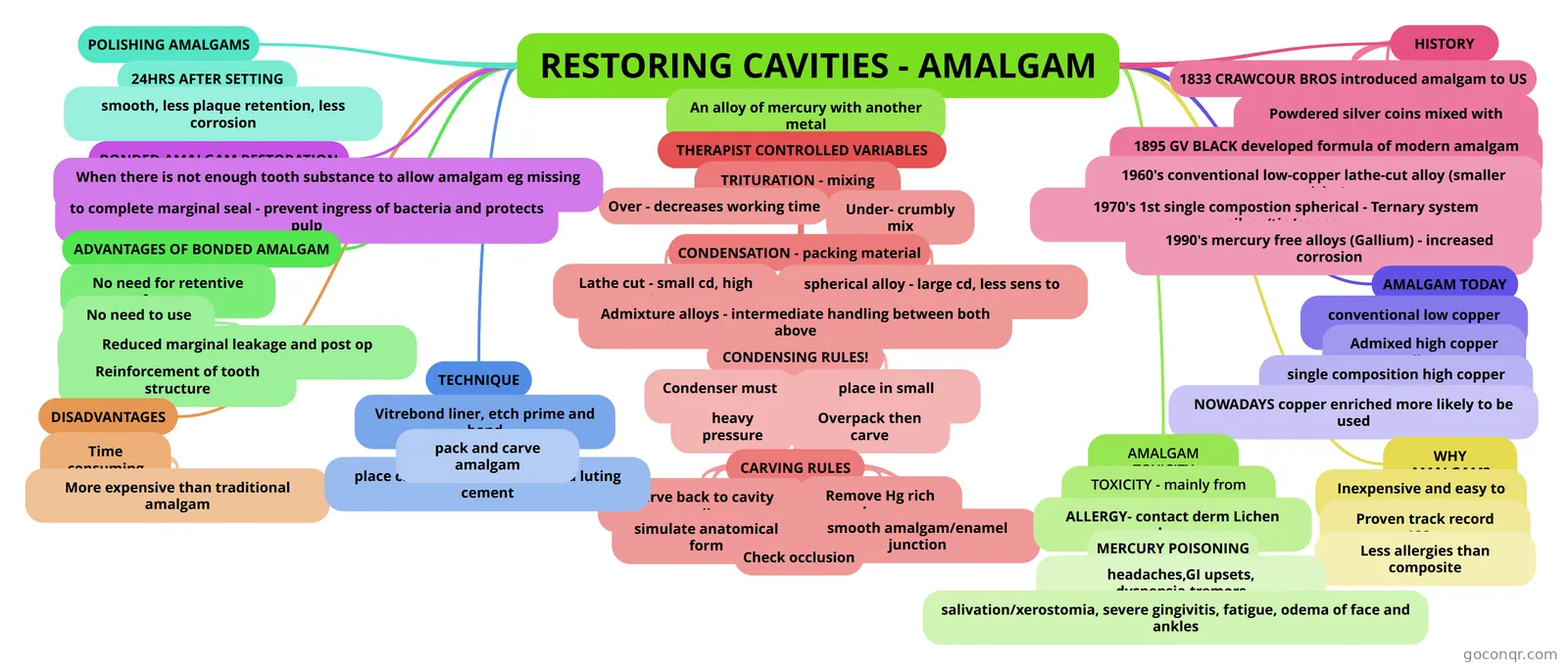
Mind map: restoring cavities amalgam
Contenido del mapa
RESTORING CAVITIES - AMALGAM
An alloy of mercury with another metal
HISTORY
- 1833 CRAWCOUR BROS introduced amalgam to US
- Powdered silver coins mixed with mercury
- 1895 GV BLACK developed formula of modern amalgam alloy
- 1960's conventional low-copper lathe-cut alloy (smaller particles)
- 1970's 1st single compostion spherical - Ternary system silver/tin/copper
- 1990's mercury free alloys (Gallium) - increased corrosion
AMALGAM TODAY
- conventional low copper alloys
- Admixed high copper alloys
- single composition high copper alloys
- NOWADAYS copper enriched more likely to be used
- single composition high copper alloys
- Admixed high copper alloys
- conventional low copper alloys
WHY AMALGAM?
- Inexpensive and easy to use
- Proven track record >100yrs
- Less allergies than composite
- Proven track record >100yrs
- Inexpensive and easy to use
THERAPIST CONTROLLED VARIABLES
- TRITURATION - mixing time
- Over - decreases working time
- Under- crumbly mix
- CONDENSATION - packing material
- Lathe cut - small cd, high force
- spherical alloy - large cd, less sens to force
- Admixture alloys - intermediate handling between both above
- CONDENSING RULES!
- Condenser must fit!
- place in small increments
- heavy pressure
- Overpack then carve
- CARVING RULES
- Carve back to cavity outline
- Remove Hg rich layer
- simulate anatomical form
- smooth amalgam/enamel junction
- Check occlusion
- TRITURATION - mixing time
POLISHING AMALGAMS
- 24HRS AFTER SETTING
- smooth, less plaque retention, less corrosion
- 24HRS AFTER SETTING
BONDED AMALGAM RESTORATION
- When there is not enough tooth substance to allow amalgam eg missing cusps
- to complete marginal seal - prevent ingress of bacteria and protects pulp
ADVANTAGES OF BONDED AMALGAM
- No need for retentive feature
- No need to use pins
- Reduced marginal leakage and post op sensitivity
- Reinforcement of tooth structure
- No need for retentive feature
DISADVANTAGES
- Time consuming
- More expensive than traditional amalgam
- Time consuming
TECHNIQUE
- Vitrebond liner, etch prime and bond
- place chemical cure resin based luting cement
- pack and carve amalgam
- place chemical cure resin based luting cement
- Vitrebond liner, etch prime and bond
AMALGAM TOXICITY
- TOXICITY - mainly from mercury
- ALLERGY- contact derm Lichen planus
- MERCURY POISONING
- headaches,GI upsets, dyspepsia,tremors
- salivation/xerostomia, severe gingivitis, fatigue, odema of face and ankles
- MERCURY POISONING
- ALLERGY- contact derm Lichen planus
- TOXICITY - mainly from mercury
Información
- Descripción
- Restorative dentistry Mapa Mental sobre RESTORING CAVITIES - AMALGAM, creado por aahughes el 18/10/2013.
- Creado por
- aahughes
- Visitas
- 132
- Etiquetas
- Valoración