
Mapa mental
Methods, hormones & development
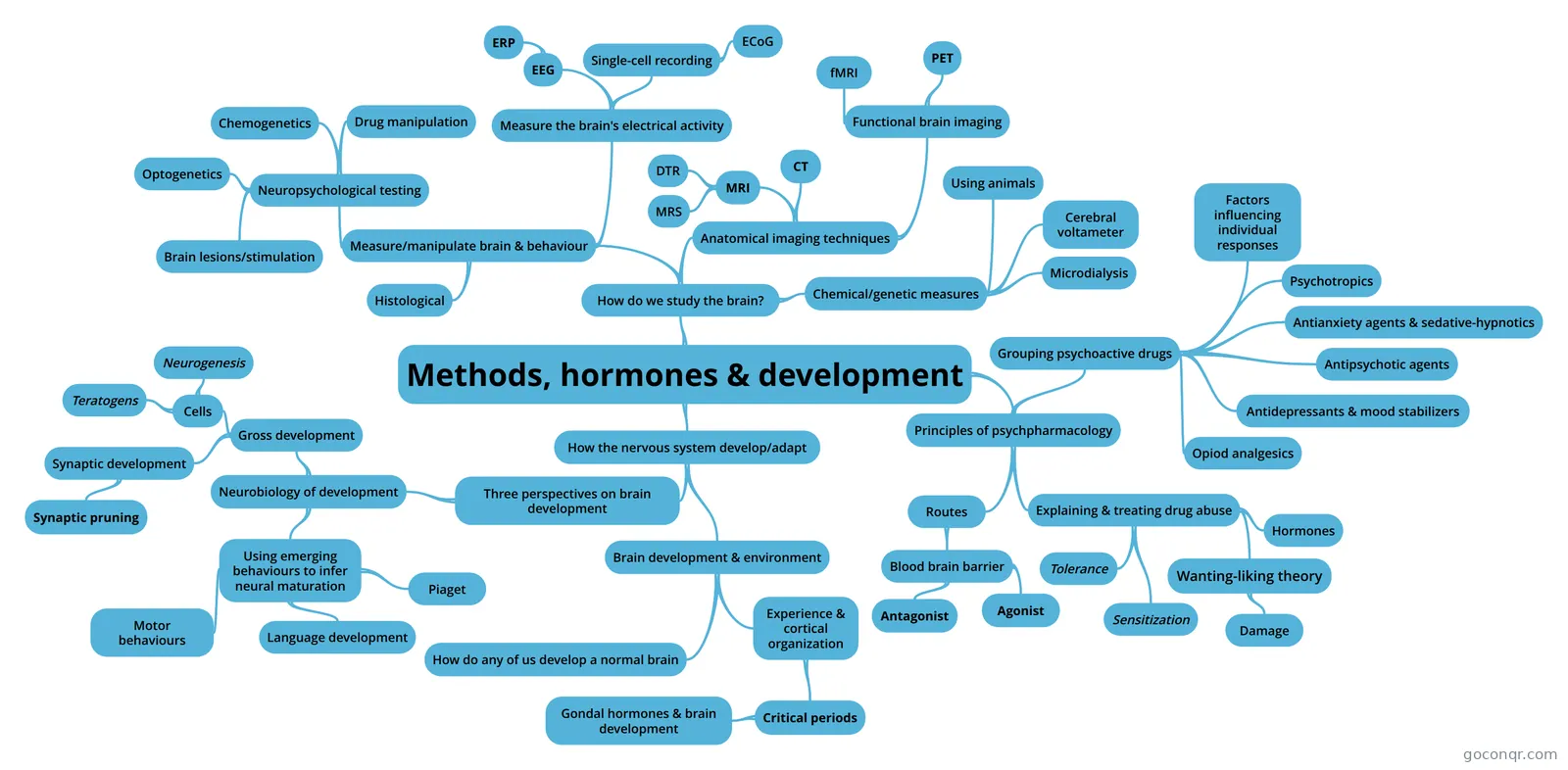
Mind map: Methods, hormones & development
Contenido del mapa
Methods, hormones & development
How do we study the brain?
- Measure/manipulate brain & behaviour
- study the direct relation between brain & behaviour - healthy or unhealthy
- first they just observed behaviour, now advanced technique can measure specific functions - fine movements, memory, emotion
- manipulated by altering brain function, electric/magnetic current, optogenetics
- chemogenetic stimulation combines designer receptors & synthetic drugs to excite targeted cells in living tissue
- Measure the brain's electrical activity
- cell recording - neurons employ a code, cortical neurons organized into functional groups work as coordinated networks
- neurons respond to specific characteristics of stimuli
- EEG & ERP measure electric/magnetic activity from thousands of neurons at once, eeg can reveal gross behavior, erp change location increased behaviour
- egg erp noninvasive methods, electrodes on scalp, ECoG & single-cell recording is invasive
- EEG
- changes as behaviour changes
- recorded from cortex displays an array of patterns, some rhytmical
- brain's electrical activity is never silent, even asleep or comatose
- ERP
- complex electronencephalographic waveform related in time to specific sensory event
- mapping brain function, must repeat several times bc distortion
- brief changes in eeg signal, regions participation, activated zones knowing route info takes, clinical work
- Single-cell recording
- could kill the cell, cannot do awake freely moving animals
- invasive method
- ECoG
- graded potentials recorded with electrodes placed directly on the brain's surface
- Histological
- brains sectioned postmortem, tissue stained with dyes
- Neuropsychological testing
- memory - corsi block tapping test, mirror drawing test, test of recent memory
- of rats - place learning, matching to place learning, landmark learning
- Brain lesions/stimulation
- stereotaxic apparatus, compensation,
- deep-brain stimulation, electrical/chemical stimulation
- Drug manipulation
- Optogenetics
- transgenetic technique that combines genetics & light to control targeted cells in living tissue
- lights can activate certain proteins that occur naturally & have been inserted into cells of model organism
- can activate a single cell
- Chemogenetics
- transgenetic technique that combines genetics & synthetic drugs to activate targeted cells in living tissue
- activate only genetically modified receptors
- Anatomical imaging techniques
- CT & MRI - sensitive to density of brain structures, ventricles, nuclei & pathways
- ct three dimensional x-ray, quicker & less expensive
- mri - hydrogen atoms behave like spinning bar magnets in presence of magnetic field, time & money consuming, clear image
- diffusion tensor imaging is a form of mri, discover abnormal fiber tracts/myelin in the brain - mrs detects brain metabolites
- Functional brain imaging
- metabolic imaging shows every behaviour requires collaboration of widespread neural circuits
- positron emission tomography records blood flow/other changes
- fmr + mri can locate changes in individual brain & complement erp results - fmri resting state connectivity across regions
- fnirs is a form of optical tomography, brain tissue can be reconstructed by gathering light transmitted through the object
- fnirs simplier than fmri/pet but cannot go deep so only used for cortical function studies
- fMRI
- changes in elements such as iron & oxygen are measured during the performance of a specific behaviour
- used to measure cerebral blood flow
- PET
- detects changes in blood flow by measuring changes in the uptake of compounds such as oxygen or glucose
- can detect decay of hundreds of radiochemicals,
- can detect relative amounts of a given neurotransmitter, density of receptors, metabolic activity
- injected radioactive water before
- MRI
- portrays density differences among the hydrogen atoms
- DTR
- image fiber pathways in the brain by detecting the directional movements in water molecules
- MRS
- uses hydrogen proton signal to determine the concentration of brain metabolites
- CT
- x-ray technique that produces a static three dimensional image of the brain in cross section
- radiation
- Chemical/genetic measures
- analysis of changes in genes/neurochemicals gives insight into molecule correlates with behaviour
- Using animals
- Microdialysis
- determine chemical constituents of extracellular fluid in freely moving animals
- Cerebral voltameter
- identify the concentration of specific chemicals of the brain as animals behave freely
- Measure/manipulate brain & behaviour
How the nervous system develop/adapt
- Three perspectives on brain development
- development a complex dance between genes & environment, fit in a cultural/environmental context
- 1) correlating emerging brain structures with emerging behaviours
- 2) correlating new behaviours with neural maturation
- 3) identifying influences on the brain & behaviour
- Neurobiology of development
- long process of brain maturation, late as 30
- neurons develop phenotype, migrate, as process elaborate, establish connections with other neurons even before birth
- the developing brain produces more neurons/connections than it needs, prunes back, early adulthood stable level maintained by some neurogenesis
- experiences throughout development can trigger epigenetic mechanisms, such as gene methylation that alter gene expression
- Using emerging behaviours to infer neural maturation
- we develop through similiar stages around the world, Piaget
- from gross poorly directed movement to controlled grasps - cognition stages of logic & problem solving
- behaviours emerge as the neural systems that produce them develop, happens synchrony,
- maturation of cognitive behaviour as neural circuits in the frontal/temporal lobes mature in early adulthood
- motor behavoiurs in synch with maturing motor circuits in cerebral cortex, basala ganglia, cerebellum, connections spinal cord
- Motor behaviours
- changes take place especially in the development of dendric arborizations & in fiber connections between neocortex & spinal cord
- myelin formation & ability to grasp
- Language development
- start vocabulary at 12m, 6yrs 2500
- motor skill develop befire
- Piaget
- sensorimotor - object permanence & stranger anxiety
- preoperational - pretend play, egocentrism, language development
- concrete operational - conservation, mathematical transformations
- formal operational - abstract logic, potential mature moral reasoning
- Gross development
- zygot, fertilization 2w - embryo, 2-8w - fetus, 9w+
- formation of neural tube, forebrain, midbrain, hindbrain
- 7w miniature person,
- Cells
- neural stem cells - progenitor cells - neuroblast/gliablast - specialize
- cell birth (neurogenesis/gliogenesis) - cell migration - cell differentiation - cell maturation - synaptogenesis - cell death & pruning - myelogenesis
- maturation = growing dendrites to provide surface area for synapses + extending axons to initiate synapse formation
- glia starts develop after most neurogenesis is complete, keeps develop through life, cortical till 18
- Teratogens
- full-term birth more sensitive than during neurogenisis
- adult tumours & lack of neurogenesis vs children
- Neurogenesis
- largely complete about 5 months of gestation
- hippocampus exception, grow thorugh life
- Synaptic development
- specific synapse contacts is guided into place by local environmental cues/signals
- simple synapse contacts in fith gestational month, by seventh synaptic development on cortical neurns are extensive, increase at birth..
- Synaptic pruning
- Brain development & environment
- plastic during development, neural structures/connections can be affected
- brains sensitivity to external events, quality of environment, tactile stimulation, drugs, gonodal hormones, injury
- critical periods for specific brain regions - anoxia toxins trauma can alter the brain, disorders
- neurological & hormonal abnormalities - deprivation
- How do any of us develop a normal brain
- the brain has substantial ability to repair or correct minor abnormalities
- Experience & cortical organization
- stimulating environment & intellectual development
- increase of synapses numbers from sensory processing
- richer in synapses, changes neural structures in cortex
- tactil stimulation improves recovery - before, during after pregnancy
- Critical periods
- developmental window for a specific ability, critical for typical development
- Gondal hormones & brain development
- testosterone vs androgen - alike till these come in
- female better at discrimination task - men better at object reversal learning
- gondal hormones alter basic neural development, shape experienced-dependent changes in the brain
- Three perspectives on brain development
Principles of psychpharmacology
- produce effects by acting on neural receptors/chemical processes in nervous system - agonist vs antagonist
- drugs administrated by mouth, inhalation, absorbation through skin, rectally by suppository or injection
- drugs must pass through numerious barriers by digestation/dilution, blood barrier & cell membrane to reach nervous system target
- drugs don't act specifically & consistantly, learning affects response - body become tolerant must higher dose - or sensitized same dose stronger each time
- Grouping psychoactive drugs
- grouped by major behavioural effect - five groups
- antianxiety agents & sedativehyponotics, antipsychotic agents, antidepressants & mood stabilizers, opioid analgesics, psychotropics
- each contains natural or synthetic drugs or both - they may produce their actions in different ways
- Factors influencing individual responses
- a drug no uniform action on every person - body weight,sex, age, genetic background, learning, cultural & environmental contexts
- influence varies with the situation & as a person learns drug-related behaviours
- behavioural myopia ex can influence person to only focus on prominent environmental cues, may encourage uncharacteristic behavour
- females more sensitive to drugs, may become addicted faster to lower doses
- Antianxiety agents & sedative-hypnotics
- benzodiazeptines: diazepam, alprazolam vs alcohole or barbiturates
- seductive-hypnotics increase GABA binding - maximize pore opening
- antianxiety drugs influence the frequency of pore opening - tips don't use together
- GABA - inhibitory neurons firing rate
- Antipsychotic agents
- chloropromazine can lessen schizophrenia symptoms, occupies the dopamine site on D2 receptor, preventing activation
- amphetamine & cocaine block the reuptake of dopamine - amphetamine promotes the release of dopamine
- Antidepressants & mood stabilizers
- MAO inhibitor inhibits the breakdown of seratonin -> more seratonin is available for release
- selective seratonin block transporter protein for seratonin reuptake: stays in cleft longer
- MAO, the trycyclic antidepressants, second generation antidepressants
- mood stabilizers for bipolar disorder - mutes intensity of one pole, making the other pole less likely to recur
- Opiod analgesics
- morphine, codein, heroin
- sleep inducing & pain relieving properties
- results in both tolerance & sensitization - overdose possibility always - increased dose within a few weeks
- Psychotropics
- amphetamine, cocaine, LSD, ecstacy
- blocking the dopamine reuptake transporter - amphetamine/cocaine
- psychedelic drugs = alters sensation & perception, LSD
- acetylcholine psychedelics, anandamide, glutamate, norepinepherine, seratonin psychedelics
- Explaining & treating drug abuse
- neural mechanisms implicated in addiction are the same for liking & wanting more generally - develops in stages
- initially it produces pleasure (liking) - repeated use the behaviour becomes conditioned to other things - eventually wanting seekout - drug seeking promotes craving - like decrease want increase
- treatment varies with the drug, whatever approach lifestyle change must occur
- all can get addicted, but some are more vulnerable bc genetic/epigenetic
- alcohole damage thalamus, hypothalamus, poor nutrition before the drug - cocaine can reduce bloodflow, ecstacy result in loss of axons impairment cognitive, marijuana/LSD psychotic behaviour
- Hormones
- steriod/peptide hormones produced by endoctrine glands circulate in bloodstream to affect various targets -
- brain stimulates pituitary gland through hypothalamus to regulate hormone levels - stimulates or inhibits
- homeostatic hormones regulate the balance of sugars, proteins, carbohydrates, salt & more - gonadal hormones regulate sex characteristics - glucocorticoids stress
- hippocampus important for ending the stress response - failure to turn down PTSD - may modify expressions of genes, hormones
- synthetic anabolic steroids mimic the effects of testosterone, increase muscle bulk, stamina & agression but can have deleterious side effects
- Tolerance
- aka habituation - repeated intake - cross tolerance
- 1. metabolic tolerance, enzymes that break down toxins increases - quicker metabolized - blood alcohole levels fall
- 2. cellular tolerance, brain cell activities adjust to minimize the effect of toxin in the blood
- 3. learned tolerance, ppl learn to cope with the demands & appear sober tho not
- Sensitization
- increased effect, periodic intake
- change in synapse, changes in receptor numbers on postsynaptic membrane, rate of transmitter metamolism, transmitter reuptake, number size synapses
- conditioned to environment
- Wanting-liking theory
- stages - first repeated use liking (pleasure) then decrease - higher dose for liking - & wanting increase
- explanation holding that when a drug is associated with certain cues, the cues themselves elict desire for the drug
- activates opiod systems in the brainstem - wanting spring from actiity in the mesolimbic pathways of dopaminergic activation system
- learning, dorsal stratum, region in the basal ganglia
- Damage
- the developing brain particularly sensitive
- MSG killed neurons, as PCP & ketamine
- domoic acid produces hippocampal damage - ecstacy degeneration of very fine seratonergic nerve terminals
- Routes
- oral - to reach bloodstream drug must be absorbed in stomach
- gases - respiratory tract absorbed across these membranes when inhaled, reach bloodstream by circumventing the barriers in digestive system
- into brain is the best, lower dose no barriers - next into bloodstream few barriers must be hydrophilic
- drugs contained adhesive patches are absorbed through the skin & into bloodstream
- Blood brain barrier
- capillaries in most of the body allow for substances to pass between capillary cell membranes, but those stimulated by actions of astrocytes form a tight junction of blodd brain barrier
- transporter proteins specialied to convey a particular substance
- pineal glad entry of chemicals that affect day-night cycles - pituitary gland entry of chemicals that influence pituitary hormones - area postrema entry of toxic substances that induce vomiting
- Antagonist
- substance that blocks synapse function
- Agonist
- substance that enhances synapse function
Información
- Descripción
- B Psykologi B Mapa Mental sobre Methods, hormones & development, creado por amelia juslin el 01/03/2021.
- Creado por
- amelia juslin
- Visitas
- 0
- Valoración