
Mapa mental
Theories of Developmental Psychology
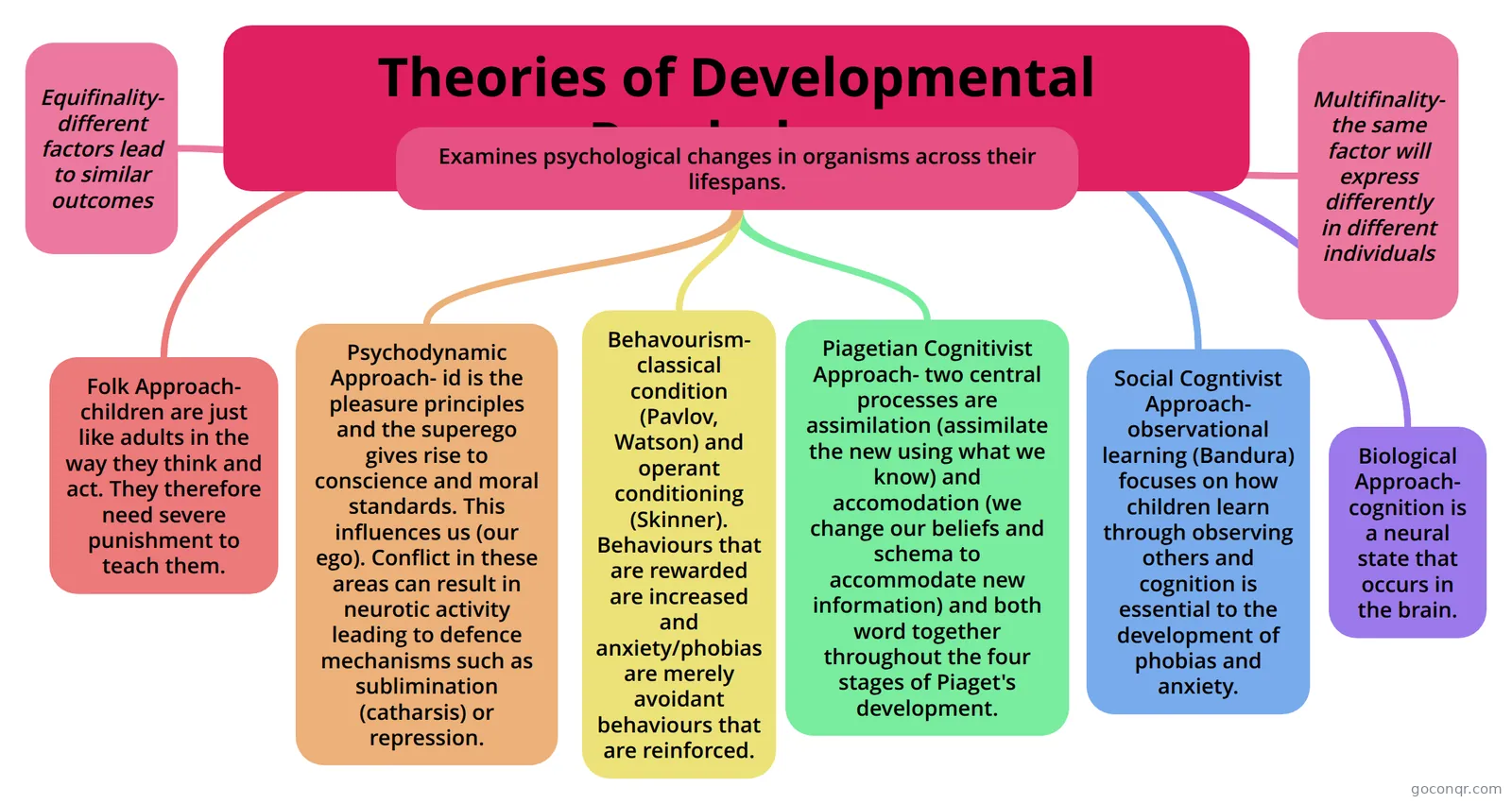
Mind map: Theories of developmental psychology
Contenido del mapa
Theories of Developmental Psychology
Examines psychological changes in organisms across their lifespans.
- Equifinality- different factors lead to similar outcomes
- Multifinality- the same factor will express differently in different individuals
- Folk Approach- children are just like adults in the way they think and act. They therefore need severe punishment to teach them.
- Psychodynamic Approach- id is the pleasure principles and the superego gives rise to conscience and moral standards. This influences us (our ego). Conflict in these areas can result in neurotic activity leading to defence mechanisms such as sublimination (catharsis) or repression.
- Behavourism- classical condition (Pavlov, Watson) and operant conditioning (Skinner). Behaviours that are rewarded are increased and anxiety/phobias are merely avoidant behaviours that are reinforced.
- Piagetian Cognitivist Approach- two central processes are assimilation (assimilate the new using what we know) and accomodation (we change our beliefs and schema to accommodate new information) and both word together throughout the four stages of Piaget's development.
- Social Cogntivist Approach- observational learning (Bandura) focuses on how children learn through observing others and cognition is essential to the development of phobias and anxiety.
- Biological Approach- cognition is a neural state that occurs in the brain.
Información
- Descripción
- Child And Adolescent Development Mapa Mental sobre Theories of Developmental Psychology, creado por lynda_ashford_25 el 23/10/2013.
- Creado por
- lynda_ashford_25
- Visitas
- 117
- Etiquetas
- Valoración