
Mapa mental
Global Concerns
Contenido del mapa
Global Concerns
Christian beliefs about the world
- Genesis says 'God saw all that he made, and it was very good.'
- Christians believe God created the world.
- Human beings should not damage or destroy things made by God
- The natural things of the world have a goodness in themselves because God said so.
- They believe the natural world was created for human beings to use responsibly.
- Food, natural resources, possible medicines and natural beauty are all things which enhance and enrich human life.
- Many Christians believe they should be stewards of the world.
- Stewardship=the belief that believers have a duty to look after the environment on behalf of God
- Being a good steward might involve:
- Joining groups which campaign to protect the environment
- Using resources of the world in a way whioh is sustainable
- Preserving the environment for the people who are young now or are to be born in the future
- Sharing the natural resources of the world fairly among people
- Bible says suggests God made his covenant with the whole of creation, so he's interested in the whole world.
Environmental Problems
- There are 4 factors that threaten both existing ways of life and future survival:
- Pollution
- Caused by car exhausts, power plants, nuclear waste disposal activity, factories.
- Level of pollution increased since humans started using coal and gas during Industrial Revolution.
- Emissions of 'greenhouse gases' affect atmosphere and threaten to disrupt or damage life on Earth.
- Level of pollution increased since humans started using coal and gas during Industrial Revolution.
- Caused by car exhausts, power plants, nuclear waste disposal activity, factories.
- Destruction of natural habitats
- Tropical rainforests under threat from deforestation
- To sell timber
- Use for paasture
- Forests are 'lungs of the Earth'
- They remove carbon dioxide from atmosphere
- Without them greenhouse gases increases and the Earth warms which cause climate change
- Natural beautiful landscapes lost for future generation
- Forests retain soil but deforested areas don't. Soil moves into rivers causing silting and leads to flooding
- Removing plants and wildlife damages possibility of learning more about the world and removes possibility of scientific benefits ie. Medical cures.
- Tropical rainforests under threat from deforestation
- Abuse of natural resources
- World has limited supply.
- Drained very quickly because of way of life and increasing population
- Life forms become extinct and there is less variety in the world
- Climate Change
- Climate change refers to the long-term change in 'average temperature.'
- This includes the increase in average temperature.
- Precipitation (rain and snowfall)
- and wind patterns.
- Precipitation (rain and snowfall)
- This includes the increase in average temperature.
- These changes can be caused by processes on Earth and external forces such as variations in sunlight intensity.
- A significant factor is human activity.
- Effects of climate change on human life.
- The consequences of climate change are serious for agriculture, forestry, ecosystems,water resources, human health, industry, settlement and society
- Crops yields will reduce
- Deaths among elderly and the sick will increase due to hotter weather.
- Those without appropriate housing will have reduction in quality of life.
- There will be water shortages, more flooding and more wildfires.
- Poorer parts of world will be hit earlier and harder by effects of climate change. Richer countries can better protect themselves against changes but won't be immune
- The consequences of climate change are serious for agriculture, forestry, ecosystems,water resources, human health, industry, settlement and society
- Climate change refers to the long-term change in 'average temperature.'
- Pollution
- There are 4 factors that threaten both existing ways of life and future survival:
Individual and community responses
- Individual Responses
- Recycling and reducing unnecessary packaging
- People can stop using plastic bags and avoid buying products that are packed with unnecessary packaging.
- Plastic bags take a long time to break down.
- Currently, most rubbish ends up in incinerators (which adds carbon to atmosphere) or in landfill sites.
- Better recycling of paper, cardboard, metal and plastics can significantly reduce need to burn or bury waste
- People can stop using plastic bags and avoid buying products that are packed with unnecessary packaging.
- Home energy conservation and insulation
- Loft and wall-cavity insulation reduce energy needed to heat houses.
- Don't leave taps running, this saves water and the power needed to pump water throughout the system
- Don't leave appliances on standby: they are using energy when they don't need to
- Use energy-efficient light bulbs. They last longer and use less energy
- Recycling and reducing unnecessary packaging
- Community Responses
- Non-polluting forms of transport
- Many people make car journeys for distances less than 2 miles.
- Walk or cycle instead
- Some environmentalists feel we shouldn't use planes unless absolutely necessaryy and have given up using them for holidays.
- They are major carbon emitters
- Buy local
- Instead of buying food from other side of world
- Buy it from local producer
- This reduces transport emissions
- Helps local businesses
- Non-polluting forms of transport
- Individual Responses
National and international responses
- National Responses
- The Stern Review on the Economics of Climate Change
- It concluded that:
- Climate change was real
- Human activity was contributing to it
- world should spend 1% of global gross domestic product to avoid worst effects of climate change
- It concluded that:
- UK government policies
- They're finding non-carbon producing alternatives for electricity generating and renewable forms of power generating
- increasing regulations on buildings
- supporting development of newer, greener car fuels
- encouraging energy conservation and recycling
- The Stern Review on the Economics of Climate Change
- International Responses
- 1977 Kyoto Protocol
- Aim to reduce greenhouse gases by 5%
- Came into force in 2005
- Aim to reduce greenhouse gases by 5%
- 1992 Earth summit in Rio
- Find ways to halt destruction of irreplaceable natural resources and pollution of planet
- EU 2020 targets
- Aim to reduce carbon emissions to at least 20% below 1990 levels.
- Renewable energy sources:
- Solar power
- Wind farms
- Power stations which don't release greenhouse gases
- 1977 Kyoto Protocol
- National Responses
Chrisitan responses to environmental problems
- Simple living and respect for life
- Many Christains believe that they should live simply, not wastefully
- Natural resources shouldn't be wasted, cause they are part of God's creation
- Many Christains believe that they should live simply, not wastefully
- A change of lifestyle is needed
- Christian leaders argue problem requires change of lifestyle.
- Human beings have consumed the world without care.
- Christian leaders argue problem requires change of lifestyle.
- The Earth Charter
- Its supported by over 2,500 organisations including UNESCO
- Examples are:
- Respect Earth and life in all its diversity
- Care for the community of life
- Eradicate poverty
- Prevent harm to Earth
- Affirm equality and many more
- Prevent harm to Earth
- Eradicate poverty
- Care for the community of life
- Respect Earth and life in all its diversity
- Other Christian views
- Some Christians see the coming environmental catastrophe as part of God's plan
- They believe we're entering an 'End time' and approaching end of the world
- They believe Christians should prepare for the second coming of Jesus
- And final judgement at the end of the world.
- They believe Christians should prepare for the second coming of Jesus
- They believe we're entering an 'End time' and approaching end of the world
- Some Christians see environmental problems as God's punishment for sin.
- Just as he flooded the Earth in the time of Noah because of his sins
- Some Christians see the coming environmental catastrophe as part of God's plan
- Simple living and respect for life
Christian beliefs about respect for each other
- The mission of love: justice and respect for all
- The poor are blessed and Kingdom of Heaven is theirs- Luke 6:20
- The poor are waiting for justice- Luke 1:17
- Must show respect for people, since God loves the world
- Why do people matter?
- Many Christians believe every human has dignity and should be respected
- Humans are a sacred, unique being created by God in his image
- 'Love your neighbour'
- Parable of sheep and the goats
- The works of mercy: actions of love
- caring for strangers
- Providing for the hungry and thirsty
- visiting and looking after the sick and those in prison
- clothing and respecting those who have lost everything
- The mission of love: justice and respect for all
A world divided
- Poorer countries are known as LEDC
- Less economically developed country
- Each day 40,000 children starve to death.
- Many are born into poverty
- Many are born into situations where life is short
- Extreme poverty
- Defined as living on less than $1 a day.
- It means that people can't meet basic needs for survival
- Such as food, water clothing, shelter, sanitisation, education and health care.
- It means that people can't meet basic needs for survival
- 1 in 5 of the worlds population lives in poverty
- Life expectancy is another way to look at poverty.
- Defined as living on less than $1 a day.
- The worlds resources are not evenly distributed
- in Europe and central Asia, 3.5% of people live in extreme poverty
- While in African countries south of the Sahara, it is 38.5%
- in Europe and central Asia, 3.5% of people live in extreme poverty
- 5 basic human needs
- Poor world
- Food is difficult to come by and expensive
- 1.2 billion people don't have access to safe drinking water and women and girls spend hours carrying and collecting water
- 855 million people can't read or write and 73 million children receive no primary education
- In many poorer countries hospital provision is poor, drug treatments must be paid for so treatable diseases often get worse.
- Many people have low paid and low skilled jobs with few opportunities to flourish
- People may spend long days in unsafe conditions
- Little or no support for unemployed
- Rich world
- Food is cheap and easy to come by
- Water taken for granted, rarely not available on tap
- Primary and secondary education is free and all have access to education
- In UK, there's free access to local GP's and hospitals and drugs and other treatments are subsidise or free
- More people have jobs which have higher income.
- Working conditions are monitored and meant to keep you safe.
- Financial support for unemployed
- Food
- Water
- Education
- Health
- Work
- Poor world
- Poorer countries are known as LEDC
What are the causes of world poverty
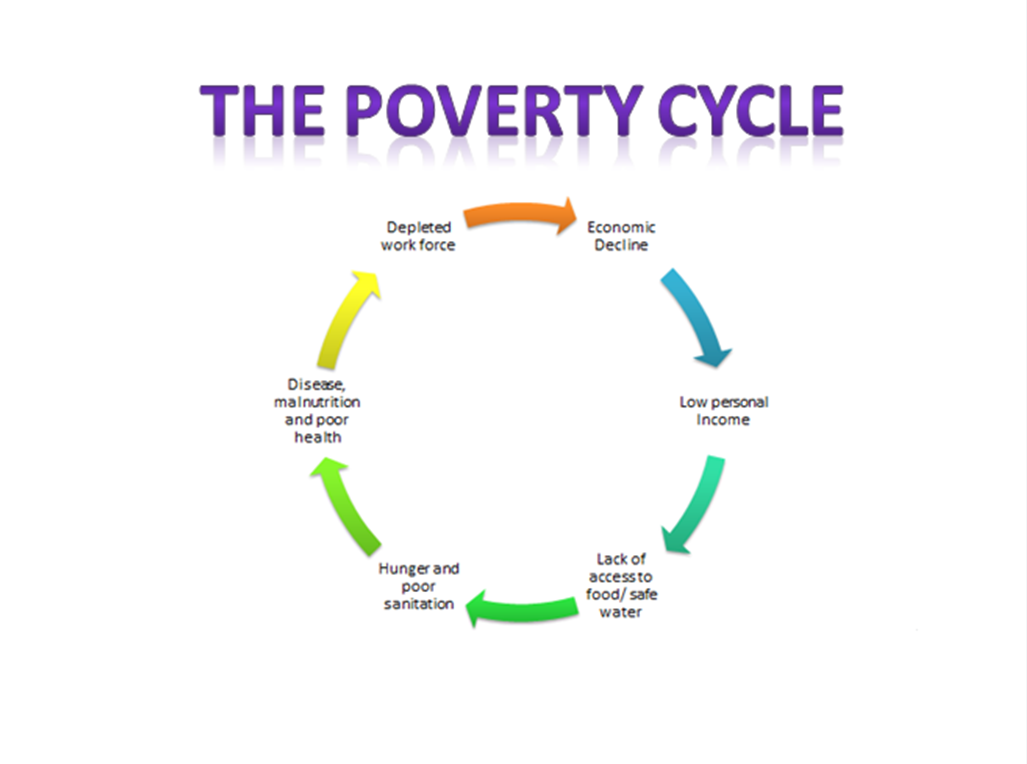
- Poverty cycle
- Poverty can lead to a cycle of decline
- Older generation look after children and work
- Not enough wealth is made
- Leads to hunger and poor health, person less able to look after children and work
- leads to less money to buy food
- Leads to hunger and poor health, person less able to look after children and work
- Not enough wealth is made
- Older generation look after children and work
- Poverty can lead to a cycle of decline
- Man-made or environmental
- Environmental problems
- Frequent natural disasters, weakens communities
- Healthcare
- Lack of basic healthcare makes it difficult for families and communities to develop economically
- Bad government
- Corruption and mismanagement waste resources and lead to bad decisions by leaders
- HIV/Aids
- Young adults part of workforce are often affected, so they die or are weakened and country can't develop
- Conflict
- Drives people from their homes and destroys their way of living so their unable to live safe and productive lives
- Debt
- Poorer countries have to pay back money to richer countries
- Trade barriers
- Unfair trade rules benefit richer countries
- Greed in MEDC's
- Richer and more powerful countries will consume far more wealth of the world than is fair
- Environmental problems
- Poverty cycle
How Christians respond to the needs of the poor overseas
- How do Christians respond to poverty
- With a prayer
- Give to charity
- Campaign for a change
- Christian charity
- Churches have charity groups like Cafod, Trocaire etc.
- Some churches have fast days or periods where people give something up for others
- Churches have charity groups like Cafod, Trocaire etc.
- Campaigning against exploration
- Look at causes of hard times
- Workers in some factories are exploited
- Children can be forced to work
- Workers can be made to work too long without rest
- And can be forced to work in unsafe conditions
- Christians believe it's wrong and should be stopped
- Fairer trading
- Fairtrade Foundation
- Established in 1992
- An independant non-profit organisation
- Believes trade should be just and with respect for all
- Fairtrade Foundation
- How do Christians respond to poverty
Christian Aid, Tearfund, CAFOD & Trocaire
- 4 Christian voluntary aid agencies who support the poorest and most disadvantaged, marginalised people throughout the world.
- Their activities include:
- -educational and awareness campaigns
- -emergency relief (short-term aid)
- -development projects (long-term aid)
- -campaigning to promote justice.
- These organisations help people in the long-term.
- Quote- 'Give a man a fish and he can feed himself for a day, give him a fishing rod and you feed him for a lifetime.'
- They improve access to drinking water and sanitation.
- Education and tools.
- And provide initial investments in some start up local businesses such as farms.
- Long term development helps people regain dignity, self-respect and the ability to support themselves.
- And provide initial investments in some start up local businesses such as farms.
- Education and tools.
- They improve access to drinking water and sanitation.
- Christian aid and CAFOD respond quickly to emergencies and disasters.
- They help those affected by providing food and shelter.
- Trocaire's emergency response provided 350,000 people with lifesaving food supplies.
- Church networks can raise funds quickly by asking organisations and groups to help
- -development projects (long-term aid)
- Charities and aid agencies inspired by Christianity work to educate people in richer countries about the situation for people in poorer countries
- They use leaflets, posters, books, videos, the internet and working through Churches
- Different themes and projects are selected each year responding to new and ongoing emergencies
- Educational teams work with community groups raising awareness and encouraging fundraising activities
- They also work for justice in world.
- Defending the rights of the poor and marginalised, throwing light on injustice and disadvantage
- provide help for people living with HIV/Aids.
- Also help women, who are often disadvantaged and discriminated against, often not having access to education and jobs.
- -emergency relief (short-term aid)
- -educational and awareness campaigns
- Their activities include:
- 4 Christian voluntary aid agencies who support the poorest and most disadvantaged, marginalised people throughout the world.
Imágenes y archivos del mapa
Información
- Descripción
- Mapa Mental sobre Global Concerns, creado por Henry Nguyen el 30/06/2015.
- Creado por
- Henry Nguyen
- Visitas
- 39
- Valoración