
Mapa mental
Unit A: Biological Diversity
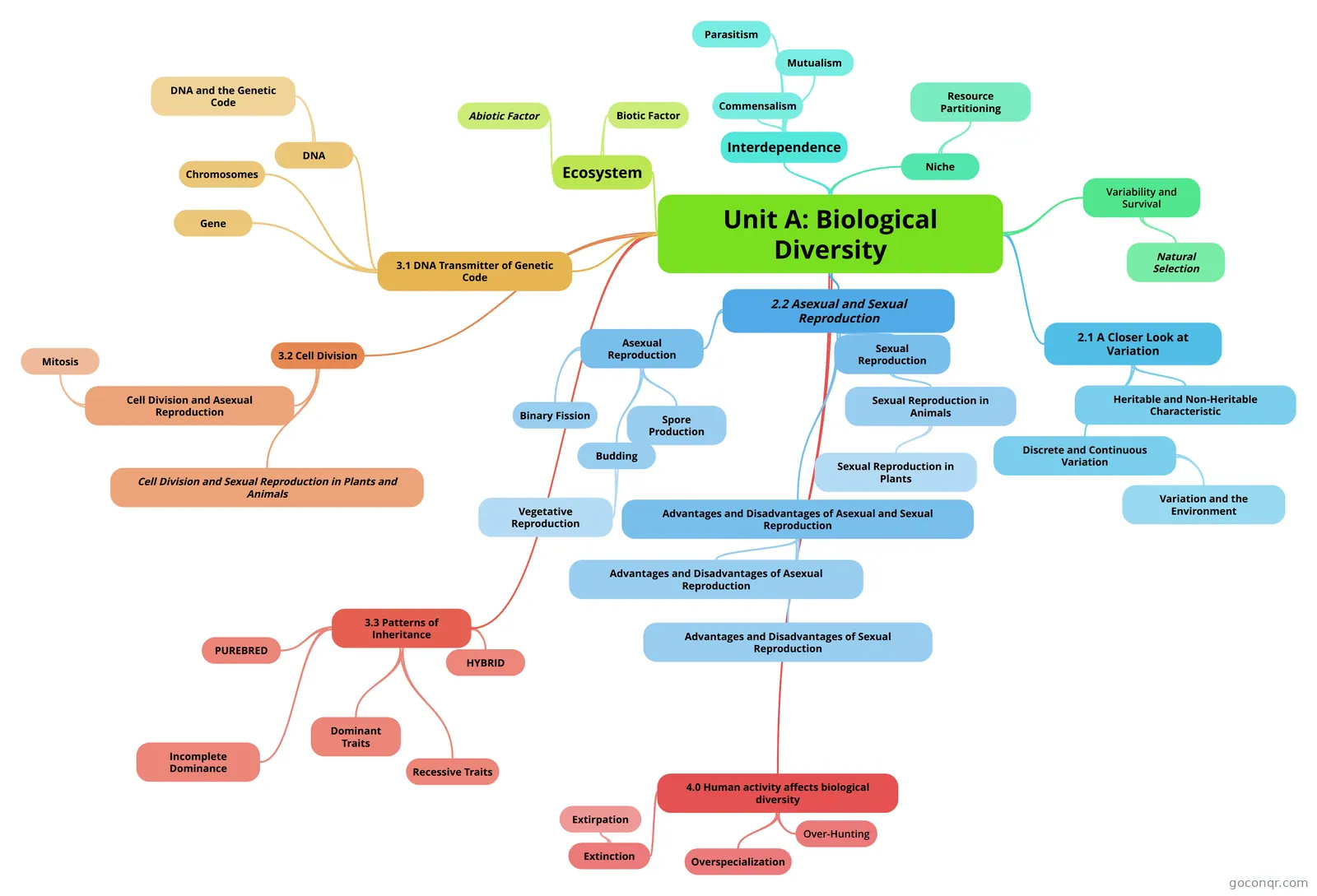
Mind map: Unit A: Biological Diversity
Contenido del mapa
Unit A: Biological Diversity
Ecosystem
- A particular environment where living things interact with other living things ang non-living things.
- Abiotic Factor
- Non- Living Things.!
- Biotic Factor
- Living Things.!
Interdependence
- The relationship between two different species.
- Commensalism
- The relationship between species in which one species benefits,and the other species neither benefits nor is harmed.
- Mutualism
- The relationship between species in which both species benefit.
- Parasitism
- The relationship between species in which one species benefits and the other is harmed.
Niche
- The role of an organism or species in an ecosystem, including where it lives,what it eats,how it reproduces,and how it interact
- Resource Partitioning
- Division of a resource among two or more coexisting species such that the niche of each species differs sligthly
Variability and Survival
- Variability- varations within a species.
- Natural Selection
- A process in which the environment "selects"which individuals will survive and reproduce.
2.1 A Closer Look at Variation
- Heritable and Non-Heritable Characteristic
- Heritable Characteristics-characteristics that are transmitted from generation to generation, such as eye colour. Non-Heritable Characteristic- characteristics caused by the environment, such as tanned skin due to exposure to sunligth.
- Discrete and Continuous Variation
- Discrete Variation- variation in a heritable characteristic that has an either/ or form, such as either being albino or not being albino. Continuous Variation-variation in a heritable characteristic that falls within a range, such as heigth.
- Variation and the Environment
- Some variations in individual organisms result from interactions with the environment.
- Heritable and Non-Heritable Characteristic
2.2 Asexual and Sexual Reproduction
- Asexual Reproduction
- Reproduction without the fusion of sex cells, resulting identical offspring and parent.
- Binary Fission
- A type of asexual reproduction in amoebas and other organism in which a parent cell divides exactly into two identical cells.
- Budding
- A type of asexual reproduction in which a new organism develops from an outgrowth, or bud, on the parent.
- Vegetative Reproduction
- A type of asexual reproduction in plants that does not involve the formation of a speed.
- Spore Production
- Spore- a cell produced by asexual reproduction in certain organism such as ferns, which can develop directly into an adult.
- Sexual Reproduction
- Sexual Reproduction in Animals
- Almost all animal species, from fungi to protists, from salmon to dragonflies to bears, reproduce sexually.Sexual reproduction involves specialized cells known as gametes(sex cell). The male gametes are called sperm cells, and the females gametes are known as egg cells(ova)
- Sexual Reproduction in Plants
- As in animals, sexual reproduction in plants requires the joining of a male gamete with the female gamete to produce a zygote and an embryo.
- Sexual Reproduction in Animals
- Advantages and Disadvantages of Asexual and Sexual Reproduction
- Advantages and Disadvantages of Asexual Reproduction
- Advantages- Asexual Reproduction does not require any specialized cells or a way of bringing gametes together. As a result, asexual reproduction can produce lots of individuals very quickly. Disadvantages- The main disadvantages of asexual reproduction is that if conditions become unfavourable, the entire population may be wiped out.
- Advantages and Disadvantages of Sexual Reproduction
- Advantages- Sexual Reproduction has the advantage of providing lots of variation, which helps species survive environment change. Disadvantages- The main disadvantage of sexual reproduction is that it takes a lot of energy.
- Advantages and Disadvantages of Asexual Reproduction
- Asexual Reproduction
3.1 DNA Transmitter of Genetic Code
- DNA
- DNA- (Deoxyribonucleic Acid) genetic material found mainly in the nuclei of cells of living things.
- DNA and the Genetic Code
- DNA was first identified in 1869, but little was know about the structure of the molecule or its role in heredity. Genetic Code- Arrangement of four chemical "letters" on a DNA molecule that can be arranged into"words" that form the instructions for making an organism.
- Chromosomes
- Chromosomes- A structure in which DNA is arranged and along which genes are located.
- Gene
- Gene- A segment of DNA, located at one particular place on a chromosome, which determines a specific characteristic of an organism.
- DNA
3.2 Cell Division
- Cell Division and Asexual Reproduction
- When a unicelluar paramecium splits to form two new organism during binary fission, its cell contents are divided equally between the two new cells. In multicelluar organisms, such as humans, petunias, and gophers, process that produces two new cells with the same number of chromosomes is called "mitosis".
- Mitosis
- A type of cell division that produces two identical daughter cells from one parent cell.
- Cell Division and Sexual Reproduction in Plants and Animals
- During sexual reproduction, the specialized sex cells ( gametes) unite to
- Cell Division and Asexual Reproduction
3.3 Patterns of Inheritance
- PUREBRED
- Referring to a plant or animal that has ancestors all with the same form of a trait.
- HYBRID
- An organism produced by crossing two individuals purebred for different forms of trait.
- Dominant Traits
- The outward form observed when two opposite acting alleles are inherited.
- Recessive Traits
- The outward form observed only when two same acting, non dominant alleles are inherited.
- Incomplete Dominance
- A pattern of inheritance seen when two different alleles are present at the same gene.
- PUREBRED
4.0 Human activity affects biological diversity
- Extinction
- Extirpation
- Overspecialization
- Over-Hunting
- Extinction
Información
- Descripción
- Mapa Mental sobre Unit A: Biological Diversity, creado por dormiendoallainj el 25/10/2013.
- Creado por
- dormiendoallainj
- Visitas
- 30
- Valoración