
Mapa mental
Building High-Functioning Communities of Inquiry with Computer Mediated Communications
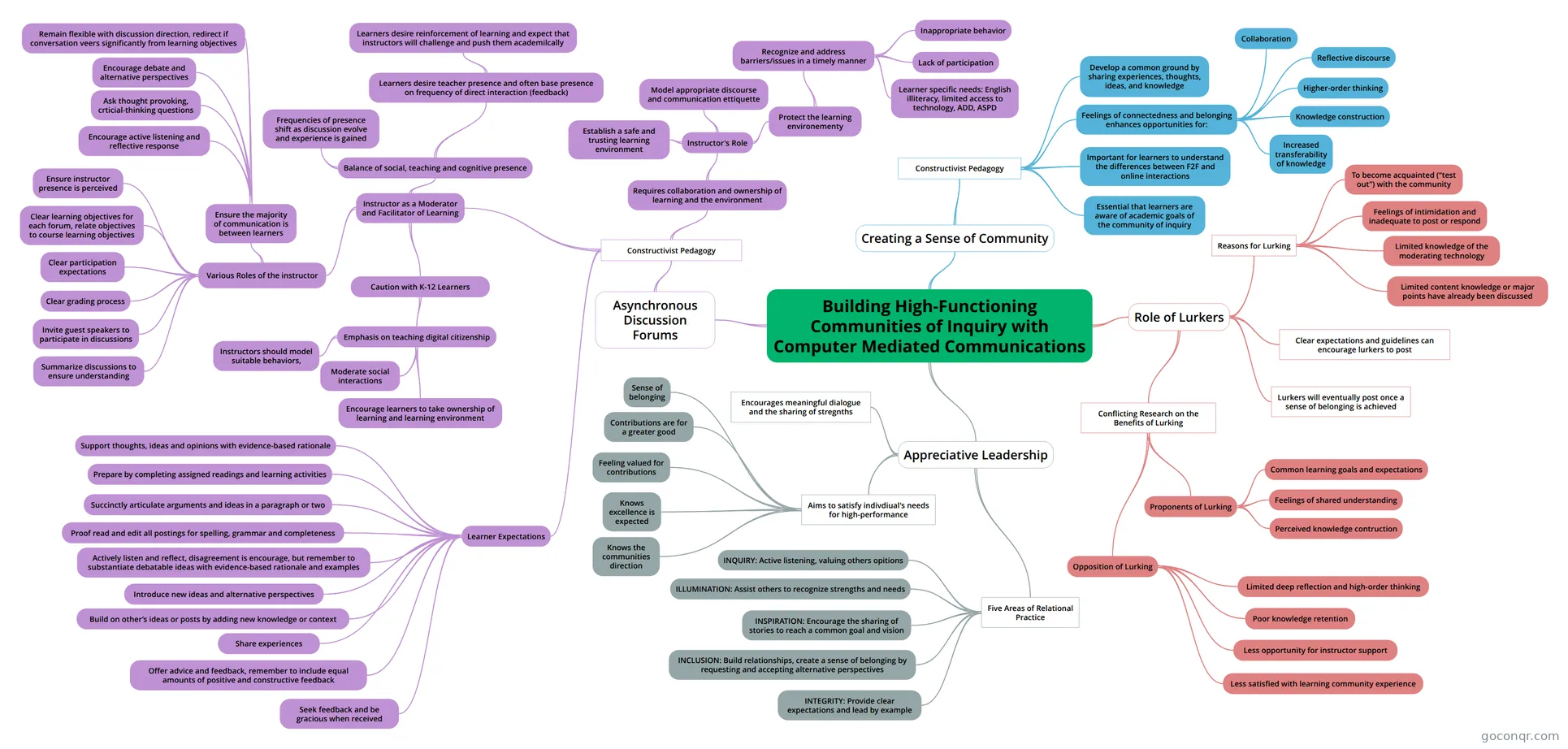
Mind map: communities of inquiry with computer mediated communications
Contenido del mapa
Building High-Functioning Communities of Inquiry with Computer Mediated Communications
Creating a Sense of Community
- Constructivist Pedagogy
- Develop a common ground by sharing experiences, thoughts, ideas, and knowledge
- Feelings of connectedness and belonging enhances opportunities for:
- Collaboration
- Reflective discourse
- Knowledge construction
- Higher-order thinking
- Increased transferability of knowledge
- Important for learners to understand the differences between F2F and online interactions
- Essential that learners are aware of academic goals of the community of inquiry
- Constructivist Pedagogy
Asynchronous Discussion Forums
- Constructivist Pedagogy
- Requires collaboration and ownership of learning and the environment
- Instructor's Role
- Model appropriate discourse and communication ettiquette
- Protect the learning environementy
- Recognize and address barriers/issues in a timely manner
- Inappropriate behavior
- Lack of participation
- Learner specific needs: English illiteracy, limited access to technology, ADD, ASPD
- Recognize and address barriers/issues in a timely manner
- Establish a safe and trusting learning environment
- Instructor's Role
- Instructor as a Moderator and Facilitator of Learning
- Various Roles of the instructor
- Clear participation expectations
- Clear grading process
- Clear learning objectives for each forum, relate objectives to course learning objectives
- Ensure instructor presence is perceived
- Ensure the majority of communication is between learners
- Encourage active listening and reflective response
- Remain flexible with discussion direction, redirect if conversation veers significantly from learning objectives
- Encourage debate and alternative perspectives
- Ask thought provoking, crticial-thinking questions
- Invite guest speakers to participate in discussions
- Summarize discussions to ensure understanding
- Caution with K-12 Learners
- Emphasis on teaching digital citizenship
- Instructors should model suitable behaviors,
- Moderate social interactions
- Encourage learners to take ownership of learning and learning environment
- Emphasis on teaching digital citizenship
- Balance of social, teaching and cognitive presence
- Frequencies of presence shift as discussion evolve and experience is gained
- Learners desire teacher presence and often base presence on frequency of direct interaction (feedback)
- Learners desire reinforcement of learning and expect that instructors will challenge and push them academilcally
- Various Roles of the instructor
- Learner Expectations
- Support thoughts, ideas and opinions with evidence-based rationale
- Prepare by completing assigned readings and learning activities
- Succinctly articulate arguments and ideas in a paragraph or two
- Proof read and edit all postings for spelling, grammar and completeness
- Introduce new ideas and alternative perspectives
- Build on other’s ideas or posts by adding new knowledge or context
- Share experiences
- Actively listen and reflect, disagreement is encourage, but remember to substantiate debatable ideas with evidence-based rationale and examples
- Offer advice and feedback, remember to include equal amounts of positive and constructive feedback
- Seek feedback and be gracious when received
- Requires collaboration and ownership of learning and the environment
- Constructivist Pedagogy
Appreciative Leadership
- Aims to satisfy indivdiual's needs for high-performance
- Sense of belonging
- Feeling valued for contributions
- Knows the communities direction
- Knows excellence is expected
- Contributions are for a greater good
- Encourages meaningful dialogue and the sharing of stregnths
- Five Areas of Relational Practice
- INQUIRY: Active listening, valuing others opitions
- INSPIRATION: Encourage the sharing of stories to reach a common goal and vision
- INTEGRITY: Provide clear expectations and lead by example
- ILLUMINATION: Assist others to recognize strengths and needs
- INCLUSION: Build relationships, create a sense of belonging by requesting and accepting alternative perspectives
- Aims to satisfy indivdiual's needs for high-performance
Role of Lurkers
- Reasons for Lurking
- To become acquainted (“test out”) with the community
- Feelings of intimidation and inadequate to post or respond
- Limited content knowledge or major points have already been discussed
- Limited knowledge of the moderating technology
- Clear expectations and guidelines can encourage lurkers to post
- Lurkers will eventually post once a sense of belonging is achieved
- Conflicting Research on the Benefits of Lurking
- Opposition of Lurking
- Less satisfied with learning community experience
- Poor knowledge retention
- Limited deep reflection and high-order thinking
- Less opportunity for instructor support
- Proponents of Lurking
- Feelings of shared understanding
- Common learning goals and expectations
- Perceived knowledge contruction
- Opposition of Lurking
- Reasons for Lurking