
Mapa mental
ACUTE NEUROLOGICAL SYNDROME
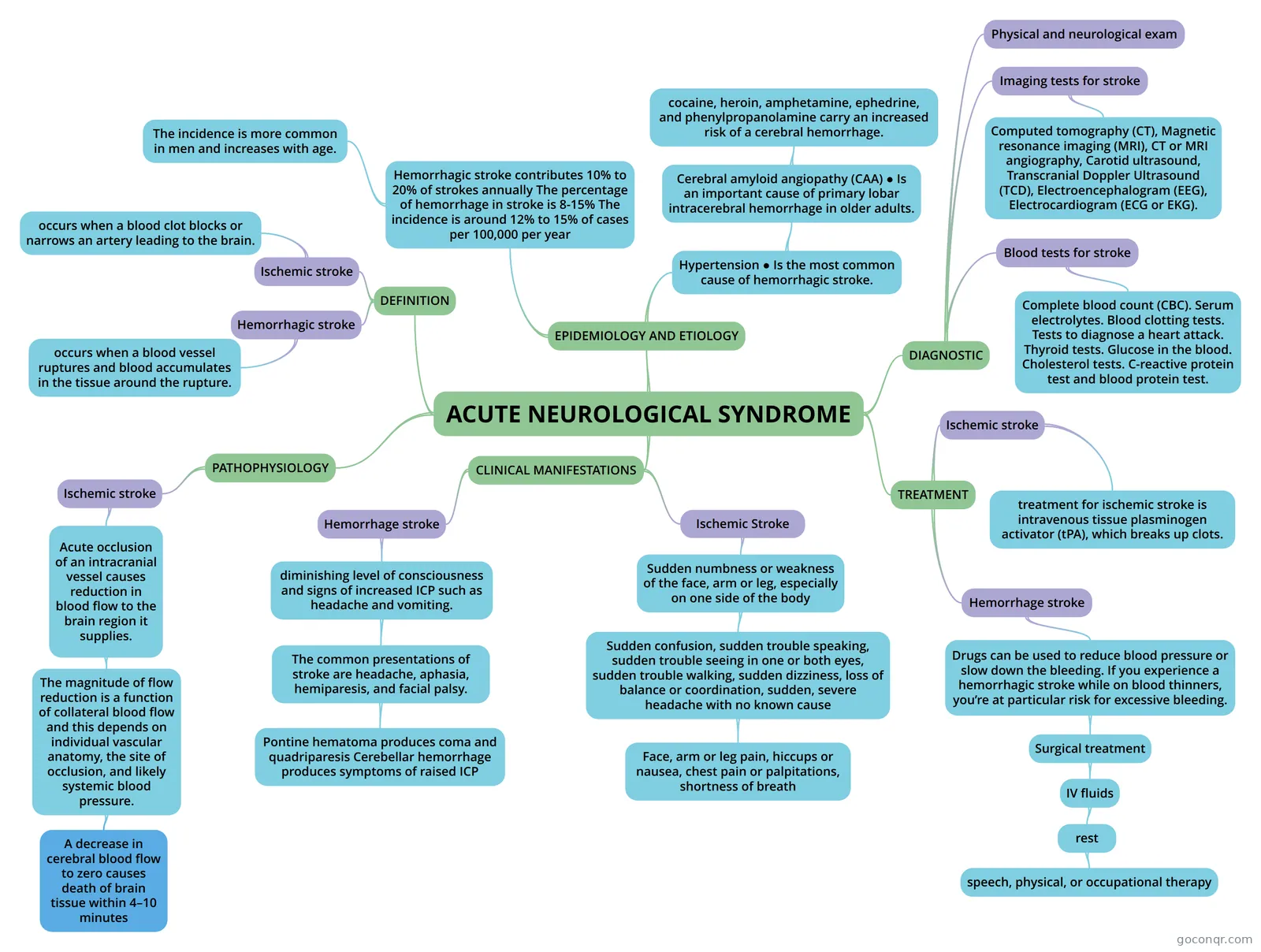
Mind map: Acute Neurological Syndrome
Contenido del mapa
ACUTE NEUROLOGICAL SYNDROME
DEFINITION
- Ischemic stroke
- occurs when a blood clot blocks or narrows an artery leading to the brain.
- Hemorrhagic stroke
- occurs when a blood vessel ruptures and blood accumulates in the tissue around the rupture.
- Ischemic stroke
PATHOPHYSIOLOGY
- Ischemic stroke
- Acute occlusion of an intracranial vessel causes reduction in blood flow to the brain region it supplies.
- The magnitude of flow reduction is a function of collateral blood flow and this depends on individual vascular anatomy, the site of occlusion, and likely systemic blood pressure.
- A decrease in cerebral blood flow to zero causes death of brain tissue within 4–10 minutes
- The magnitude of flow reduction is a function of collateral blood flow and this depends on individual vascular anatomy, the site of occlusion, and likely systemic blood pressure.
- Acute occlusion of an intracranial vessel causes reduction in blood flow to the brain region it supplies.
- Ischemic stroke
EPIDEMIOLOGY AND ETIOLOGY
- Hemorrhagic stroke contributes 10% to 20% of strokes annually The percentage of hemorrhage in stroke is 8-15% The incidence is around 12% to 15% of cases per 100,000 per year
- The incidence is more common in men and increases with age.
- Hypertension ● Is the most common cause of hemorrhagic stroke.
- Cerebral amyloid angiopathy (CAA) ● Is an important cause of primary lobar intracerebral hemorrhage in older adults.
- cocaine, heroin, amphetamine, ephedrine, and phenylpropanolamine carry an increased risk of a cerebral hemorrhage.
- Cerebral amyloid angiopathy (CAA) ● Is an important cause of primary lobar intracerebral hemorrhage in older adults.
- Hemorrhagic stroke contributes 10% to 20% of strokes annually The percentage of hemorrhage in stroke is 8-15% The incidence is around 12% to 15% of cases per 100,000 per year
CLINICAL MANIFESTATIONS
- Hemorrhage stroke
- diminishing level of consciousness and signs of increased ICP such as headache and vomiting.
- The common presentations of stroke are headache, aphasia, hemiparesis, and facial palsy.
- Pontine hematoma produces coma and quadriparesis Cerebellar hemorrhage produces symptoms of raised ICP
- The common presentations of stroke are headache, aphasia, hemiparesis, and facial palsy.
- diminishing level of consciousness and signs of increased ICP such as headache and vomiting.
- Ischemic Stroke
- Sudden numbness or weakness of the face, arm or leg, especially on one side of the body
- Sudden confusion, sudden trouble speaking, sudden trouble seeing in one or both eyes, sudden trouble walking, sudden dizziness, loss of balance or coordination, sudden, severe headache with no known cause
- Face, arm or leg pain, hiccups or nausea, chest pain or palpitations, shortness of breath
- Sudden confusion, sudden trouble speaking, sudden trouble seeing in one or both eyes, sudden trouble walking, sudden dizziness, loss of balance or coordination, sudden, severe headache with no known cause
- Sudden numbness or weakness of the face, arm or leg, especially on one side of the body
- Hemorrhage stroke
DIAGNOSTIC
- Physical and neurological exam
- Imaging tests for stroke
- Computed tomography (CT), Magnetic resonance imaging (MRI), CT or MRI angiography, Carotid ultrasound, Transcranial Doppler Ultrasound (TCD), Electroencephalogram (EEG), Electrocardiogram (ECG or EKG).
- Blood tests for stroke
- Complete blood count (CBC). Serum electrolytes. Blood clotting tests. Tests to diagnose a heart attack. Thyroid tests. Glucose in the blood. Cholesterol tests. C-reactive protein test and blood protein test.
TREATMENT
- Ischemic stroke
- treatment for ischemic stroke is intravenous tissue plasminogen activator (tPA), which breaks up clots.
- Hemorrhage stroke
- Drugs can be used to reduce blood pressure or slow down the bleeding. If you experience a hemorrhagic stroke while on blood thinners, you’re at particular risk for excessive bleeding.
- Surgical treatment
- IV fluids
- rest
- speech, physical, or occupational therapy
- rest
- IV fluids
- Surgical treatment
- Drugs can be used to reduce blood pressure or slow down the bleeding. If you experience a hemorrhagic stroke while on blood thinners, you’re at particular risk for excessive bleeding.
- Ischemic stroke
Información
- Descripción
- Mapa Mental sobre ACUTE NEUROLOGICAL SYNDROME, creado por ALEXIS FERNANDEZ el 13/06/2021.
- Creado por
- ALEXIS FERNANDEZ
- Visitas
- 0
- Valoración