
Mapa mental
The link between technology and development
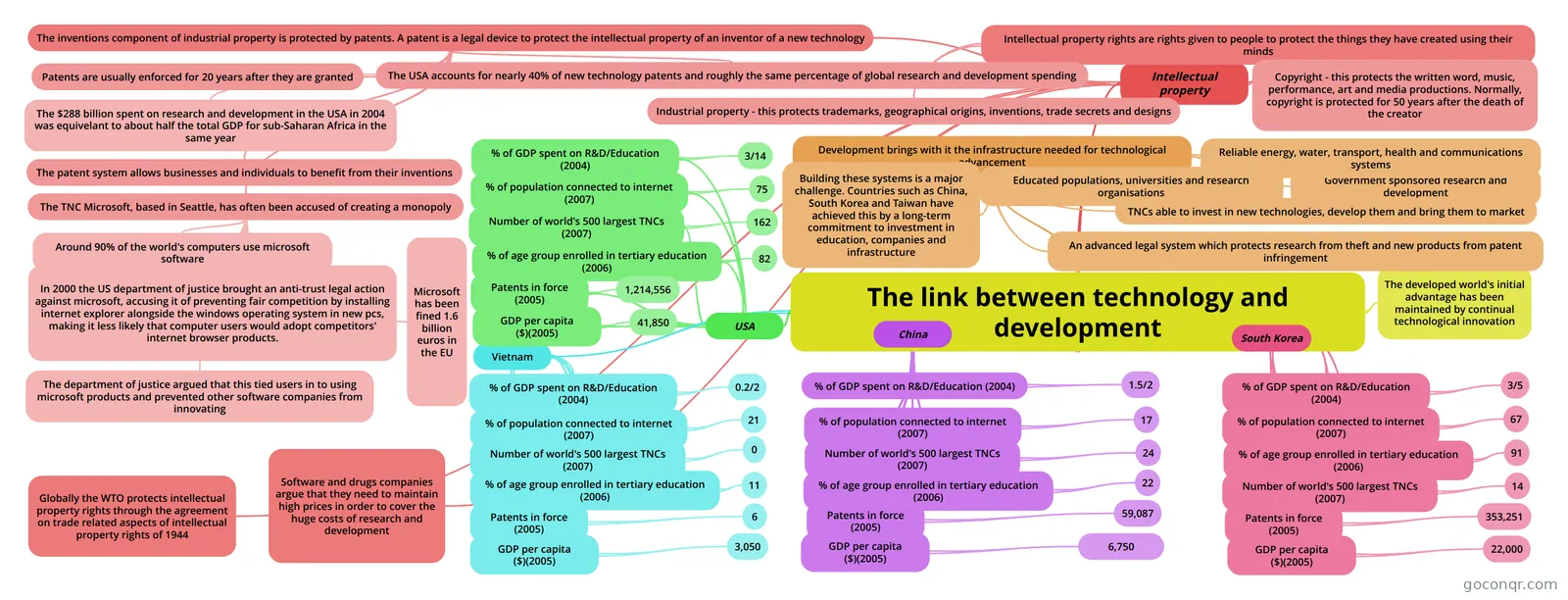
Mind map: link between technology and development
Contenido del mapa
The link between technology and development
The developed world's initial advantage has been maintained by continual technological innovation
Development brings with it the infrastructure needed for technological advancement
- Educated populations, universities and research organisations
- Government sponsored research and development
- TNCs able to invest in new technologies, develop them and bring them to market
- An advanced legal system which protects research from theft and new products from patent infringement
- Reliable energy, water, transport, health and communications systems
- Building these systems is a major challenge. Countries such as China, South Korea and Taiwan have achieved this by a long-term commitment to investment in education, companies and infrastructure
USA
- % of age group enrolled in tertiary education (2006)
- 82
- Number of world's 500 largest TNCs (2007)
- 162
- % of population connected to internet (2007)
- 75
- % of GDP spent on R&D/Education (2004)
- 3/14
- Patents in force (2005)
- 1,214,556
- GDP per capita ($)(2005)
- 41,850
- % of age group enrolled in tertiary education (2006)
South Korea
- % of age group enrolled in tertiary education (2006)
- 91
- % of GDP spent on R&D/Education (2004)
- 3/5
- Number of world's 500 largest TNCs (2007)
- 14
- Patents in force (2005)
- 353,251
- GDP per capita ($)(2005)
- 22,000
- % of population connected to internet (2007)
- 67
- % of age group enrolled in tertiary education (2006)
China
- % of age group enrolled in tertiary education (2006)
- 22
- % of GDP spent on R&D/Education (2004)
- 1.5/2
- Patents in force (2005)
- 59,087
- Number of world's 500 largest TNCs (2007)
- 24
- GDP per capita ($)(2005)
- 6,750
- % of population connected to internet (2007)
- 17
- % of age group enrolled in tertiary education (2006)
Vietnam
- % of age group enrolled in tertiary education (2006)
- 11
- Number of world's 500 largest TNCs (2007)
- 0
- % of GDP spent on R&D/Education (2004)
- 0.2/2
- Patents in force (2005)
- 6
- GDP per capita ($)(2005)
- 3,050
- % of population connected to internet (2007)
- 21
- % of age group enrolled in tertiary education (2006)
Intellectual property
- Intellectual property rights are rights given to people to protect the things they have created using their minds
- Copyright - this protects the written word, music, performance, art and media productions. Normally, copyright is protected for 50 years after the death of the creator
- Industrial property - this protects trademarks, geographical origins, inventions, trade secrets and designs
- The inventions component of industrial property is protected by patents. A patent is a legal device to protect the intellectual property of an inventor of a new technology
- Patents are usually enforced for 20 years after they are granted
- The USA accounts for nearly 40% of new technology patents and roughly the same percentage of global research and development spending
- The $288 billion spent on research and development in the USA in 2004 was equivelant to about half the total GDP for sub-Saharan Africa in the same year
- The patent system allows businesses and individuals to benefit from their inventions
- The TNC Microsoft, based in Seattle, has often been accused of creating a monopoly
- Around 90% of the world's computers use microsoft software
- In 2000 the US department of justice brought an anti-trust legal action against microsoft, accusing it of preventing fair competition by installing internet explorer alongside the windows operating system in new pcs, making it less likely that computer users would adopt competitors' internet browser products.
- The department of justice argued that this tied users in to using microsoft products and prevented other software companies from innovating
- Microsoft has been fined 1.6 billion euros in the EU
- Globally the WTO protects intellectual property rights through the agreement on trade related aspects of intellectual property rights of 1944
- Software and drugs companies argue that they need to maintain high prices in order to cover the huge costs of research and development
- Intellectual property rights are rights given to people to protect the things they have created using their minds
Información
- Descripción
- A-Levels (The Technological Fix) Geography Mapa Mental sobre The link between technology and development, creado por Jodie Goodacre el 31/10/2013.
- Creado por
- Jodie Goodacre
- Visitas
- 88
- Etiquetas
- Valoración