
Mapa mental
1.1 Cellular foundations
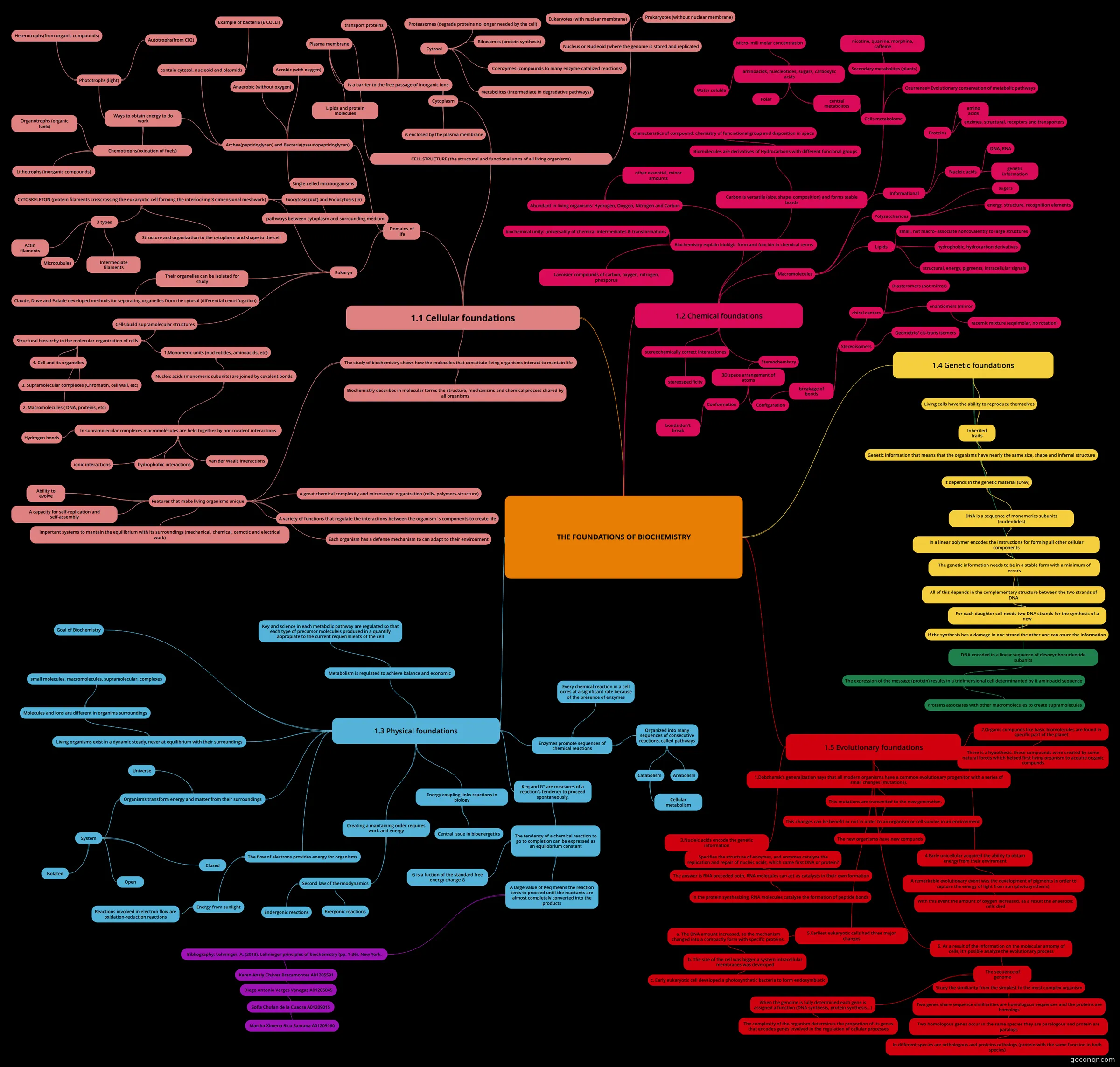
Mind map: Cellular foundations
Contenido del mapa
1.1 Cellular foundations
The study of biochemistry shows how the molecules that constitute living organisms interact to mantain life
- Features that make living organisms unique
- A great chemical complexity and microscopic organization (cells- polymers-structure)
- Important systems to mantain the equilibrium with its surroundings (mechanical, chemical, osmotic and electrical work)
- A variety of functions that regulate the interactions between the organism´s components to create life
- Each organism has a defense mechanism to can adapt to their environment
- A capacity for self-replication and self-assembly
- Ability to evolve
- Biochemistry describes in molecular terms the structure, mechanisms and chemical process shared by all organisms
- Features that make living organisms unique
CELL STRUCTURE (the structural and functional units of all living organisms)
- Plasma membrane
- Lipids and protein molecules
- Is a barrier to the free passage of inorganic ions
- transport proteins
- Cytoplasm
- Cytosol
- Proteasomes (degrade proteins no longer needed by the cell)
- Ribosomes (protein synthesis)
- Coenzymes (compounds to many enzyme-catalized reactions)
- Metabolites (intermediate in degradative pathways)
- is enclosed by the plasma membrane
- Cytosol
- Nucleus or Nucleoid (where the genome is stored and replicated
- Eukaryotes (with nuclear membrane)
- Prokaryotes (without nuclear membrane)
- Plasma membrane
Domains of life
- Archea(peptidoglycan) and Bacteria(pseudopeptidoglycan)
- Aerobic (with oxygen)
- Anaerobic (without oxygen)
- Ways to obtain energy to do work
- Phototrophs (light)
- Autotrophs(from C02)
- Heterotrophs(from organic compounds)
- Chemotrophs(oxidation of fuels)
- Lithotrophs (inorganic compounds)
- Organotrophs (organic fuels)
- Phototrophs (light)
- contain cytosol, nucleoid and plasmids
- Example of bacteria (E COLLI)
- Single-celled microorganisms
- Eukarya
- Their organelles can be isolated for study
- Claude, Duve and Palade developed methods for separating organelles from the cytosol (diferential centrifugation)
- CYTOSKELETON (protein filaments crisscrossing the eukaryotic cell forming the interlocking 3 dimensional meshwork)
- 3 types
- Actin filaments
- Microtubules
- Intermediate filaments
- Structure and organization to the cytoplasm and shape to the cell
- Exocytosis (out) and Endocytosis (in)
- pathways between cytoplasm and surrounding médium
- 3 types
- Cells build Supramolecular structures
- Structural hierarchy in the molecular organization of cells
- 1.Monomeric units (nucleotides, aminoacids, etc)
- Nucleic acids (monomeric subunits) are joined by covalent bonds
- In supramolecular complexes macromolécules are held together by noncovalent interactions
- Hydrogen bonds
- ionic interactions
- hydrophobic interactions
- van der Waals interactions
- In supramolecular complexes macromolécules are held together by noncovalent interactions
- Nucleic acids (monomeric subunits) are joined by covalent bonds
- 2. Macromolecules ( DNA, proteins, etc)
- 3. Supramolecular complexes (Chromatin, cell wall, etc)
- 4. Cell and its organelles
- 1.Monomeric units (nucleotides, aminoacids, etc)
- Structural hierarchy in the molecular organization of cells
- Their organelles can be isolated for study
- Archea(peptidoglycan) and Bacteria(pseudopeptidoglycan)
THE FOUNDATIONS OF BIOCHEMISTRY
- 1.2 Chemical foundations
- Biochemistry explain biológic form and función in chemical terms
- Lavoisier compounds of carbon, oxygen, nitrogen, phosporus
- Abundant in living organisms: Hydrogen, Oxygen, Nitrogen and Carbon
- other essential, minor amounts
- biochemical unity: universality of chemical intermediates & transformations
- Carbon is versatile (size, shape, composition) and forms stable bonds
- Biomolecules are derivatives of Hydrocarbons with different funcional groups
- characteristics of compound: chemistry of funciotional group and disposition in space
- Cells metabolome
- Secondary metabolites (plants)
- nicotine, quanine, morphine, caffeine
- Ocurrence= Evolutionary conservation of metabolic pathways
- central metabolites
- aminoacids, nuecleotides, sugars, carboxylic acids
- Micro- mili molar concentration
- Water soluble
- Polar
- aminoacids, nuecleotides, sugars, carboxylic acids
- Secondary metabolites (plants)
- Biomolecules are derivatives of Hydrocarbons with different funcional groups
- Macromolecules
- Informational
- Proteins
- enzimes, structural, receptors and transporters
- amino acids
- Nucleic acids
- DNA, RNA
- genetic information
- Proteins
- Polysaccharides
- sugars
- energy, structure, recognition elements
- Lipids
- small, not macro- associate noncovalently to large structures
- hydrophobic, hydrocarbon derivatives
- structural, energy, pigments, intracellular signals
- Informational
- Stereochemistry
- 3D space arrangement of atoms
- Configuration
- breakage of bonds
- Stereoisomers
- Geometric/ cis-trans isomers
- chiral centers
- enantiomers (mirror
- racemic mixture (equimolar, no rotation)
- Diasteromers (not mirror)
- enantiomers (mirror
- Stereoisomers
- breakage of bonds
- Conformation
- bonds don't break
- Configuration
- 3D space arrangement of atoms
- stereochemically correct interacciones
- stereospecificity
- Biochemistry explain biológic form and función in chemical terms
- 1.3 Physical foundations
- Goal of Biochemistry
- Living organisms exist in a dynamic steady, never at equilibrium with their surroundings
- Molecules and ions are different in organims surroundings
- small molecules, macromolecules, supramolecular, complexes
- Molecules and ions are different in organims surroundings
- Organisms transform energy and matter from their surroundings
- Universe
- System
- Isolated
- Closed
- Open
- The flow of electrons provides energy for organisms
- Energy from sunlight
- Reactions involved in electron flow are oxidation-reduction reactions
- Energy from sunlight
- Creating a mantaining order requires work and energy
- Second law of thermodynamics
- Endergonic reactions
- Exergonic reactions
- Second law of thermodynamics
- Energy coupling links reactions in biology
- Central issue in bioenergetics
- Keq and G° are measures of a reaction's tendency to proceed spontaneously.
- The tendency of a chemical reaction to go to completion can be expressed as an equilobrium constant
- A large value of Keq means the reaction tenis to proceed until the reactants are almost completely converted into the products
- Bibliography: Lehninger, A. (2013). Lehninger principles of biochemistry (pp. 1-36). New York.
- Karen Analy Chávez Bracamontes A01205591
- Diego Antonio Vargas Vanegas A01205045
- Sofia Chufan de la Cuadra A01209015
- Martha Ximena Rico Santana A01209160
- Sofia Chufan de la Cuadra A01209015
- Diego Antonio Vargas Vanegas A01205045
- Karen Analy Chávez Bracamontes A01205591
- Bibliography: Lehninger, A. (2013). Lehninger principles of biochemistry (pp. 1-36). New York.
- G is a fuction of the standard free energy change G
- A large value of Keq means the reaction tenis to proceed until the reactants are almost completely converted into the products
- The tendency of a chemical reaction to go to completion can be expressed as an equilobrium constant
- Enzymes promote sequences of chemical reactions
- Every chemical reaction in a cell ocres at a significant rate because of the presence of enzymes
- Organized into many sequences of consecutive reactions, called pathways
- Anabolism
- Catabolism
- Cellular metabolism
- Metabolism is regulated to achieve balance and economic
- Key and science in each metabolic pathway are regulated so that each type of precursor moleculeis produced in a quantify appropiate to the current requerimients of the cell
- 1.4 Genetic foundations
- Living cells have the ability to reproduce themselves
- Inherited traits
- Genetic information that means that the organisms have nearly the same size, shape and infernal structure
- It depends in the genetic material (DNA)
- DNA is a sequence of monomerics subunits (nucleotides)
- In a linear polymer encodes the instructions for forming all other cellular components
- The genetic information needs to be in a stable form with a mínimum of errors
- All of this depends in the complementary structure between the two strands of DNA
- For each daughter cell needs two DNA strands for the synthesis of a new
- If the synthesis has a damage in one strand the other one can asure the information
- For each daughter cell needs two DNA strands for the synthesis of a new
- All of this depends in the complementary structure between the two strands of DNA
- The genetic information needs to be in a stable form with a mínimum of errors
- In a linear polymer encodes the instructions for forming all other cellular components
- DNA is a sequence of monomerics subunits (nucleotides)
- It depends in the genetic material (DNA)
- Genetic information that means that the organisms have nearly the same size, shape and infernal structure
- Inherited traits
- DNA encoded in a linear sequence of desoxyribonucleotide subunits
- The expression of the message (protein) results in a tridimensional cell determinanted by it aminoacid sequence
- Proteins associates with other macromolecules to create supramolecules
- The expression of the message (protein) results in a tridimensional cell determinanted by it aminoacid sequence
- Living cells have the ability to reproduce themselves
- 1.5 Evolutionary foundations
- 1.Dobzhansk's generalization says that all modern organisms have a common evolutionary progenitor with a series of small changes (mutations).
- This mutations are transmited to the new generation.
- This changes can be benefit or not in order to an organism or cell survive in an environment
- The new organisms have new compunds
- This changes can be benefit or not in order to an organism or cell survive in an environment
- This mutations are transmited to the new generation.
- 2.Organic compunds like basic biomolecules are found in specific part of the planet
- There is a hypothesis, these compounds were created by some natural forces which helped first living organism to acquire organic compunds
- 3.Nucleic acids encode the genetic information
- Specifies the structure of enzymes, and enzymes catalyze the replication and repair of nucleic acids, which came first DNA or protein?
- The answer is RNA preceded both, RNA molecules can act as catalysts in their own formation
- In the protein synthesizing, RNA molecules catalyze the formation of peptide bonds
- The answer is RNA preceded both, RNA molecules can act as catalysts in their own formation
- Specifies the structure of enzymes, and enzymes catalyze the replication and repair of nucleic acids, which came first DNA or protein?
- 4.Early unicellular acquired the ability to obtain energy from their enviroment
- A remarkable evolutionary event was the development of pigments in order to capture the energy of light from sun (photosynthesis).
- With this event the amount of oxygen increased, as a result the anaerobic cells died
- A remarkable evolutionary event was the development of pigments in order to capture the energy of light from sun (photosynthesis).
- 5.Earliest eukaryotic cells had three major changes
- a. The DNA amount increased, so the mechanism changed into a compactly form with specific proteins.
- b. The size of the cell was bigger a system intracellular membranes was developed
- c. Early eukaryotic cell developed a photosynthetic bacteria to form endosymbiotic
- b. The size of the cell was bigger a system intracellular membranes was developed
- a. The DNA amount increased, so the mechanism changed into a compactly form with specific proteins.
- 6. As a result of the information on the molecular antomy of cells, it's posible analyze the evolutionary process
- The sequence of genome
- Study the similiarity from the simplest to the most complex organism
- Two genes share sequence similiarities are homologous sequences and the proteins are homologs
- Two homologous genes occur in the same species they are paralogous and protein are paralogs
- In different species are orthologous and proteins orthologs (protein with the same function in both species)
- Two homologous genes occur in the same species they are paralogous and protein are paralogs
- Two genes share sequence similiarities are homologous sequences and the proteins are homologs
- When the genome is fully determined each gene is assigned a function (DNA synthesis, protein synthesis...)
- The complexity of the organism determines the proportion of its genes that encodes genes involved in the regulation of cellular processes
- Study the similiarity from the simplest to the most complex organism
- The sequence of genome
- 1.Dobzhansk's generalization says that all modern organisms have a common evolutionary progenitor with a series of small changes (mutations).
- 1.2 Chemical foundations
Información
- Descripción
- Mapa Mental sobre 1.1 Cellular foundations, creado por Karen Chá el 12/08/2015.
- Creado por
- Karen Chá
- Visitas
- 0
- Valoración