
Mapa mental
Company
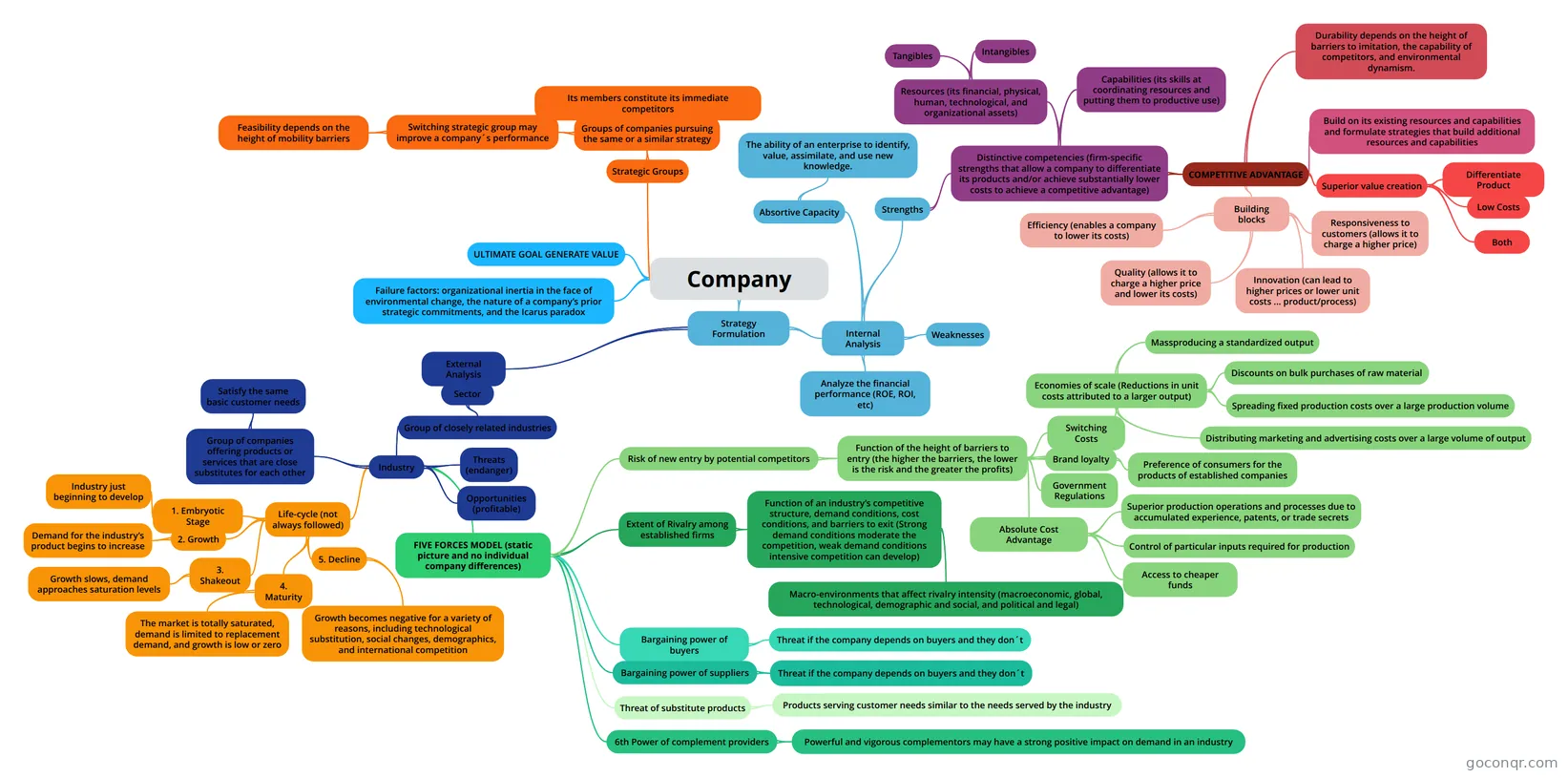
Mind map: company strategy
Contenido del mapa
Company
Strategy Formulation
- External Analysis
- Sector
- Group of closely related industries
- Industry
- Group of companies offering products or services that are close substitutes for each other
- Satisfy the same basic customer needs
- Opportunities (profitable)
- Threats (endanger)
- Life-cycle (not always followed)
- 1. Embryotic Stage
- Industry just beginning to develop
- 2. Growth
- Demand for the industry’s product begins to increase
- 3. Shakeout
- Growth slows, demand approaches saturation levels
- 4. Maturity
- The market is totally saturated, demand is limited to replacement demand, and growth is low or zero
- 5. Decline
- Growth becomes negative for a variety of reasons, including technological substitution, social changes, demographics, and international competition
- 1. Embryotic Stage
- FIVE FORCES MODEL (static picture and no individual company differences)
- Risk of new entry by potential competitors
- Function of the height of barriers to entry (the higher the barriers, the lower is the risk and the greater the profits)
- Economies of scale (Reductions in unit costs attributed to a larger output)
- Massproducing a standardized output
- Discounts on bulk purchases of raw material
- Spreading fixed production costs over a large production volume
- Distributing marketing and advertising costs over a large volume of output
- Brand loyalty
- Preference of consumers for the products of established companies
- Absolute Cost Advantage
- Superior production operations and processes due to accumulated experience, patents, or trade secrets
- Control of particular inputs required for production
- Access to cheaper funds
- Switching Costs
- Government Regulations
- Economies of scale (Reductions in unit costs attributed to a larger output)
- Function of the height of barriers to entry (the higher the barriers, the lower is the risk and the greater the profits)
- Extent of Rivalry among established firms
- Function of an industry’s competitive structure, demand conditions, cost conditions, and barriers to exit (Strong demand conditions moderate the competition, weak demand conditions intensive competition can develop)
- Macro-environments that affect rivalry intensity (macroeconomic, global, technological, demographic and social, and political and legal)
- Function of an industry’s competitive structure, demand conditions, cost conditions, and barriers to exit (Strong demand conditions moderate the competition, weak demand conditions intensive competition can develop)
- Bargaining power of buyers
- Threat if the company depends on buyers and they don´t
- Bargaining power of suppliers
- Threat if the company depends on buyers and they don´t
- Threat of substitute products
- Products serving customer needs similar to the needs served by the industry
- 6th Power of complement providers
- Powerful and vigorous complementors may have a strong positive impact on demand in an industry
- Risk of new entry by potential competitors
- Group of companies offering products or services that are close substitutes for each other
- Industry
- Group of closely related industries
- Sector
- Internal Analysis
- Weaknesses
- Strengths
- Distinctive competencies (firm-specific strengths that allow a company to differentiate its products and/or achieve substantially lower costs to achieve a competitive advantage)
- Resources (its financial, physical, human, technological, and organizational assets)
- Tangibles
- Intangibles
- Capabilities (its skills at coordinating resources and putting them to productive use)
- COMPETITIVE ADVANTAGE
- Build on its existing resources and capabilities and formulate strategies that build additional resources and capabilities
- Superior value creation
- Low Costs
- Differentiate Product
- Both
- Building blocks
- Efficiency (enables a company to lower its costs)
- Quality (allows it to charge a higher price and lower its costs)
- Innovation (can lead to higher prices or lower unit costs ... product/process)
- Responsiveness to customers (allows it to charge a higher price)
- Durability depends on the height of barriers to imitation, the capability of competitors, and environmental dynamism.
- Resources (its financial, physical, human, technological, and organizational assets)
- Distinctive competencies (firm-specific strengths that allow a company to differentiate its products and/or achieve substantially lower costs to achieve a competitive advantage)
- Analyze the financial performance (ROE, ROI, etc)
- Absortive Capacity
- The ability of an enterprise to identify, value, assimilate, and use new knowledge.
- External Analysis
Strategic Groups
- Groups of companies pursuing the same or a similar strategy
- Its members constitute its immediate competitors
- Switching strategic group may improve a company´s performance
- Feasibility depends on the height of mobility barriers
- Groups of companies pursuing the same or a similar strategy
ULTIMATE GOAL GENERATE VALUE
Failure factors: organizational inertia in the face of environmental change, the nature of a company’s prior strategic commitments, and the Icarus paradox