
Mapa mental
Cinematography
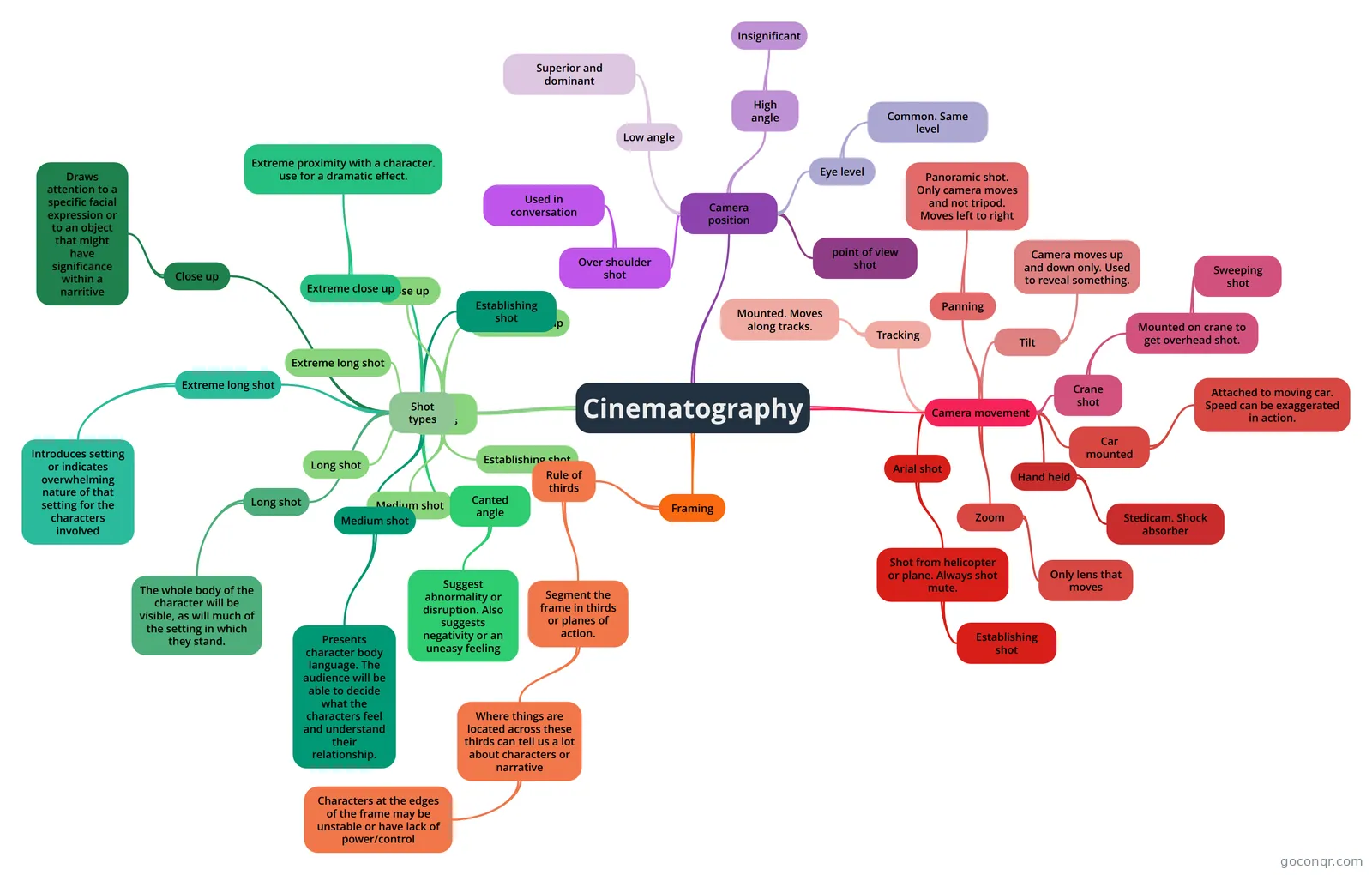
Mind map: cinematography
Contenido del mapa
Cinematography
Shot Types
- Extreme long shot
- Long shot
- Medium shot
- Close up
- Extreme close up
- Establishing shot
Shot types
- Medium shot
- Presents character body language. The audience will be able to decide what the characters feel and understand their relationship.
- Long shot
- The whole body of the character will be visible, as will much of the setting in which they stand.
- Extreme long shot
- Introduces setting or indicates overwhelming nature of that setting for the characters involved
- Close up
- Draws attention to a specific facial expression or to an object that might have significance within a narritive
- Extreme close up
- Extreme proximity with a character. use for a dramatic effect.
- Establishing shot
- Canted angle
- Suggest abnormality or disruption. Also suggests negativity or an uneasy feeling
- Medium shot
Camera position
- High angle
- Insignificant
- Eye level
- Common. Same level
- Low angle
- Superior and dominant
- point of view shot
- Over shoulder shot
- Used in conversation
- High angle
Camera movement
- Tracking
- Mounted. Moves along tracks.
- Panning
- Panoramic shot. Only camera moves and not tripod. Moves left to right
- Tilt
- Camera moves up and down only. Used to reveal something.
- Crane shot
- Mounted on crane to get overhead shot.
- Sweeping shot
- Mounted on crane to get overhead shot.
- Car mounted
- Attached to moving car. Speed can be exaggerated in action.
- Hand held
- Stedicam. Shock absorber
- Zoom
- Only lens that moves
- Arial shot
- Shot from helicopter or plane. Always shot mute.
- Establishing shot
- Shot from helicopter or plane. Always shot mute.
- Tracking
Framing
- Rule of thirds
- Segment the frame in thirds or planes of action.
- Where things are located across these thirds can tell us a lot about characters or narrative
- Characters at the edges of the frame may be unstable or have lack of power/control
- Where things are located across these thirds can tell us a lot about characters or narrative
- Segment the frame in thirds or planes of action.
- Rule of thirds
Información
- Descripción
- Mapa Mental sobre Cinematography, creado por jessica.pearce el 16/09/2015.
- Creado por
- jessica.pearce
- Visitas
- 16
- Valoración