
Mapa mental
ELIZABETH LAVENZA
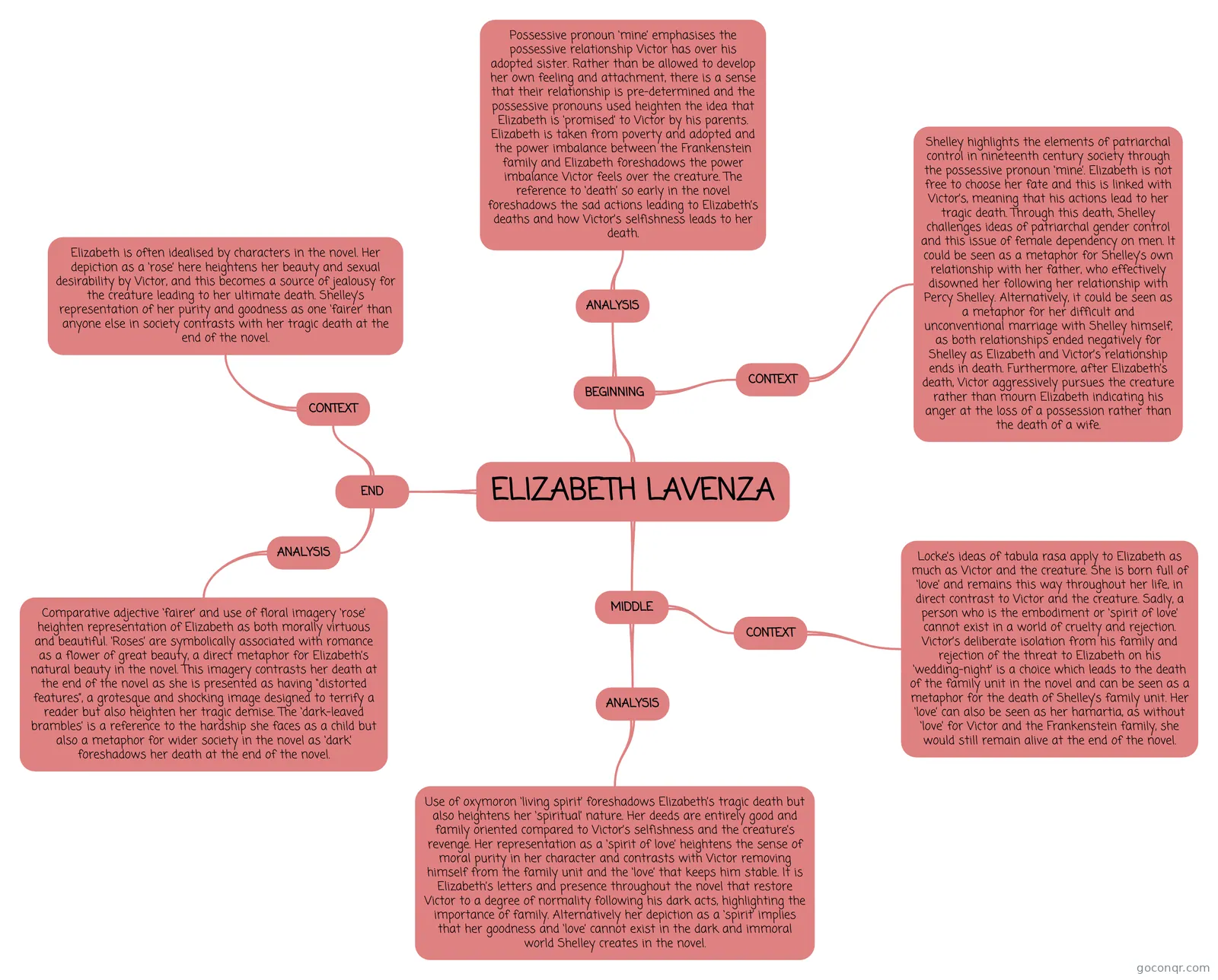
Mind map: Elizabeth Lavenza
Contenido del mapa
ELIZABETH LAVENZA
BEGINNING
- ANALYSIS
- Possessive pronoun ‘mine’ emphasises the possessive relationship Victor has over his adopted sister. Rather than be allowed to develop her own feeling and attachment, there is a sense that their relationship is pre-determined and the possessive pronouns used heighten the idea that Elizabeth is ‘promised’ to Victor by his parents. Elizabeth is taken from poverty and adopted and the power imbalance between the Frankenstein family and Elizabeth foreshadows the power imbalance Victor feels over the creature. The reference to ‘death’ so early in the novel foreshadows the sad actions leading to Elizabeth’s deaths and how Victor’s selfishness leads to her death.
- CONTEXT
- Shelley highlights the elements of patriarchal control in nineteenth century society through the possessive pronoun ‘mine’. Elizabeth is not free to choose her fate and this is linked with Victor’s, meaning that his actions lead to her tragic death. Through this death, Shelley challenges ideas of patriarchal gender control and this issue of female dependency on men. It could be seen as a metaphor for Shelley’s own relationship with her father, who effectively disowned her following her relationship with Percy Shelley. Alternatively, it could be seen as a metaphor for her difficult and unconventional marriage with Shelley himself, as both relationships ended negatively for Shelley as Elizabeth and Victor’s relationship ends in death. Furthermore, after Elizabeth’s death, Victor aggressively pursues the creature rather than mourn Elizabeth indicating his anger at the loss of a possession rather than the death of a wife.
- ANALYSIS
MIDDLE
- ANALYSIS
- Use of oxymoron ‘living spirit’ foreshadows Elizabeth’s tragic death but also heightens her ‘spiritual’ nature. Her deeds are entirely good and family oriented compared to Victor’s selfishness and the creature’s revenge. Her representation as a ‘spirit of love’ heightens the sense of moral purity in her character and contrasts with Victor removing himself from the family unit and the ‘love’ that keeps him stable. It is Elizabeth’s letters and presence throughout the novel that restore Victor to a degree of normality following his dark acts, highlighting the importance of family. Alternatively her depiction as a ‘spirit’ implies that her goodness and ‘love’ cannot exist in the dark and immoral world Shelley creates in the novel.
- CONTEXT
- Locke’s ideas of tabula rasa apply to Elizabeth as much as Victor and the creature. She is born full of ‘love’ and remains this way throughout her life, in direct contrast to Victor and the creature. Sadly, a person who is the embodiment or ‘spirit of love’ cannot exist in a world of cruelty and rejection. Victor’s deliberate isolation from his family and rejection of the threat to Elizabeth on his ‘wedding-night’ is a choice which leads to the death of the family unit in the novel and can be seen as a metaphor for the death of Shelley’s family unit. Her ‘love’ can also be seen as her hamartia, as without ‘love’ for Victor and the Frankenstein family, she would still remain alive at the end of the novel.
- ANALYSIS
END
- ANALYSIS
- Comparative adjective ‘fairer’ and use of floral imagery ‘rose’ heighten representation of Elizabeth as both morally virtuous and beautiful. ‘Roses’ are symbolically associated with romance as a flower of great beauty, a direct metaphor for Elizabeth’s natural beauty in the novel. This imagery contrasts her death at the end of the novel as she is presented as having “distorted features”, a grotesque and shocking image designed to terrify a reader but also heighten her tragic demise. The ‘dark-leaved brambles’ is a reference to the hardship she faces as a child but also a metaphor for wider society in the novel as ‘dark’ foreshadows her death at the end of the novel.
- CONTEXT
- Elizabeth is often idealised by characters in the novel. Her depiction as a ‘rose’ here heightens her beauty and sexual desirability by Victor, and this becomes a source of jealousy for the creature leading to her ultimate death. Shelley’s representation of her purity and goodness as one ‘fairer’ than anyone else in society contrasts with her tragic death at the end of the novel.
- ANALYSIS
Información
- Descripción
- Mapa Mental sobre ELIZABETH LAVENZA, creado por Sarah Mawson el 31/05/2022.
- Creado por
- Sarah Mawson
- Visitas
- 5
- Valoración
Más sobre Frankenstein Characters