
Mapa mental
SELFISHNESS
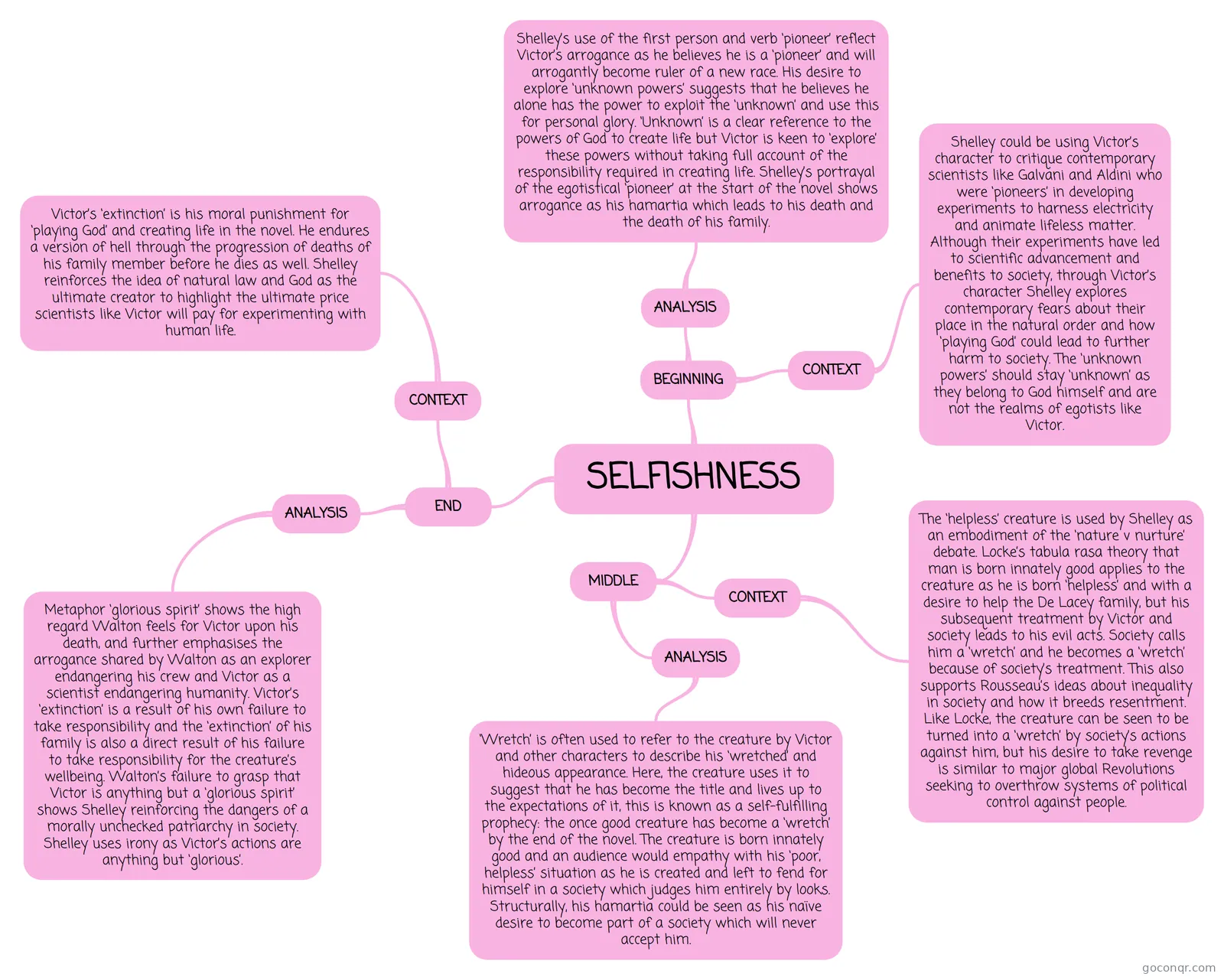
Mind map: Selfishness
Contenido del mapa
SELFISHNESS
BEGINNING
- ANALYSIS
- Shelley’s use of the first person and verb ‘pioneer’ reflect Victor’s arrogance as he believes he is a ‘pioneer’ and will arrogantly become ruler of a new race. His desire to explore ‘unknown powers’ suggests that he believes he alone has the power to exploit the ‘unknown’ and use this for personal glory. ‘Unknown’ is a clear reference to the powers of God to create life but Victor is keen to ‘explore’ these powers without taking full account of the responsibility required in creating life. Shelley’s portrayal of the egotistical ‘pioneer’ at the start of the novel shows arrogance as his hamartia which leads to his death and the death of his family.
- CONTEXT
- Shelley could be using Victor’s character to critique contemporary scientists like Galvani and Aldini who were ‘pioneers’ in developing experiments to harness electricity and animate lifeless matter. Although their experiments have led to scientific advancement and benefits to society, through Victor’s character Shelley explores contemporary fears about their place in the natural order and how ‘playing God’ could lead to further harm to society. The ‘unknown powers’ should stay ‘unknown’ as they belong to God himself and are not the realms of egotists like Victor.
- ANALYSIS
MIDDLE
- ANALYSIS
- ‘Wretch’ is often used to refer to the creature by Victor and other characters to describe his ‘wretched’ and hideous appearance. Here, the creature uses it to suggest that he has become the title and lives up to the expectations of it, this is known as a self-fulfilling prophecy: the once good creature has become a ‘wretch’ by the end of the novel. The creature is born innately good and an audience would empathy with his ‘poor, helpless’ situation as he is created and left to fend for himself in a society which judges him entirely by looks. Structurally, his hamartia could be seen as his naïve desire to become part of a society which will never accept him.
- CONTEXT
- The ‘helpless’ creature is used by Shelley as an embodiment of the ‘nature v nurture’ debate. Locke’s tabula rasa theory that man is born innately good applies to the creature as he is born ‘helpless’ and with a desire to help the De Lacey family, but his subsequent treatment by Victor and society leads to his evil acts. Society calls him a ‘wretch’ and he becomes a ‘wretch’ because of society’s treatment. This also supports Rousseau’s ideas about inequality in society and how it breeds resentment. Like Locke, the creature can be seen to be turned into a ‘wretch’ by society’s actions against him, but his desire to take revenge is similar to major global Revolutions seeking to overthrow systems of political control against people.
- ANALYSIS
END
- ANALYSIS
- Metaphor ‘glorious spirit’ shows the high regard Walton feels for Victor upon his death, and further emphasises the arrogance shared by Walton as an explorer endangering his crew and Victor as a scientist endangering humanity. Victor’s ‘extinction’ is a result of his own failure to take responsibility and the ‘extinction’ of his family is also a direct result of his failure to take responsibility for the creature’s wellbeing. Walton’s failure to grasp that Victor is anything but a ‘glorious spirit’ shows Shelley reinforcing the dangers of a morally unchecked patriarchy in society. Shelley uses irony as Victor’s actions are anything but ‘glorious’.
- CONTEXT
- Victor’s ‘extinction’ is his moral punishment for ‘playing God’ and creating life in the novel. He endures a version of hell through the progression of deaths of his family member before he dies as well. Shelley reinforces the idea of natural law and God as the ultimate creator to highlight the ultimate price scientists like Victor will pay for experimenting with human life.
- ANALYSIS
Información
- Descripción
- Mapa Mental sobre SELFISHNESS, creado por Sarah Mawson el 31/05/2022.
- Creado por
- Sarah Mawson
- Visitas
- 0
- Valoración