
Mapa mental
social class and identity
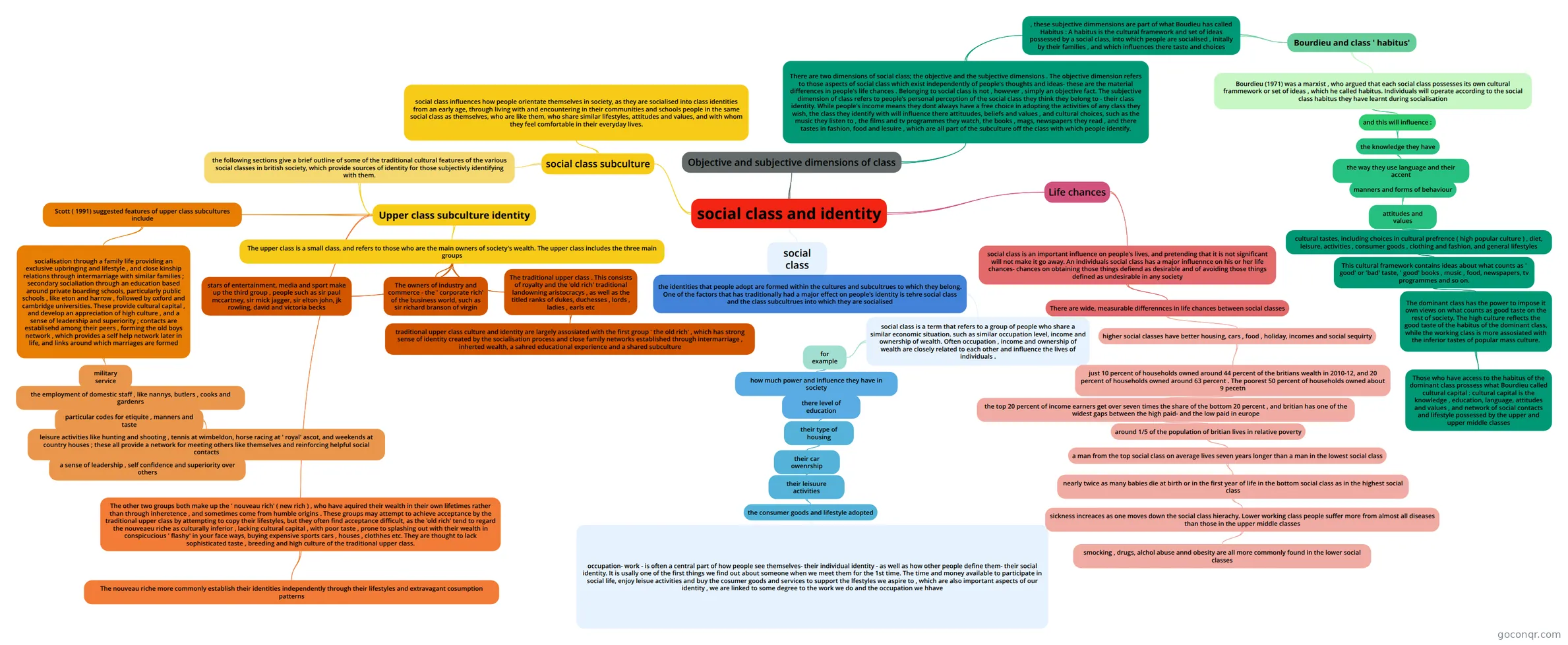
Mind map: social class and identity
Contenido del mapa
social class and identity
social class
- the identities that people adopt are formed within the cultures and subcultrues to which they belong. One of the factors that has traditionally had a major effect on people's identity is tehre social class and the class subcultrues into which they are socialised
- social class is a term that refers to a group of people who share a similar economic situation. such as similar occupation level, income and ownership of wealth. Often occupation , income and ownership of wealth are closely related to each other and influence the lives of individuals .
- for example
- how much power and influence they have in society
- there level of education
- their type of housing
- their car owenrship
- their leisuure activities
- the consumer goods and lifestyle adopted
- occupation- work - is often a central part of how people see themselves- their individual identity - as well as how other people define them- their social identity. It is usally one of the first things we find out about someone when we meet them for the 1st time. The time and money available to participate in social life, enjoy leisue activities and buy the cosumer goods and services to support the lfestyles we aspire to , which are also important aspects of our identity , we are linked to some degree to the work we do and the occupation we hhave
- the consumer goods and lifestyle adopted
- their leisuure activities
- their car owenrship
- their type of housing
- there level of education
- how much power and influence they have in society
- for example
- social class is a term that refers to a group of people who share a similar economic situation. such as similar occupation level, income and ownership of wealth. Often occupation , income and ownership of wealth are closely related to each other and influence the lives of individuals .
- the identities that people adopt are formed within the cultures and subcultrues to which they belong. One of the factors that has traditionally had a major effect on people's identity is tehre social class and the class subcultrues into which they are socialised
Life chances
- social class is an important influence on people's lives, and pretending that it is not significant will not make it go away. An individuals social class has a major influennce on his or her life chances- chances on obtaining those things defiend as desirable and of avoiding those things defined as undesirable in any society
- There are wide, measurable differennces in life chances between social classes
- higher social classes have better housing, cars , food , holiday, incomes and social sequirty
- just 10 percent of households owned around 44 percent of the britians wealth in 2010-12, and 20 percent of households owned around 63 percent . The poorest 50 percent of households owned about 9 pecetn
- the top 20 percent of income earners get over seven times the share of the bottom 20 percent , and britian has one of the widest gaps between the high paid- and the low paid in europe
- around 1/5 of the population of britian lives in relative poverty
- a man from the top social class on average lives seven years longer than a man in the lowest social class
- nearly twice as many babies die at birth or in the first year of life in the bottom social class as in the highest social class
- sickness increaces as one moves down the social class hierachy. Lower working class people suffer more from almost all diseases than those in the upper middle classes
- smocking , drugs, alchol abuse annd obesity are all more commonly found in the lower social classes
- sickness increaces as one moves down the social class hierachy. Lower working class people suffer more from almost all diseases than those in the upper middle classes
- nearly twice as many babies die at birth or in the first year of life in the bottom social class as in the highest social class
- a man from the top social class on average lives seven years longer than a man in the lowest social class
- around 1/5 of the population of britian lives in relative poverty
- the top 20 percent of income earners get over seven times the share of the bottom 20 percent , and britian has one of the widest gaps between the high paid- and the low paid in europe
- just 10 percent of households owned around 44 percent of the britians wealth in 2010-12, and 20 percent of households owned around 63 percent . The poorest 50 percent of households owned about 9 pecetn
- higher social classes have better housing, cars , food , holiday, incomes and social sequirty
- There are wide, measurable differennces in life chances between social classes
- social class is an important influence on people's lives, and pretending that it is not significant will not make it go away. An individuals social class has a major influennce on his or her life chances- chances on obtaining those things defiend as desirable and of avoiding those things defined as undesirable in any society
Objective and subjective dimensions of class
- There are two dimensions of social class; the objective and the subjective dimensions . The objective dimension refers to those aspects of social class which exist independently of people's thoughts and ideas- these are the material differences in people's life chances . Belonging to social class is not , however , simply an objective fact. The subjective dimension of class refers to people's personal perception of the social class they think they belong to - their class identity. While people's income means they dont always have a free choice in adopting the activities of any class they wish, the class they identify with will influence there attituudes, beliefs and values , and cultural choices, such as the music they listen to , the films and tv programmes they watch, the books , mags, newspapers they read , and there tastes in fashion, food and lesuire , which are all part of the subculture off the class with which people identify.
- , these subjective dimmensions are part of what Boudieu has called Habitus : A habitus is the cultural framework and set of ideas possessed by a social class, into which people are socialised , initally by their families , and which influences there taste and choices
- Bourdieu and class ' habitus'
- Bourdieu (1971) was a marxist , who argued that each social class possesses its own cultural frammework or set of ideas , which he called habitus. Individuals will operate according to the social class habitus they have learnt during socialisation
- and this will influence :
- the knowledge they have
- the way they use language and their accent
- manners and forms of behaviour
- attitudes and values
- cultural tastes, including choices in cultural prefrence ( high popular culture ) , diet, leisure, activities , consumer goods , clothing and fashion, and general lifestyles
- This cultural framework contains ideas about what counts as ' good' or 'bad' taste, ' good' books , music , food, newspapers, tv programmes and so on.
- The dominant class has the power to impose it own views on what counts as good taste on the rest of society. The high culture reflects the good taste of the habitus of the dominant class, while the working class is more assosiated with the inferior tastes of popular mass culture.
- Those who have access to the habitus of the dominant class prossess what Bourdieu called cultural capital : cultural capital is the knowledge , education, language, attitudes and values , and network of social contacts and lifestyle possessed by the upper and upper middle classes
- The dominant class has the power to impose it own views on what counts as good taste on the rest of society. The high culture reflects the good taste of the habitus of the dominant class, while the working class is more assosiated with the inferior tastes of popular mass culture.
- This cultural framework contains ideas about what counts as ' good' or 'bad' taste, ' good' books , music , food, newspapers, tv programmes and so on.
- cultural tastes, including choices in cultural prefrence ( high popular culture ) , diet, leisure, activities , consumer goods , clothing and fashion, and general lifestyles
- attitudes and values
- manners and forms of behaviour
- the way they use language and their accent
- the knowledge they have
- and this will influence :
- Bourdieu (1971) was a marxist , who argued that each social class possesses its own cultural frammework or set of ideas , which he called habitus. Individuals will operate according to the social class habitus they have learnt during socialisation
- Bourdieu and class ' habitus'
- , these subjective dimmensions are part of what Boudieu has called Habitus : A habitus is the cultural framework and set of ideas possessed by a social class, into which people are socialised , initally by their families , and which influences there taste and choices
- There are two dimensions of social class; the objective and the subjective dimensions . The objective dimension refers to those aspects of social class which exist independently of people's thoughts and ideas- these are the material differences in people's life chances . Belonging to social class is not , however , simply an objective fact. The subjective dimension of class refers to people's personal perception of the social class they think they belong to - their class identity. While people's income means they dont always have a free choice in adopting the activities of any class they wish, the class they identify with will influence there attituudes, beliefs and values , and cultural choices, such as the music they listen to , the films and tv programmes they watch, the books , mags, newspapers they read , and there tastes in fashion, food and lesuire , which are all part of the subculture off the class with which people identify.
social class subculture
- social class influences how people orientate themselves in society, as they are socialised into class identities from an early age, through living with and encountering in their communities and schools people in the same social class as themselves, who are like them, who share similar lifestyles, attitudes and values, and with whom they feel comfortable in their everyday lives.
- the following sections give a brief outline of some of the traditional cultural features of the various social classes in british society, which provide sources of identity for those subjectivly identifying with them.
- Upper class subculture identity
- The upper class is a small class, and refers to those who are the main owners of society's wealth. The upper class includes the three main groups
- The traditional upper class . This consists of royalty and the 'old rich' traditional landowning aristocracys , as well as the titled ranks of dukes, duchesses , lords , ladies , earls etc
- traditional upper class culture and identity are largely assosiated with the first group ' the old rich' , which has strong sense of identity created by the socialisation process and close family networks established through intermarriage , inherted wealth, a sahred educational experience and a shared subculture
- The owners of industry and commerce - the ' corporate rich' of the business world, such as sir richard branson of virgin
- stars of entertainment, media and sport make up the third group , people such as sir paul mccartney, sir mick jagger, sir elton john, jk rowling, david and victoria becks
- The traditional upper class . This consists of royalty and the 'old rich' traditional landowning aristocracys , as well as the titled ranks of dukes, duchesses , lords , ladies , earls etc
- Scott ( 1991) suggested features of upper class subcultures include
- socialisation through a family life providing an exclusive upbringing and lifestyle , and close kinship relations through intermarriage with similar families ; secondary socialiation through an education based around private boarding schools, particularly public schools , like eton and harrow , followed by oxford and cambridge universities. These provide cultural capital , and develop an appreciation of high culture , and a sense of leadership and superiority ; contacts are establisehd among their peers , forming the old boys network , which provides a self help network later in life, and links around which marriages are formed
- military service
- the employment of domestic staff , like nannys, butlers , cooks and gardenrs
- particular codes for etiquite , manners and taste
- leisure activities like hunting and shooting , tennis at wimbeldon, horse racing at ' royal' ascot, and weekends at country houses ; these all provide a network for meeting others like themselves and reinforcing helpful social contacts
- a sense of leadership , self confidence and superiority over others
- leisure activities like hunting and shooting , tennis at wimbeldon, horse racing at ' royal' ascot, and weekends at country houses ; these all provide a network for meeting others like themselves and reinforcing helpful social contacts
- particular codes for etiquite , manners and taste
- the employment of domestic staff , like nannys, butlers , cooks and gardenrs
- military service
- socialisation through a family life providing an exclusive upbringing and lifestyle , and close kinship relations through intermarriage with similar families ; secondary socialiation through an education based around private boarding schools, particularly public schools , like eton and harrow , followed by oxford and cambridge universities. These provide cultural capital , and develop an appreciation of high culture , and a sense of leadership and superiority ; contacts are establisehd among their peers , forming the old boys network , which provides a self help network later in life, and links around which marriages are formed
- The other two groups both make up the ' nouveau rich' ( new rich ) , who have aquired their wealth in their own lifetimes rather than through inheretence , and sometimes come from humble origins . These groups may attempt to achieve acceptance by the traditional upper class by attempting to copy their lifestyles, but they often find acceptance difficult, as the 'old rich' tend to regard the nouveaeu riche as culturally inferior , lacking cultural capital , with poor taste , prone to splashing out with their wealth in conspicucious ' flashy' in your face ways, buying expensive sports cars , houses , clothhes etc. They are thought to lack sophisticated taste , breeding and high culture of the traditional upper class.
- The nouveau riche more commonly establish their identities independently through their lifestyles and extravagant cosumption patterns
- The upper class is a small class, and refers to those who are the main owners of society's wealth. The upper class includes the three main groups
- Upper class subculture identity
Información
- Descripción
- Mapa Mental sobre social class and identity, creado por sazzystessa el 10/10/2015.
- Creado por
- sazzystessa
- Visitas
- 0
- Valoración
Más sobre Social Class and Identity