
Mapa mental
Feed-Food Competition
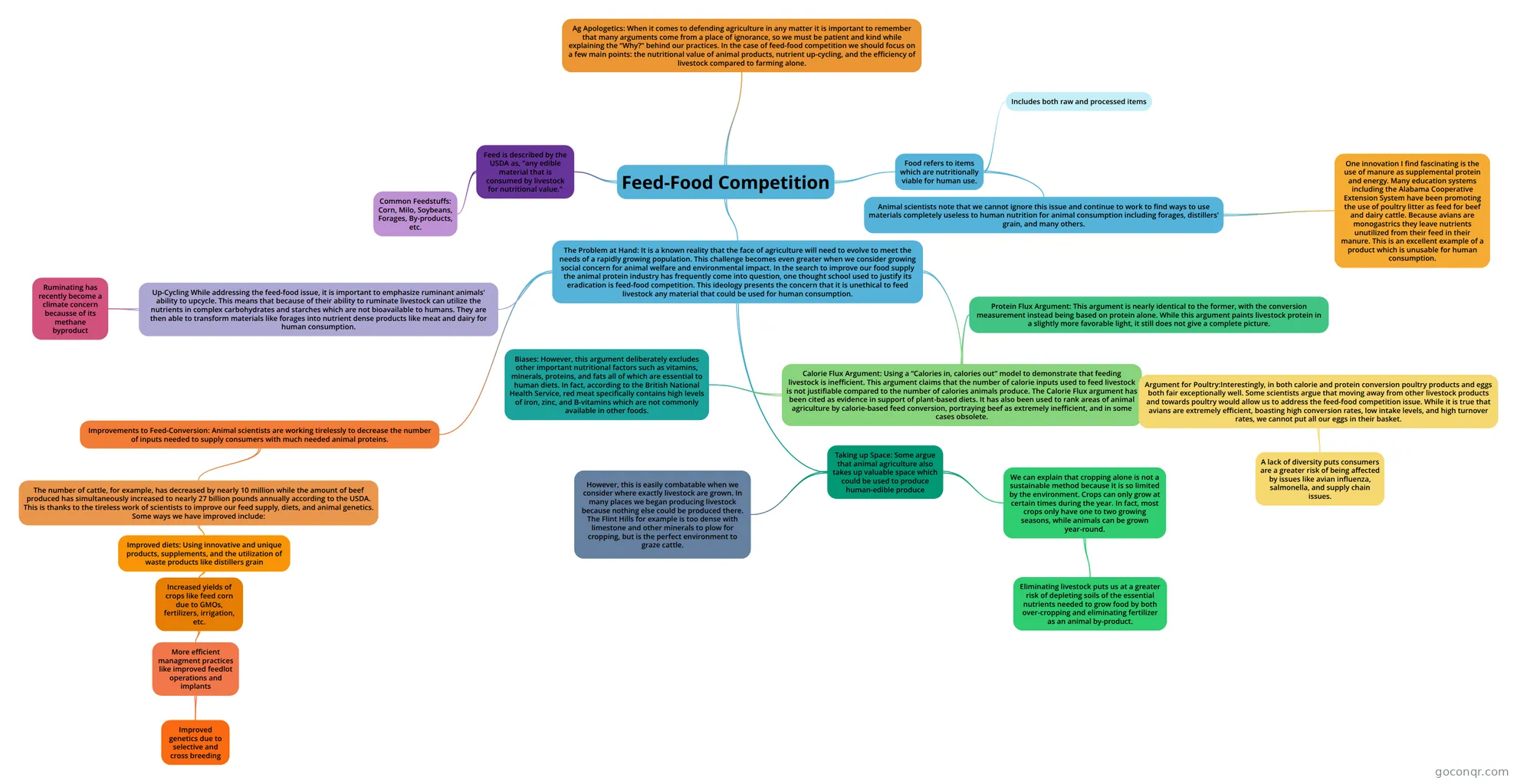
Mind map: Feed-food competition
Contenido del mapa
Feed-Food Competition
Feed is described by the USDA as, "any edible material that is consumed by livestock for nutritional value."
- Common Feedstuffs: Corn, Milo, Soybeans, Forages, By-products, etc.
Food refers to items which are nutritionally viable for human use.
- Includes both raw and processed items
- Animal scientists note that we cannot ignore this issue and continue to work to find ways to use materials completely useless to human nutrition for animal consumption including forages, distillers' grain, and many others.
- One innovation I find fascinating is the use of manure as supplemental protein and energy. Many education systems including the Alabama Cooperative Extension System have been promoting the use of poultry litter as feed for beef and dairy cattle. Because avians are monogastrics they leave nutrients unutilized from their feed in their manure. This is an excellent example of a product which is unusable for human consumption.
The Problem at Hand: It is a known reality that the face of agriculture will need to evolve to meet the needs of a rapidly growing population. This challenge becomes even greater when we consider growing social concern for animal welfare and environmental impact. In the search to improve our food supply the animal protein industry has frequently come into question, one thought school used to justify its eradication is feed-food competition. This ideology presents the concern that it is unethical to feed livestock any material that could be used for human consumption.
- Calorie Flux Argument: Using a “Calories in, calories out” model to demonstrate that feeding livestock is inefficient. This argument claims that the number of calorie inputs used to feed livestock is not justifiable compared to the number of calories animals produce. The Calorie Flux argument has been cited as evidence in support of plant-based diets. It has also been used to rank areas of animal agriculture by calorie-based feed conversion, portraying beef as extremely inefficient, and in some cases obsolete.
- Biases: However, this argument deliberately excludes other important nutritional factors such as vitamins, minerals, proteins, and fats all of which are essential to human diets. In fact, according to the British National Health Service, red meat specifically contains high levels of iron, zinc, and B-vitamins which are not commonly available in other foods.
- Argument for Poultry:Interestingly, in both calorie and protein conversion poultry products and eggs both fair exceptionally well. Some scientists argue that moving away from other livestock products and towards poultry would allow us to address the feed-food competition issue. While it is true that avians are extremely efficient, boasting high conversion rates, low intake levels, and high turnover rates, we cannot put all our eggs in their basket.
- A lack of diversity puts consumers are a greater risk of being affected by issues like avian influenza, salmonella, and supply chain issues.
- Protein Flux Argument: This argument is nearly identical to the former, with the conversion measurement instead being based on protein alone. While this argument paints livestock protein in a slightly more favorable light, it still does not give a complete picture.
- Up-Cycling While addressing the feed-food issue, it is important to emphasize ruminant animals' ability to upcycle. This means that because of their ability to ruminate livestock can utilize the nutrients in complex carbohydrates and starches which are not bioavailable to humans. They are then able to transform materials like forages into nutrient dense products like meat and dairy for human consumption.
- Ruminating has recently become a climate concern becausse of its methane byproduct
- Taking up Space: Some argue that animal agriculture also takes up valuable space which could be used to produce human-edible produce
- However, this is easily combatable when we consider where exactly livestock are grown. In many places we began producing livestock because nothing else could be produced there. The Flint Hills for example is too dense with limestone and other minerals to plow for cropping, but is the perfect environment to graze cattle.
- We can explain that cropping alone is not a sustainable method because it is so limited by the environment. Crops can only grow at certain times during the year. In fact, most crops only have one to two growing seasons, while animals can be grown year-round.
- Eliminating livestock puts us at a greater risk of depleting soils of the essential nutrients needed to grow food by both over-cropping and eliminating fertilizer as an animal by-product.
- Improvements to Feed-Conversion: Animal scientists are working tirelessly to decrease the number of inputs needed to supply consumers with much needed animal proteins.
- The number of cattle, for example, has decreased by nearly 10 million while the amount of beef produced has simultaneously increased to nearly 27 billion pounds annually according to the USDA. This is thanks to the tireless work of scientists to improve our feed supply, diets, and animal genetics. Some ways we have improved include:
- Improved diets: Using innovative and unique products, supplements, and the utilization of waste products like distillers grain
- Increased yields of crops like feed corn due to GMOs, fertilizers, irrigation, etc.
- More efficient managment practices like improved feedlot operations and implants
- Improved genetics due to selective and cross breeding
- More efficient managment practices like improved feedlot operations and implants
- Increased yields of crops like feed corn due to GMOs, fertilizers, irrigation, etc.
- Improved diets: Using innovative and unique products, supplements, and the utilization of waste products like distillers grain
- The number of cattle, for example, has decreased by nearly 10 million while the amount of beef produced has simultaneously increased to nearly 27 billion pounds annually according to the USDA. This is thanks to the tireless work of scientists to improve our feed supply, diets, and animal genetics. Some ways we have improved include:
- Calorie Flux Argument: Using a “Calories in, calories out” model to demonstrate that feeding livestock is inefficient. This argument claims that the number of calorie inputs used to feed livestock is not justifiable compared to the number of calories animals produce. The Calorie Flux argument has been cited as evidence in support of plant-based diets. It has also been used to rank areas of animal agriculture by calorie-based feed conversion, portraying beef as extremely inefficient, and in some cases obsolete.
Ag Apologetics: When it comes to defending agriculture in any matter it is important to remember that many arguments come from a place of ignorance, so we must be patient and kind while explaining the “Why?” behind our practices. In the case of feed-food competition we should focus on a few main points: the nutritional value of animal products, nutrient up-cycling, and the efficiency of livestock compared to farming alone.
Información
- Descripción
- Mapa Mental sobre Feed-Food Competition, creado por Molly Brown el 19/10/2024.
- Creado por
- Molly Brown
- Visitas
- 2
- Valoración