
Mapa mental
Gastroenterology
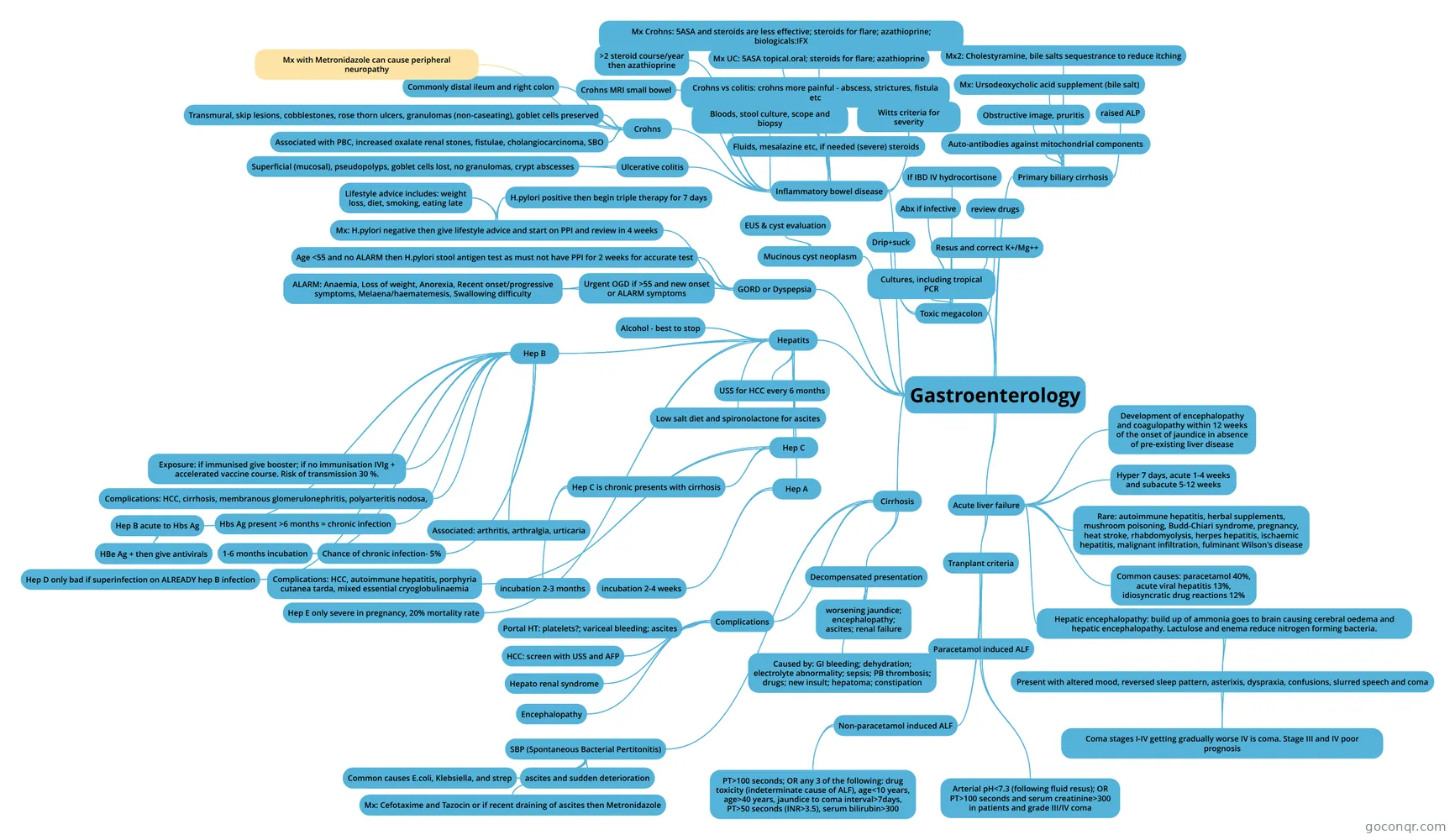
Mind map: Gastroenterology
Contenido del mapa
Gastroenterology
GORD or Dyspepsia
- Urgent OGD if >55 and new onset or ALARM symptoms
- ALARM: Anaemia, Loss of weight, Anorexia, Recent onset/progressive symptoms, Melaena/haematemesis, Swallowing difficulty
- Age <55 and no ALARM then H.pylori stool antigen test as must not have PPI for 2 weeks for accurate test
- Mx: H.pylori negative then give lifestyle advice and start on PPI and review in 4 weeks
- Lifestyle advice includes: weight loss, diet, smoking, eating late
- H.pylori positive then begin triple therapy for 7 days
- Urgent OGD if >55 and new onset or ALARM symptoms
Inflammatory bowel disease
- Crohns vs colitis: crohns more painful - abscess, strictures, fistula etc
- Bloods, stool culture, scope and biopsy
- Fluids, mesalazine etc, if needed (severe) steroids
- Witts criteria for severity
- Crohns MRI small bowel
- Mx UC: 5ASA topical.oral; steroids for flare; azathioprine
- Mx Crohns: 5ASA and steroids are less effective; steroids for flare; azathioprine; biologicals:IFX
- >2 steroid course/year then azathioprine
- Crohns
- Transmural, skip lesions, cobblestones, rose thorn ulcers, granulomas (non-caseating), goblet cells preserved
- Associated with PBC, increased oxalate renal stones, fistulae, cholangiocarcinoma, SBO
- Commonly distal ileum and right colon
- Mx with Metronidazole can cause peripheral neuropathy
- Ulcerative colitis
- Superficial (mucosal), pseudopolyps, goblet cells lost, no granulomas, crypt abscesses
Toxic megacolon
- Cultures, including tropical PCR
- Resus and correct K+/Mg++
- Drip+suck
- Abx if infective
- If IBD IV hydrocortisone
- review drugs
Mucinous cyst neoplasm
- EUS & cyst evaluation
Primary biliary cirrhosis
- Auto-antibodies against mitochondrial components
- Obstructive image, pruritis
- raised ALP
- Mx: Ursodeoxycholic acid supplement (bile salt)
- Mx2: Cholestyramine, bile salts sequestrance to reduce itching
Cirrhosis
- Complications
- Portal HT: platelets?; variceal bleeding; ascites
- HCC: screen with USS and AFP
- Hepato renal syndrome
- Encephalopathy
- Decompensated presentation
- worsening jaundice; encephalopathy; ascites; renal failure
- Caused by: GI bleeding; dehydration; electrolyte abnormality; sepsis; PB thrombosis; drugs; new insult; hepatoma; constipation
- SBP (Spontaneous Bacterial Pertitonitis)
- ascites and sudden deterioration
- Mx: Cefotaxime and Tazocin or if recent draining of ascites then Metronidazole
- Common causes E.coli, Klebsiella, and strep
- Complications
Hepatits
- Alcohol - best to stop
- USS for HCC every 6 months
- Low salt diet and spironolactone for ascites
- Hep B
- Hep B acute to Hbs Ag
- HBe Ag + then give antivirals
- 1-6 months incubation
- Associated: arthritis, arthralgia, urticaria
- Chance of chronic infection- 5%
- Hbs Ag present >6 months = chronic infection
- Complications: HCC, cirrhosis, membranous glomerulonephritis, polyarteritis nodosa,
- Exposure: if immunised give booster; if no immunisation IVIg + accelerated vaccine course. Risk of transmission 30 %.
- Hep D only bad if superinfection on ALREADY hep B infection
- Hep B acute to Hbs Ag
- Hep A
- incubation 2-4 weeks
- Hep C
- Hep C is chronic presents with cirrhosis
- incubation 2-3 months
- Complications: HCC, autoimmune hepatitis, porphyria cutanea tarda, mixed essential cryoglobulinaemia
- Hep C is chronic presents with cirrhosis
- Hep E only severe in pregnancy, 20% mortality rate
Acute liver failure
- Tranplant criteria
- Paracetamol induced ALF
- Arterial pH<7.3 (following fluid resus); OR PT>100 seconds and serum creatinine>300 in patients and grade III/IV coma
- Non-paracetamol induced ALF
- PT>100 seconds; OR any 3 of the following: drug toxicity (indeterminate cause of ALF), age<10 years, age>40 years, jaundice to coma interval>7days, PT>50 seconds (INR>3.5), serum bilirubin>300
- Paracetamol induced ALF
- Development of encephalopathy and coagulopathy within 12 weeks of the onset of jaundice in absence of pre-existing liver disease
- Hyper 7 days, acute 1-4 weeks and subacute 5-12 weeks
- Common causes: paracetamol 40%, acute viral hepatitis 13%, idiosyncratic drug reactions 12%
- Rare: autoimmune hepatitis, herbal supplements, mushroom poisoning, Budd-Chiari syndrome, pregnancy, heat stroke, rhabdomyolysis, herpes hepatitis, ischaemic hepatitis, malignant infiltration, fulminant Wilson's disease
- Hepatic encephalopathy: build up of ammonia goes to brain causing cerebral oedema and hepatic encephalopathy. Lactulose and enema reduce nitrogen forming bacteria.
- Present with altered mood, reversed sleep pattern, asterixis, dyspraxia, confusions, slurred speech and coma
- Coma stages I-IV getting gradually worse IV is coma. Stage III and IV poor prognosis
- Present with altered mood, reversed sleep pattern, asterixis, dyspraxia, confusions, slurred speech and coma
- Tranplant criteria
Información
- Descripción
- Mapa Mental sobre Gastroenterology, creado por Layla Abdulbaki el 08/04/2025.
- Creado por
- Layla Abdulbaki
- Visitas
- 1
- Historial
-
- Creado por Amelia Seifalian · 6 abr 2020
- Copiado por Layla Abdulbaki · 8 abr 2025
- Valoración