
Mapa mental
Immune system
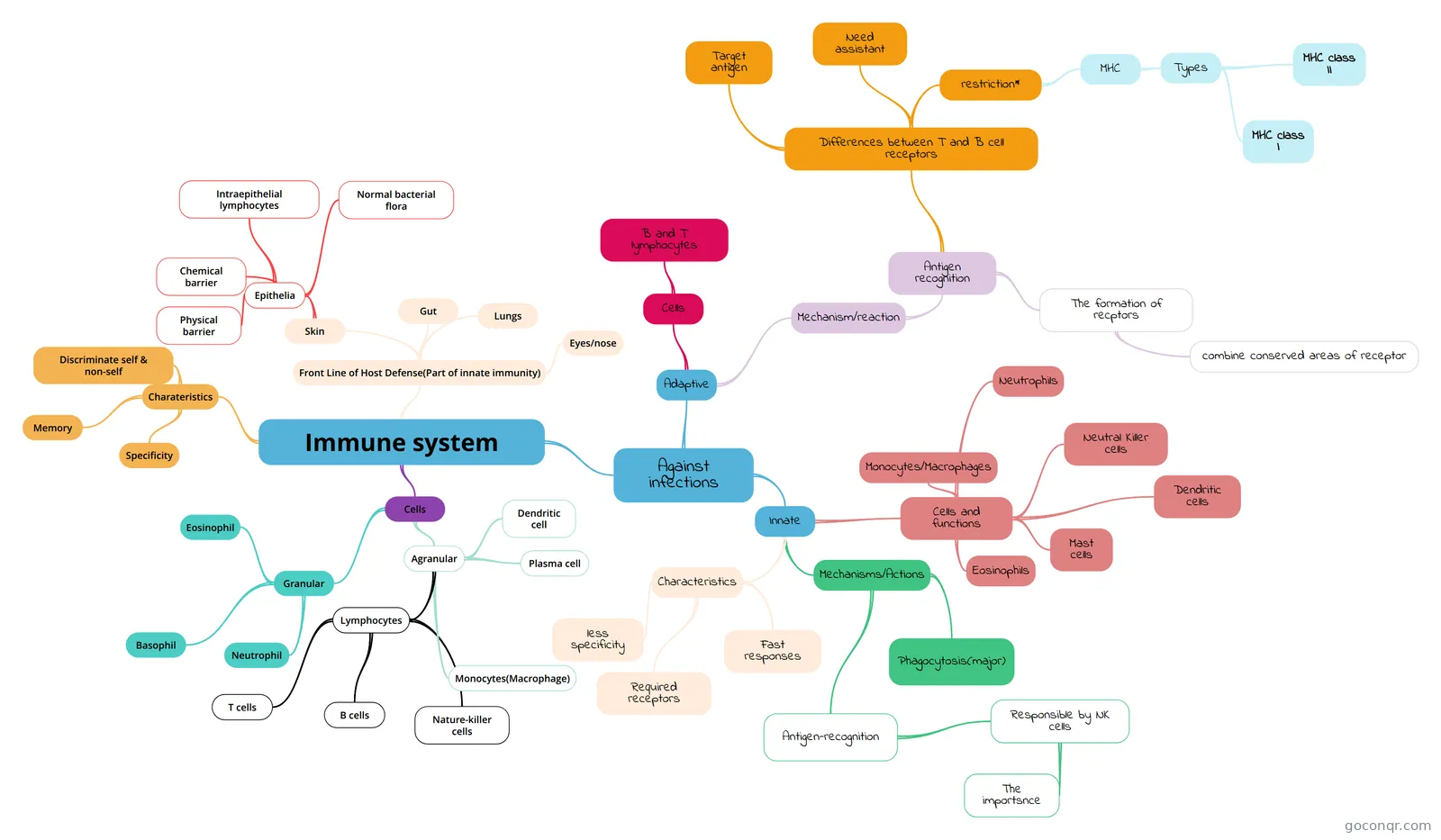
Mind map: immune system
Contenido del mapa
Immune system
Against infections
- Innate
- -work within minutes after a pathogen invasion
- Characteristics
- less specificity
- general, attack pathogens
- Fast responses
- not require time to develop
- Required receptors
- recognize pathogen-associated molecular patterns(PAMP)
- less specificity
- Mechanisms/Actions
- 1. phylogenetically order 2. exist before or react immediately after contact with pathogen(no memory) 3.react predominantly to infectious agents 4.First line defense 5.stimulate and shape adaptive immunity
- Phagocytosis(major)
- Antigen-recognition
- Responsible by NK cells
- 1. no antigen receptors 2. have surface receptors that inhibit killing function: -Kill inhibitory receptor(KIR):recognize abnormal levels of MHC class I(normal : NK cells do not kill it ; lower amounts(usually the indicator of infected cells/tumor cells): will be killed)
- The importsnce
- 1. Viral can interfere with the expression of MHC-avoid the killing by CD8+ T cells: NK cells are important for catching these infected cells
- Responsible by NK cells
- Cells and functions
- Mast cells
- 1. inflammation
- Monocytes/Macrophages
- 1 Phagocytosis 2.inflammation 3.T-cell activation 4.Tissue repair
- Neutrophils
- 1. Phagocytosis 2. Inflammation
- Neutral Killer cells
- 1.Killing of infected or tumor cells(through detect the amount of MHC I) 2.Activation of Macrophages(by IFN-y)
- Eosinophils
- 1. Defense against parasite
- Dendritic cells
- 1. Phagocytosis 2. Activation of Naive T-cells
- Mast cells
- Adaptive
- -take times for the responses to a specific pathogens with memory -Highly specific -it work when the innate immunity cannot control and eliminate the pathogen. -with the ability to form "memory' of the pathogen -Quickly response: the organism is infected with the same pathogen
- Cells
- B and T lymphocytes
- 1. Have surface proteins(antigen receptors): recognize only one antigen 2. T cells: responsible for one small peptide 3. B cell: responsible for more than just a small peptide once the antigen binds the receptor of B cell/Tcell, they are activated and triggers an immune response.
- B and T lymphocytes
- Mechanism/reaction
- Antigen recognition
- The formation of recptors
- combine conserved areas of receptor
- with variable gene segments 1. recombining DNA 2. DNA mutation
- combine conserved areas of receptor
- Differences between T and B cell receptors
- Structure: BCR:Divalent TCR: monovalent
- Target antigen
- B cells : antigen in native form T cells :only recognize antigen fragments with epitope size
- Need assistant
- B cells : does not need help from other cells to recognize antigen T cells: only recognize peptides in the presence of MHC (a surface protein)-antigen has to go through antigen processing
- restriction*
- T cells : MHC restricted and hiscompatible to be activated
- MHC
- -Highly variable proteins:that allow the immune system to recognize self from non-self -also know as HLA(human leukocyte antigen)(CLASS II):type individuals for BM and organs transplates -inherited one set of Class I(A,B,C) and Class II(HLA-DR,DP,DQ) from each parent(expressed equally).
- Types
- MHC class I
- 1.expressed on all nucleated cells 2. responsible for graft rejection 3. MHC I must be expressed/by target cells to be killed by an antigen-specific CD8+ T cells
- MHC class II
- 1. expressed by immune cells(macrophages,dendritic cells, T cells and B cells)
- MHC class I
- The formation of recptors
- Antigen recognition
- Innate
Cells
- Granular
- -derived from Myeloid stem cell
- Eosinophil
- Basophil
- Neutrophil
- 1.contains granules 2. CD66 membrane marker protein
- Agranular
- Lymphocytes
- -T cells -B cells -NK cells
- T cells
- B cells
- Nature-killer cells
- 1. used in experiment:to test the ability of lymphocytes to kill specific target cells
- Monocytes(Macrophage)
- 1. Macrophage=Large,eating -Lysosomes -CD14 membrane marker protein 2.Function:-ingest and eliminate infectious agent-regulate other immune cells(both innate/adaptive)
- Plasma cell
- -differentiated from B Lymphocyte
- Dendritic cell
- 1.reside in tissue in an immature form: -mature when an infection/injury occurs 2.The role of mature DC: -travel to the lymphoid organs with antigen on their surface(antigen-presenting cells) -can present the antigen on the surface of T-cells
- Lymphocytes
- Granular
Front Line of Host Defense(Part of innate immunity)
- Skin
- Epithelia
- Chemical barrier
- Intraepithelial lymphocytes
- Normal bacterial flora
- Physical barrier
- Epithelia
- Gut
- Lungs
- Eyes/nose
- Skin
Charateristics
- Discriminate self & non-self
- Memory
- -allow the immune system to react more quickly and effectively to a stimulus that has encountered before.
- Specificity
- respond to the pathogen that is at hand
Información
- Descripción
- Diploma/Certificado de qualificação profissional de nivel 3 public health Mapa Mental sobre Immune system, creado por Clare Yu el 22/11/2015.
- Creado por
- Clare Yu
- Visitas
- 378
- Valoración