
Mapa mental
Demonstration(nucleic acid & lipids)
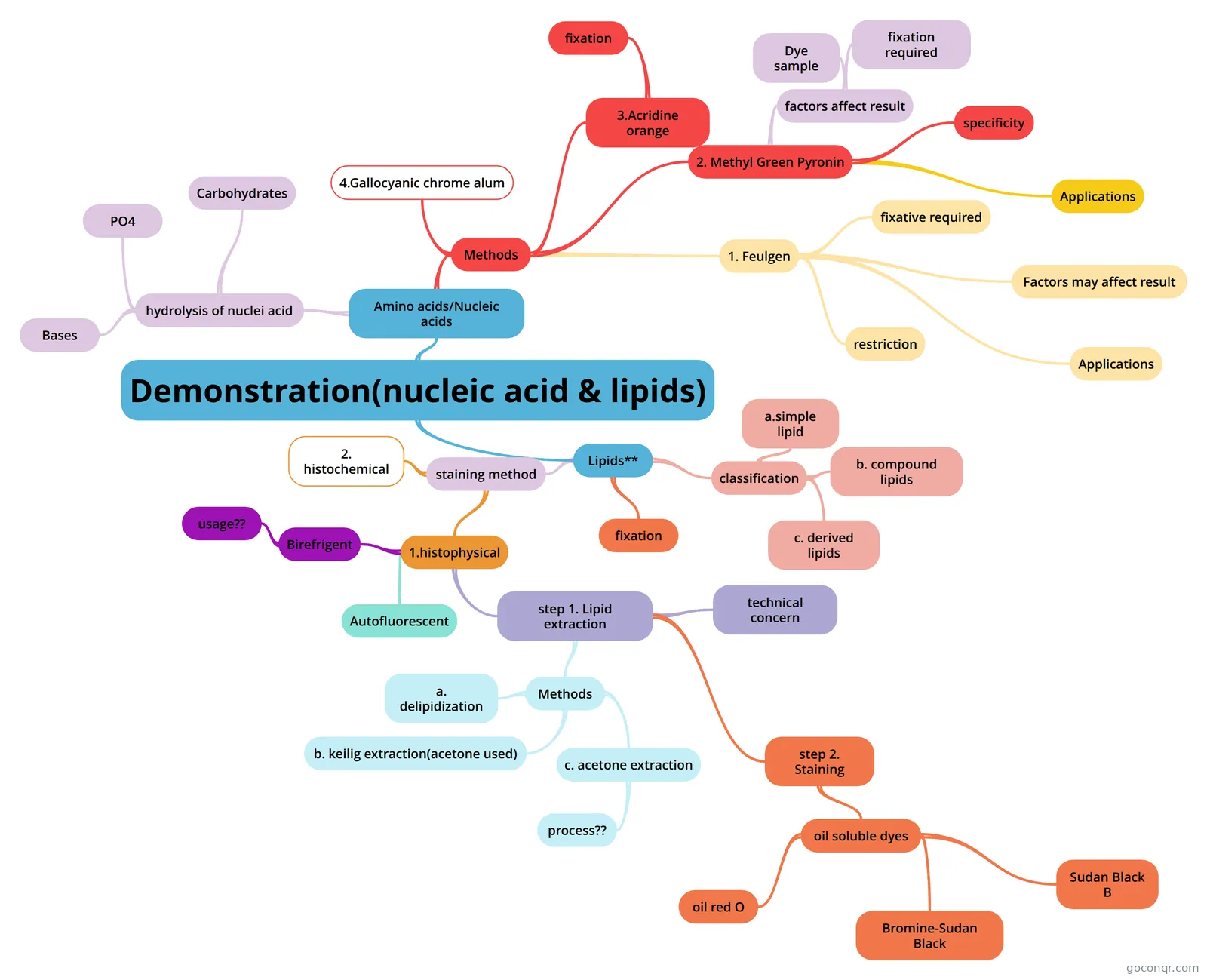
Mind map: Demonstration of nucleic acid and lipids
Contenido del mapa
Demonstration(nucleic acid & lipids)
Amino acids/Nucleic acids
- hydrolysis of nuclei acid
- Bases
- -no satisfactory histochemical method
- PO4
- -ionize at pH 1.5-2 -negative charge -basic dye staining by salt-linkages and H-bonding
- Carbohydrates
- useful for DNA demonstration
- Bases
- Methods
- 3.Acridine orange
- -Fluorochrome dye(basic dye) -used in smears or cytostat section -stain DNA & RNA
- Result: -DNA:fluoresces green -RNA:fluoresces orange-red
- fixation
- -short fixation in acetic acid ethanol or 70% alcohol(except bouin)
- 2. Methyl Green Pyronin
- combine two basic dyes for differential staining of RNA and DNA.
- the critical factor can affect the result: pH: 1. low pH(1.5); favours pyronin staining 2.high pH (9):favors MG staining 3.at pH 4.8:differential staining-DNA green(specific), RNA red(non specific ,mucous cells also stained red)
- specificity
- -MG;highly specific for DNA,not for RNA as they are protein bound. -Pyronin:it is small size, can stain RNA, depolymerized DNA, and mucous cells
- factors affect result
- fixation required
- 1.alcoholic fixative -avoid formalydehyde dichromate(e.g. zenker/helly) -delay fixation or prolog fixation in HCHO,cause loss of MG colour
- Dye sample
- -pyronin Y/G prefer to pyronin B(less diffuse and better differentiation) -MG impurities:from chloroform extraction of methyl violet
- fixation required
- Applications
- 1.histologic evaluation of immunologic disorders
- 2. detection of RNA in: -plasma cells -tumours -plasmacytoid lymphocytes -viral inclusion bodies
- 4.Gallocyanic chrome alum
- -enzyme extraction:can stain one molecule on one section
- 1. Feulgen
- 1. acid hydrolysis(1M HCl@ 60) of DNA -to break the purine-deoxyribose bond: break the sugar linkage of polymeric bonding; ruptures the glycoside linkages between sugars and bases, yield aldehyde groups
- 2.demonstration by schiff's reagent: result: aldehyde recolor schiff's reagent and produce magenta colour in the nuclear chromatin
- restriction
- cannot demonstrate RNA:it is removed by acid hydrolysis(depolymerization of RNA upon acid hydrolysis) -Purine bond and PO4 bond unaffected)
- fixative required
- 1.buffered formalin or acid fixatives (except BOUIN: over oxidation of nuclei acid)
- Factors may affect result
- 1.fixative:constitute/ nature 2.time of hydrolysis 3.temperature of hydrolysis 4.nature of specimen 5.early post-mortem changes 6.penetration of fixative 7.acid-pretreatment
- Applications
- 1.confirm/exclude DNA content of a basophilic inclusion 2.provide the distribution of DNA in various cells: due to precise site of DNA, semi-quantitative 3.nuclear sex studies-Barr bodies
- 3.Acridine orange
- hydrolysis of nuclei acid
Lipids**
- Free lipid droplets destroyed by chloroform, acetone and during processing: phospholipids and lipofuchsin can bind to other tissue element and resist paraffin processing(can be demonstrated)
- classification
- a.simple lipid
- properties: 1.esters of fatty acids and alcohols 2.Fats:natural ester of glycerol with saturated and unsaturated fatty acids 3.oil:similar to fats,liquid at RT
- b. compound lipids
- properties: 1.e.g. phospholipids, glycolipids 2.consist of a fatty acid, alcohol and one or more other groups(phosphorus/nitrogen)
- c. derived lipids
- 1.Fatty acids originate from simple and compound lipids by means of hydrolysis 2.e.g. cholesterol,sex hormone,adrenocortical hormones
- a.simple lipid
- fixation
- 1. no ideal fixatives, unfixed frozen sections
- special fixative: (i)osmium tetroxide and chromic acid- can fix lipids but will alter chemical reactivity of lipids (ii)formal calcium-for lipid histochemistry (iii)formaldehyde-fix minority of lipid(neutral fat) -cause damage after prolonged fixation
- staining method
- 2. histochemical
- demonstrate individual lipid by specific method
- 1.histophysical
- 1.without dyes or 2. with dyes
- Birefrigent
- crystalline lipids are birefrigence:Maltese cross is found in cholesterol esters of lipids -fatty droplets no birefrigent (called :isotropic)
- usage??
- 1.distinguish between glycerol ester(cholesteryl esters)- neutral fats(mainly triglycerides:non birefrigence) -can't be identified solely by their optical properties
- Autofluorescent
- results: 1.ceroids;yellow 2.lipofuscin: yellow 3.vitamin A:green
- step 1. Lipid extraction
- specific of staining technique
- step 2. Staining
- oil soluble dyes
- Properties/features 1.Lysochromes 2.Most are azo-dyes
- oil red O
- The solvent included: 1. Triethyl phosphate:stable,no ppt, no effect on lipid 2. 70% alcohol 3. 60% isopropanol 4. ethylene glycol 5.Propylene glycol
- Bromine-Sudan Black
- 1. simple sensitive method for detecting all main lipid classes. 2.only acetone resistant phospholipids are demonstrated
- The role of bromine: 1. render unsaturated lipids insoluble in organic solvents 2. converts cholesterol to cholesterol bromide esters: lower MT,oily at RT, and permeable to Sudan dye.
- Sudan Black B
- oil soluble dyes
- Methods
- a. delipidization
- lipids can be totally extracted with chloroform and ethanol
- b. keilig extraction(acetone used)
- acetone used with different temperature: a)cold acetone extract:simple lipid, cholesterol, triglycerides b)hot acetone:glycolipids
- c. acetone extraction
- properties: -acetone selectively remove hydrophobic lipid
- process??
- treat dried sections with anhydrous acetone(20 mins): 1.remove fat and cholesterol 2.acetone insoluble phospholipid intact(retained) 3.can also remove significant amount of phosphoglyceride
- a. delipidization
- technical concern
- 1.lipids seldom in pure form:they can dissolve in other lipids 2.bind with other tissue components and resists extraction(e.g. glycolipid, lipoproteins)
- 3.No ideal solvent to extract one lipid and not affect others 4.require different solvents to extract different lipids under different conditions
- 2. histochemical